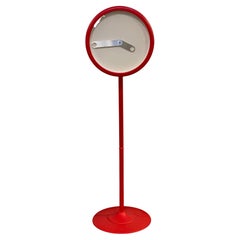

Vintage Ikea Tuno Clock, 2002
By IKEA
Located in Philadelphia, PA
Amazing rare vintage Ikea tuno clock, 2002.
Category
Early 2000s Mid-Century Modern More Clocks
Materials
Plastic
Vintage Ikea Tuno Clock, 2002
By IKEA
Located in Philadelphia, PA
Amazing rare vintage Ikea tuno clock, 2002.
Plastic
IKEA is the world's largest furniture retailer, but its origins were far humbler than its global footprint suggests. Founded in 1943 by 17-year-old Ingvar Kamprad in the Swedish village of Älmhult, the company began as a mail-order business selling pens, wallets and picture frames. It wasn't until 1948 that the IKEA catalog started featuring furniture, altering the course of modern domestic design.
IKEA is rooted in democratic design, or the belief that well-made, beautiful objects should be accessible to everyone. This philosophy took shape in the 1950s when IKEA began working with independent designers to develop its own furniture lines. The pivotal innovation came in 1956, when IKEA introduced flat-pack furniture, a practical solution born out of necessity when designer Gillis Lundgren removed a table's legs to fit it into a car. This single insight reshaped how the world thinks about manufacturing, shipping and the relationship between consumer and object.
The 1970s and 1980s are now widely considered the golden age of IKEA design, a period when the company regularly collaborated with outside designers before transitioning to entirely in-house production. These decades produced some of the brand's most collectible pieces, and vintage examples are today actively sought after by collectors worldwide. Karen Mobring's safari-influenced seating — including the Diana, Natura and Amiral chairs — captures the organic, relaxed spirit of the era, while Noboru Nakamura's Bore chair and Lundgren's Pixi lounge chair round out the most coveted 1970s offerings. The 1980s brought a sharper, more industrial sensibility through Niels Gammelgaard's work in wire and tubular steel, among them the Enetri shelf, the wire Jarpen chairs and the foldable Ted chair, as well as Tord Björklund's Skye chaise and Klinte armchair.
Beyond these core collaborators, IKEA has worked with some of the most significant names in 20th-century design. Kai Kristiansen, Ettore Sottsass, Verner Panton and Mats Theselius all produced pieces for the brand, and rare examples of their IKEA work are among the most prized finds for collectors today. More recently, collaborations with designers such as Ilse Crawford, Tom Dixon and Hella Jongerius through its IKEA PS (“post scriptum”) collections have continued to push the brand into more expressive territory.
IKEA has also shaped retail culture itself. Its sprawling, maze-like store format — introduced in Älmhult in 1958 — transformed shopping into an experience, complete with room vignettes, a Swedish café and a one-way path designed to inspire. The brand has since expanded to more than 60 countries, while its annual catalog, once one of the most widely distributed publications in the world, became a cultural artifact in its own right.
IKEA continues to balance its founding tension: mass production in the service of good design. As Kamprad once put it, "to design a desk which may cost $1,000 is easy for a furniture designer, but to design a functional and good desk which shall cost $50 can only be done by the very best."
Find a range of vintage and collectible IKEA chairs, shelving and furniture on 1stDibs.
Organically shaped, clean-lined and elegantly simple are three terms that well describe vintage mid-century modern furniture. The style, which emerged primarily in the years following World War II, is characterized by pieces that were conceived and made in an energetic, optimistic spirit by creators who believed that good design was an essential part of good living.
ORIGINS OF MID-CENTURY MODERN FURNITURE DESIGN
CHARACTERISTICS OF MID-CENTURY MODERN FURNITURE DESIGN
MID-CENTURY MODERN FURNITURE DESIGNERS TO KNOW
ICONIC MID-CENTURY MODERN FURNITURE DESIGNS
VINTAGE MID-CENTURY MODERN FURNITURE ON 1STDIBS
The mid-century modern era saw leagues of postwar American architects and designers animated by new ideas and new technology. The lean, functionalist International-style architecture of Le Corbusier and Bauhaus eminences Ludwig Mies van der Rohe and Walter Gropius had been promoted in the United States during the 1930s by Philip Johnson and others. New building techniques, such as “post-and-beam” construction, allowed the International-style schemes to be realized on a small scale in open-plan houses with long walls of glass.
Materials developed for wartime use became available for domestic goods and were incorporated into mid-century modern furniture designs. Charles and Ray Eames and Eero Saarinen, who had experimented extensively with molded plywood, eagerly embraced fiberglass for pieces such as the La Chaise and the Womb chair, respectively.
Architect, writer and designer George Nelson created with his team shades for the Bubble lamp using a new translucent polymer skin and, as design director at Herman Miller, recruited the Eameses, Alexander Girard and others for projects at the legendary Michigan furniture manufacturer.
Harry Bertoia and Isamu Noguchi devised chairs and tables built of wire mesh and wire struts. Materials were repurposed too: The Danish-born designer Jens Risom created a line of chairs using surplus parachute straps for webbed seats and backrests.
The Risom lounge chair was among the first pieces of furniture commissioned and produced by celebrated manufacturer Knoll, a chief influencer in the rise of modern design in the United States, thanks to the work of Florence Knoll, the pioneering architect and designer who made the firm a leader in its field. The seating that Knoll created for office spaces — as well as pieces designed by Florence initially for commercial clients — soon became desirable for the home.
As the demand for casual, uncluttered furnishings grew, more mid-century furniture designers caught the spirit.
Classically oriented creators such as Edward Wormley, house designer for Dunbar Inc., offered such pieces as the sinuous Listen to Me chaise; the British expatriate T.H. Robsjohn-Gibbings switched gears, creating items such as the tiered, biomorphic Mesa table. There were Young Turks such as Paul McCobb, who designed holistic groups of sleek, blond wood furniture, and Milo Baughman, who espoused a West Coast aesthetic in minimalist teak dining tables and lushly upholstered chairs and sofas with angular steel frames.
Generations turn over, and mid-century modern remains arguably the most popular style going. As the collection of vintage mid-century modern chairs, dressers, coffee tables and other furniture for the living room, dining room, bedroom and elsewhere on 1stDibs demonstrates, this period saw one of the most delightful and dramatic flowerings of creativity in design history.
Arguably the world’s most ubiquitous man-made material, plastic has impacted nearly every industry. In contemporary spaces, new and vintage plastic furniture is quite popular and its use pairs well with a range of design styles.
From the Italian lighting artisans at Fontana Arte to venturesome Scandinavian modernists such as Verner Panton, who created groundbreaking interiors as much as he did seating — see his revolutionary Panton chair — to contemporary multidisciplinary artists like Faye Toogood, furniture designers have been pushing the boundaries of plastic forever.
When The Graduate's Mr. McGuire proclaimed, “There’s a great future in plastics,” it was more than a laugh line. The iconic quote is an allusion both to society’s reliance on and its love affair with plastic. Before the material became an integral part of our lives — used in everything from clothing to storage to beauty and beyond — people relied on earthly elements for manufacturing, a process as time-consuming as it was costly.
Soon after American inventor John Wesley Hyatt created celluloid, which could mimic luxury products like tortoiseshell and ivory, production hit fever pitch, and the floodgates opened for others to explore plastic’s full potential. The material altered the history of design — mid-century modern legends Charles and Ray Eames, Joe Colombo and Eero Saarinen regularly experimented with plastics in the development of tables and chairs, and today plastic furnishings and decorative objects are seen as often indoors as they are outside.
Find vintage plastic lounge chairs, outdoor furniture, lighting and more on 1stDibs.
A sophisticated clock design, whether it’s a desk clock, mantel clock or large wall clock for your living room, is a decorative object to be admired in your home as much as it is a necessary functional element. This is part of the reason clocks make such superb collectibles. Given the versatility of these treasured fixtures — they’ve long been made in a range of shapes, sizes and styles — a clock can prove integral to your own particular interior decor.
Antique and vintage clocks can whisk us back to the 18th and 19th centuries. When most people think of antique clocks, they imagine an Art Deco Bakelite tabletop clock or wall clock, named for the revolutionary synthetic plastic, Bakelite, of which they’re made, or a stately antique grandfather clock. But the art of clock-making goes way back, transcending continents and encompassing an entire range of design styles and technologies. In short, there are many kinds of clocks depending on your needs.
A variety of wall clocks can be found on 1stDibs. A large antique hand-carved walnut wall clock is best suited to a big room and a flat background given what will likely be outwardly sculptural features, while Georgian grandfather clocks, or longcase clocks, will help welcome rainswept guests into your entryway or foyer. An interactive cuckoo clock, large or small, is guaranteed to bring outsize personality to your living room or dining room. For conversation pieces of a similar breed, mid-century modern enthusiasts go for the curious Ball clock, the first of more than 150 clock models conceived in the studio of legendary architect and designer George Nelson.
Minimalist contemporary clocks and books pair nicely on a shelf, but an eye-catching vintage mantel clock can add balance to your home library while drawing attention to your art and design books and other decorative objects. Ormolu clocks dating from the Louis XVI period, designed in the neoclassical style, are often profusely ornate, featuring architectural flourishes and rich naturalistic details. Rococo-style mantel clocks of Meissen porcelain or porcelain originating from manufacturers in cities such as Limoges, France, during the 18th and 19th centuries, exude an air of imperial elegance on your shelves or side tables and can help give your desk a 19th-century upgrade.
On 1stDibs, find a range of extraordinary antique and vintage clocks today.