Salvador Dalí Paintings

Spanish, 1904-1989

Instantly recognizable by his waxed, upturned mustache, the flamboyant Salvador Dalí is one of modern art’s most distinctive figures. He is also one of the icons of the 20th-century avant-garde Surrealist movement, whose dreamlike images, drawn from the depths of the unconscious, he deployed in paintings, sculptures, prints and fashion, as well as in film collaborations with Luis Buñuel and Alfred Hitchcock.

Dalí was born in Figueres, Catalonia, and even as a youngster, displayed the sensitivity, sharp perception and vivid imagination that would later define his artworks. In these, he conjured childhood memories and employed religious symbols and Freudian imagery like staircases, keys and dripping candles to create unexpected, often shocking pieces.

Dalí's use of hyperrealism in conveying Surrealist symbols and concepts that subvert accepted notions of reality is epitomized in what is perhaps his most recognizable painting, The Persistence of Memory (1931), in which he depicts the fluidity of time through melting clocks, their forms inspired by Camembert cheese melting in the sun. His artistic genius, eccentric personality and eternal quest for fame made him a global celebrity.

“Each morning when I awake, I experience again a supreme pleasure,” he once said. “That of being Salvador Dalí.”

Find original Salvador Dalí paintings, prints, sculptures and other works on 1stDibs.

to
6
Overall Width
to
Overall Height
to
6
2
2
6
6
6
6
6
6
1,037
758
757
738
676
6
6
Artist: Salvador Dalí
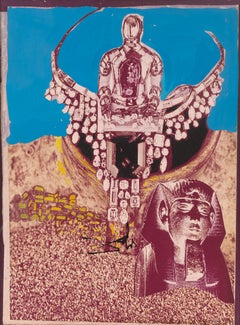
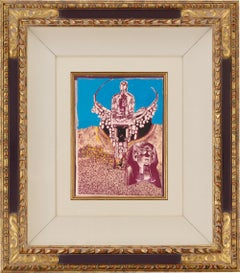
Four of Swords by Salvador Dalí

Four of Swords by Salvador Dalí

By Salvador Dalí­

Located in New Orleans, LA

Salvador Dalí 1904-1989 Spanish Four of Swords Signed “Dalí” (lower center) Gouache on photographic background Representing a unique blend of spiritualism and Surrealism, this go...

Category

20th Century Surrealist Salvador Dalí Paintings

Materials

Gouache, Photographic Paper
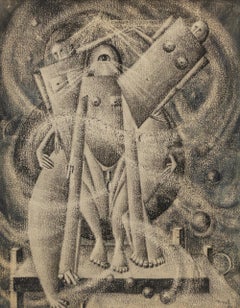
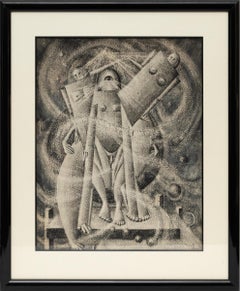
Nine of Swords by Salvador Dalí

Nine of Swords by Salvador Dalí

By Salvador Dalí­

Located in New Orleans, LA

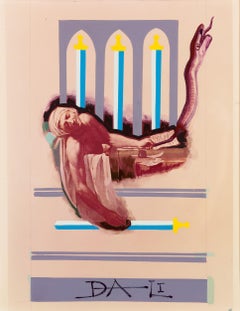
Salvador Dalí 1904-1989 Spanish Nine of Swords Signed “Dalí” (lower center) Gouache on photographic background Representing a unique blend of spiritualism and Surrealism, this go...

Category

20th Century Modern Salvador Dalí Paintings

Materials

Gouache, Photographic Paper
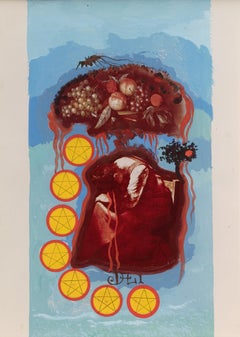
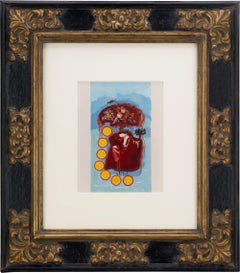
Seven of Pentacles by Salvador Dalí

Seven of Pentacles by Salvador Dalí

By Salvador Dalí­

Located in New Orleans, LA

Salvador Dalí 1904-1989 Spanish Seven of Pentacles Signed “Dalí” (lower center) Gouache on photographic background Representing a unique blend of spiritualism and Surrealism, thi...

Category

20th Century Salvador Dalí Paintings

Materials

Gouache, Photographic Paper
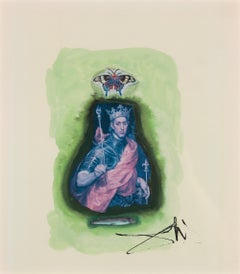
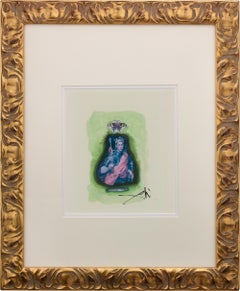
King of Swords by Salvador Dalí

King of Swords by Salvador Dalí

By Salvador Dalí­

Located in New Orleans, LA

Salvador Dalí 1904-1989 Spanish King of Swords Signed “Dalí” (lower center) Gouache on photographic background This unique gouache by Surrealist master Salvador Dalí combines the...

Category

20th Century Modern Salvador Dalí Paintings

Materials

Gouache, Photographic Paper
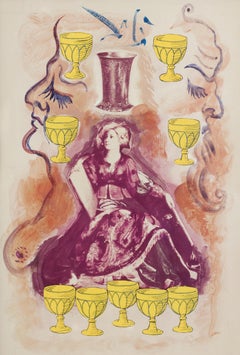
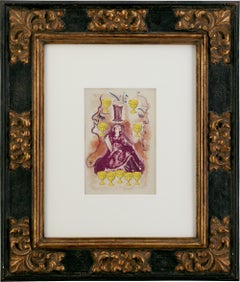
Nine of Cups by Salvador Dalí

Nine of Cups by Salvador Dalí

By Salvador Dalí­

Located in New Orleans, LA

Salvador Dalí 1904-1989 Spanish Nine of Cups Signed "Dalí’" (top center) Gouache on photographic background This original gouache is a part of Salvador Dalí’s sought-after deck o...

Category

20th Century Salvador Dalí Paintings

Materials

Gouache, Photographic Paper
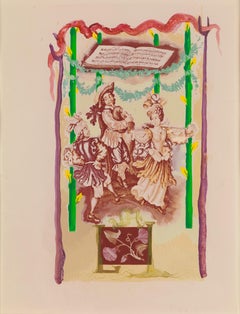
Four of Wands by Salvador Dalí

Four of Wands by Salvador Dalí

By Salvador Dalí­

Located in New Orleans, LA

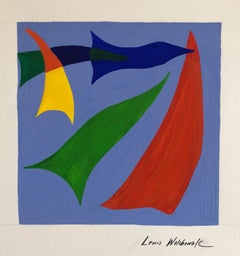
Salvador Dalí 1904-1989 Spanish Four of Wands Signed "Dalí" (lower center) Gouache on photographic background From Salvador Dalí's celebrated tarot series, Four of Wands represen...

Category

20th Century Surrealist Salvador Dalí Paintings

Materials

Gouache, Photographic Paper

Related Items
Spirit of 76

Martha Hamlin Visser't HooftSpirit of 76, 1976

$1,100Sale Price|26% Off

H 19 in W 16 in

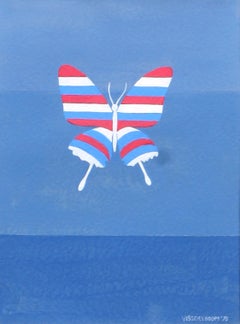
Spirit of 76

By Martha Hamlin Visser't Hooft

Located in Buffalo, NY

A whimsical gouache painting by American female surrealist Martha Visser't Hooft depicting a butterfly in a patriotic color scheme. Martha Visser't Hooft was born in Buffalo in 19...

Category

1970s Surrealist Salvador Dalí Paintings

Materials

Archival Paper, Gouache

Boats in Harbor (French Riviera painting)

Boats in Harbor (French Riviera painting)

Located in Wilton Manors, FL

Michel Colin (b.1934). Boats in Harbor, 1969. Gouache on paper, sheet measuring 16 x 20 inches. Signed and dated lower right. Sheet is unframed. Michel Colin, born in 1934, live...

Category

Mid-20th Century Abstract Salvador Dalí Paintings

Materials

Paper, Gouache

1947 Abstract Gouache Family Portrait by Lewis Lee Tilley, American Modernist

1947 Abstract Gouache Family Portrait by Lewis Lee Tilley, American Modernist

Located in Denver, CO

Ortez (Modernist Family Portrait) is a vibrant 1947 abstract gouache on paper by American modernist artist Lewis Lee Tilley (1921–2005). This dynamic mid-century composition depicts ...

Category

1940s American Modern Salvador Dalí Paintings

Materials

Paper, Gouache

Birds in Flight (Comanche Native American surrealist painting)

Birds in Flight (Comanche Native American surrealist painting)

Located in Wilton Manors, FL

Birds in Flight, ca. 1975-80. Gouache on Arches rag paper, Sheet measures 23 x 30 inches. Image measures 22 x 29 inches. Signed lower left. Excellent condition. Unframed.

Category

1970s Surrealist Salvador Dalí Paintings

Materials

Gouache, Rag Paper

"Orange Face"
"Orange Face"

Rolph Scarlett"Orange Face", Circa 1945

$3,600Sale Price|20% Off

H 12 in W 10.5 in D 1 in

"Orange Face"

By Rolph Scarlett

Located in Southampton, NY

Circa 1945 Signed lower left Sight size 12 x 10.5 in Overall size in newly matted one inch wide black frame 25.5 x 21.5 in

Category

1940s Modern Salvador Dalí Paintings

Materials

Gouache, Paper

Unique abstraction (Abstract Expressionist color field painting) Signed, Framed

Unique abstraction (Abstract Expressionist color field painting) Signed, Framed

By Lamar Briggs

Located in New York, NY

Lamar Briggs Untitled color abstraction, ca. 2008 Mixed media oil and gouache on paper Hand signed by Lamar Briggs on the lower center front Frame included: held in the original off ...

Category

Early 2000s Abstract Salvador Dalí Paintings

Materials

Paper, Mixed Media, Oil, Gouache

A Stylish, Colorful, Mid-Century Modern 1950s Abstract Geometric Textile Design

A Stylish, Colorful, Mid-Century Modern 1950s Abstract Geometric Textile Design

By Andre Delfau

Located in Chicago, IL

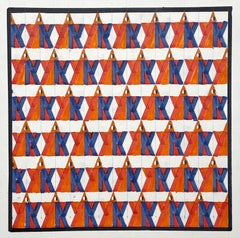
A stylish, colorful 1950s Mid-Century Modern abstract geometric textile design (depicting a polychrome Wedge Star pattern in red, white and blue tones) by notable costume, set and fa...

Category

1950s American Modern Salvador Dalí Paintings

Materials

Paper, Ink, Gouache, Graphite

Cubist mid-century abstract Shell gas station painting

Cubist mid-century abstract Shell gas station painting

Located in Wilton Manors, FL

Bernard Segal (1907-1986). Cubist Shell Gas Station ca. 1960. Gouache and watercolor on paper, sheet measures 14 x 17 inches. Unsigned. Estate stamp on front lower right. Excellent...

Category

Mid-20th Century Cubist Salvador Dalí Paintings

Materials

Paper, Gouache

Mid-Century Surrealist Watercolor, Female Figure “Birth” Charles Bunnell 1943

Mid-Century Surrealist Watercolor, Female Figure “Birth” Charles Bunnell 1943

By Charles Ragland Bunnell

Located in Denver, CO

A deeply expressive and psychologically charged work, Birth (1943) by Charles Ragland Bunnell is a striking example of the artist’s pivotal “Black and Blue” period—when his work turn...

Category

1940s Surrealist Salvador Dalí Paintings

Materials

Watercolor

Charmion von Wiegand - Pillar of Zen #124, signed painting Andre Zarre Gallery

Charmion von Wiegand - Pillar of Zen #124, signed painting Andre Zarre Gallery

By Charmion von Wiegand

Located in New York, NY

Charmion von Wiegand Pillar of Zen #124, 1959 Gouache on paper painting Hand signed, titled and dated on the front Unique Provenance: Andre Zarre Gallery, with label verso (Estate of renowned gallerist Andre Zarre, ne Andre Sowulewski) Measurements: Framed 26.5 inches vertical by 25.5 horizontal by 2 inches Artwork: 21 inches vertical by 22 inches horizontal Mid century modern, geometric, spiritual abstraction, mystical The Estate of the celebrated artist Charmion Von Wiegand has been represented exclusively by Michael Rosenfeld Gallery since 1998. From March 3 to August 13, 2023, Charmion Von Wiegand was the subject of an acclaimed retrospective at the Kunstmuseum Basel, and she has received major attention in the price, including a June, 2023 ArtNews feature entitled, "Who Was Charmion von Wiegand and Why Is She Important?". Her work was also featured in a solo presentation by Rosenfeld Gallery at the New York Art Show held at the Park Avenue Armory, which also received critical acclaim. Artists Biography - courtesy of Michael Rosenfeld Gallery: Known for her vibrant, geometric paintings that originate a deeply personal language of spiritual enlightenment expressed through a constructivist mode of abstraction, Charmion von Wiegand (1896–1983) was born in Chicago but spent much of her childhood traveling. The daughter of a journalist for Hearst, von Wiegand eventually settled in New York in 1915 to attend Barnard College and Columbia University, where she took classes at the School of Journalism while nurturing a growing interest in art history. In 1925, von Wiegand realized that she wanted to be an artist and set up a studio in Greenwich Village, teaching herself how to paint while pursuing a career as a journalist. In 1929, she secured a position in Moscow as a foreign correspondent for Hearst, the only woman at the desk at the time. In 1932, von Wiegand returned to New York and married Russian émigré Joseph Freeman, who co-founded and edited the leftist journal New Masses. Von Wiegand began writing art criticism for New Masses as well as for other publications, including New Theatre, ARTnews, and Arts Magazine. When the Abstract American Artists (AAA) held their inaugural exhibition, von Wiegand reviewed it. An early champion of abstract art, von Wiegand became close friends with AAA founder Carl Holty. In 1941, Holty introduced von Wiegand to Piet Mondrian, who would have a profound impact on her art. Fascinated by Mondrian’s artistic philosophy, von Wiegand played a key role in the introduction of his work to American audiences, translating many of the Dutch artist’s writings into English and assisting in the composition of his influential article “Toward the True Vision of Reality” (1941). Through her friendship with Mondrian, von Wiegand re-kindled her interest in Theosophy (a religion established in the late 19th century that combines aspects of Hinduism, Buddhism, occultism, and esotericism) and embarked on an extended study of neoplasticism. In her artwork, she incorporated Mondrian’s iconic grid but rejected the constraints of pure neoplasticism and embraced a wide range of influences including surrealism and German expressionism. In 1942, von Wiegand became a member of the AAA, exhibiting regularly with the group and eventually serving as its president from 1951 to 1953. In the late 1940s, sculptor and fellow AAA member Ibram Lassaw gave her a translation of The Secret of the Golden Flower: A Chinese Book of Life, which inspired von Wiegand to immerse herself in a study of Buddhist art. She began incorporating Buddhist motifs such as stupas and mandalas into her paintings, and her spiritual practice steadily intensified throughout the 1950s. In 1953, her husband gifted her a copy of the Taoist I Ching Book of Changes, a guide for divining meaning from randomly derived numbers arranged in a hexagram—a form the artist readily incorporated into her painting. Von Wiegand’s study of Theosophy also intensified over these years, bolstered by her increased access to the religion’s primary sources composed by the religion’s founders and their successors at the New York Theosophical Society’s library. Von Wiegand’s search for the sacred and transcendent ultimately led her to Tibetan Buddhism and, in 1967, von Wiegand met Khyongla Rato Rinpoche, a Gelugpa monk who had recently arrived in New York, who would mentor her spiritual study in the tradition of Mahayana Buddhism until her death. Her travels in the 1960s and 1970s took her to Tibet and India, where she had an audience with the Dalai Lama, who was living in exile in Dharamsala. Many works from these decades incorporate symbols and schematics drawn from Theosophical prismatic color charts, Chinese astrology and tantric yoga. In 1978, she was the subject of a PBS documentary titled The Circle of Charmion von Wiegand, which was scored by Philip Glass. In 1980, von Wiegand was elected to the American Academy of Arts and Letters and in 1982, the Bass Museum of Art in Miami Beach (FL) organized her first retrospective exhibition. She died the following year in New York, bequeathing her estate to Khyongla Rato and the Tibet Center of New York. In 1998, Michael Rosenfeld Gallery became the sole representative of her estate and has presented her work in four solo and multiple group exhibitions. Recent notable exhibitions that have included her work are The Third Mind: American Artists Contemplate Asia (Solomon R. Guggenheim Museum, New York, NY, 2009) and Constructive Spirit: Abstract Art in South and North America (Newark Museum, NJ, 2010). In March 2023, the Kunstmuseum Basel (Switzerland) opened the first comprehensive museum retrospective of von Wiegand’s work in Europe. Von Wiegand’s work is represented in numerous museum collections including the Addison Gallery of American Art, Phillips Academy (Andover, MA); Albright-Knox Art Gallery (Buffalo, NY); Arithmeum, University of Bonn (Germany); Birmingham Museum of Art (Alabama); Blanton Museum of Art, The University of Texas at Austin; Brooklyn Museum (NY); Carnegie Museum of Art (Pittsburgh, PA); The Cleveland Museum of Art (OH); Indianapolis Museum of Art (IN); Fondazione Marguerite Arp (Locarno, Switzerland); Museum of Fine Arts, Boston (Massachusetts); The Metropolitan Museum of Art (New York, NY); The Museum of Modern Art (New York, NY); Newark Museum of Art (New Jersey); Seattle Art Museum (WA); Smithsonian American Art Museum (Washington, DC); Walker Art Center (Minneapolis, MN); Weatherspoon Art Museum, The University of North Carolina at Greensboro; Wellin Museum of Art at Hamilton College (Clinton, NY); Whitney Museum of American Art (New York, NY); and Yale University Art Gallery (New Haven, CT). More about gallerist Andre Zarre A tribute in the New Criterion: Dispatch August 11, 2020 Andre Zarre, 1942–2020 by Dana Gordon On the late New York gallery pioneer. Art should never be aggressively explained; art should be felt. —Andre Zarre, 1977 Often, in the starlit New York cultural mecca, a longtime important figure fades away through the penumbra and dies without notice. Such was the fate of Andre Zarre, the contemporary art dealer, who passed away a few weeks ago. Andy, as he wanted friends to call him, opened his eponymous gallery in 1974 just off Madison Avenue on Sixty-ninth Street. He soon moved it to the omphalos of the art world in that era, 41 East Fifty-seventh Street, the Fuller Building. Over the years he moved to SoHo and then to Chelsea, as fashion and real estate prices pushed the art souk hither and thither. To understand his importance, all you need do is take a look at a list of artists who had solo shows at the Andre Zarre Gallery. This includes such names, from an early generation, as Sonia Delaunay, Nassos Daphnis, Sari Dienes, and Perle Fine. Among a subsequent generation are Pat Lipsky, Jay Milder, Thornton Willis, and Kes Zapkus.1 And this list does not include the many knowns and unknowns who were in his lively group shows. Zarre had a real “eye” and was a champion of abstract art from the moment he founded his gallery—even among the gathering storms of conceptual and political art, which he eschewed. He showed a good deal of figurative art as well. His galleries were always spacious and unpretentious, oriented simply to show the art. In the words of Dee Shapiro, who showed with the Zarre gallery many times, “He had a photographic memory and knew a lot about art and was always interested in the artist’s life.” Reliable biographical information on Zarre is scarce, but he said of his background that he was born in Poland in 1942 and that his parents were a diplomat and a socialite. He left home for the United States at the age of fifteen. During his decades as an art dealer in New York, Zarre did not appear to accumulate wealth, though he acquired a collection and lived on Park Avenue. “He was not personally aggressive in that way. People had to come to him,” Dee Shapiro said. He was honest in his financial dealings with artists, which not all art dealers are. For a long time while running the gallery he had a second job as a supervisor in an airline office and he kept little to no additional staff in the gallery. He supported a brother who remained in Poland. Among artists, Zarre was known to be quite ornery. After my show at his gallery in 1997, I refused to enter it for seventeen years. Then I ran into him in Chelsea and he offered me another show, an opportunity I gladly accepted, but he remained just as disagreeable. He showed the work of many women, probably more than any other gallery, save those devoted to showing only women. Collectors, curators, and writers found him mostly friendly. As Peter Reginato put it, Zarre was a “strange guy but I liked him. I think he was a dealer who was more interested in the art than in making money, but somehow he lasted forty-plus years.” Zarre is not known to have kept extensive or extant records of his gallery’s long history, though these may emerge in time. Scouring the Internet, one may compile a partial list of more than eighty artists who had solo shows at the Andre Zarre Gallery:Nancy Azara, Ellen Banks, Mary Barnes, Tony Bechara, Juan Bernal, Stephanie Bernheim, Randy Bloom, Elena Borstein, Michael Boyd, Fritz Bultman, Ed Buonagurio, Yoan Capote, Sonia Delaunay, Nassos Daphnis, Cathy Diamond, Sari Dienes, Joseph Dolinsky, Beata Drozd, Ronnie Elliot, William Fares, Perle Fine, Lynne Frehm, Ben Georgia, Mikel Glass, Dana Gordon, Juanita Guccione, Fred Gutzeit, Don Hazlitt, Amy Hill, Clinton Hill, Monroe Hodder, Budd Hopkins, Arlan Huang, Richard Hunt, Rhia Hurt, Buffie Johnson, Alexander Kaletski, Robert Kaupelis...

Category

1950s Abstract Salvador Dalí Paintings

Materials

Paper, Gouache

A Stylish, Colorful, Mid-Century Modern 1950s Abstract Geometric Textile Design

A Stylish, Colorful, Mid-Century Modern 1950s Abstract Geometric Textile Design

By Andre Delfau

Located in Chicago, IL

A stylish, colorful 1950s Mid-century Modern abstract geometric textile design (depicting a polychrome patterned design of horizontal bands and spheres in red, blue and green tones) ...

Category

1950s American Modern Salvador Dalí Paintings

Materials

Paper, Gouache, Graphite

Previously Available Items
Two of Swords by Salvador Dalí

Two of Swords by Salvador Dalí

By Salvador Dalí­

Located in New Orleans, LA

Salvador Dalí 1904-1989 Spanish Two of Swords Signed “Dalí” (upper right) Gouache on photographic background Representing a unique blend of spiritualism and Surrealism, this goua...

Category

20th Century Modern Salvador Dalí Paintings

Materials

Gouache, Photographic Paper
The Golden Calf (Chariot Tarot Card) by Salvador Dalí

The Golden Calf (Chariot Tarot Card) by Salvador Dalí

By Salvador Dalí­

Located in New Orleans, LA

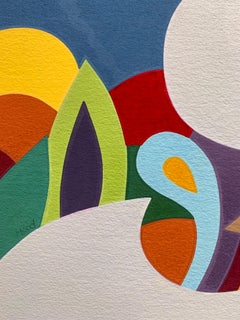
Salvador Dalí 1904-1989 Spanish The Golden Calf (Chariot Tarot Card) Signed “Dalí” (lower center) Gouache on a photographic base This gouache exemplifies a unique fusion of spiri...

Category

20th Century Modern Salvador Dalí Paintings

Materials

Gouache, Photographic Paper
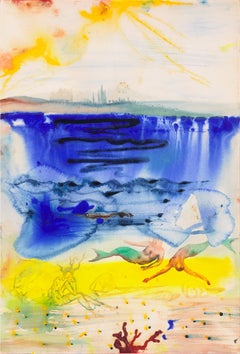
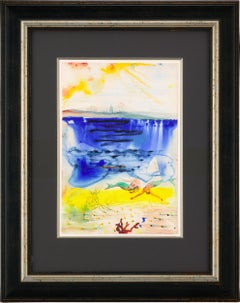
La petite sirène by Salvador Dalí

La petite sirène by Salvador Dalí

By Salvador Dalí­

Located in New Orleans, LA

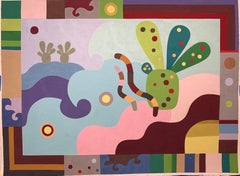
Salvador Dalí 1904-1989 Spanish La petite sirène II Signed with the monogram 'DALI' (center right) Oil, gouache and watercolor on paper Few artists have reached the ethereal heig...

Category

20th Century Modern Salvador Dalí Paintings

Materials

Paper, Oil, Watercolor, Gouache

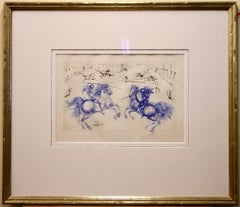
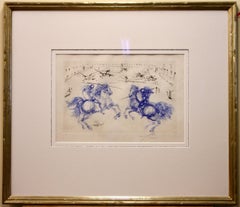
Salvador Dali "Combat de Cavaliers" Hand-signed Drypoint Etching E.A.

Salvador Dali "Combat de Cavaliers" Hand-signed Drypoint Etching E.A.

By Salvador Dalí­

Located in Berlin, DE

Salvador Dali "Combat de Cavaliers" The present sheet is a hand-signed color etching with Auqatinta from 1971. This is the sheet E.A. Professionally and museum-like framed with MIRO...

Category

20th Century Modern Salvador Dalí Paintings

Materials

Drypoint, Etching

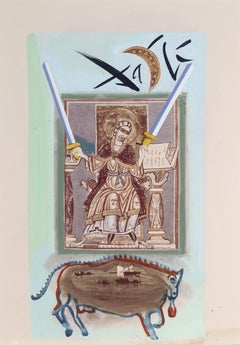
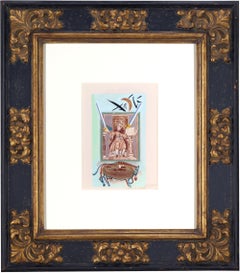
Two of Swords by Salvador Dalí

Two of Swords by Salvador Dalí

By Salvador Dalí­

Located in New Orleans, LA

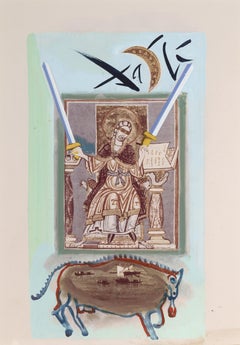
Salvador Dalí 1904-1989 Spanish Two of Swords Signed “Dalí” (upper right) Gouache on photographic background Representing a unique blend of spiritualism and Surrealism, this gouache hails from Salvador Dalí’s fascinating and highly inventive deck of custom-made tarot cards. The original commission for the design came from Albert Broccoli, the producer of the James Bond film Live and Let Die, who sought a tarot card deck to use in the film. Though the contractual deal eventually fell through, Dalí continued the project of his own accord, largely thanks to the inspiration of his wife Gala, who had an interest in mysticism. The Surrealist maestro drew upon a number of influences to complete the deck, which comprised 78 cards in total — 22 major arcana and 56 minor. His own self-portrait served as the Magician card, while his beloved wife Gala naturally posed for the Empress. Jan Gossaert’s 1516 Renaissance work Neptune and Amphitrite was the basis for the Lovers card, while the Queen of Cups card represents a fascinating marriage of Duchamp’s iconic Mona Lisa remix, L.H.O.O.Q., with a portrait of Elizabeth of Austria. The iconography of the deck is as eclectic as one would expect from the Surrealist master; it is little wonder that it took him 10 years to complete the project. The present gouache is among the original 56 minor arcana cards, this one depicting the Two of Swords. Traditionally depicting a blindfolded woman balancing a sword in each hand, the Two of Swords card represents rational decision-making, intuition and self-discipline. When one draws this card, it indicates a need for reflection rather than action — to look inward for direction and conviction in one’s own judgment. Reversed, the card suggests indecision in the face of a difficult choice. Dalí reimagines the traditional visual elements of this card, modeling it after a 12th-century German manuscript illumination depicting Saint Mark writing his Gospel, his quill replaced with swords. A crescent moon, representing cyclical change, floats above the figure, and below is a bull containing a drawing of the sea, symbolizing our deepest thoughts and feelings. After Dalí completed his deck, the original cards were assembled and published in a limited art edition in 1984. While a number of editions have since been printed of the cards, the present Two of Swords is the artist’s original gouache and collage creation. Born in Catalonia in 1904, Dalí was formally educated in the fine arts in Madrid, particularly falling under the influence of the Impressionists and the Renaissance masters. He became associated with the Madrid avant-garde group Ultrae at a young age, though he eventually grew more acquainted with avant-garde movements such as Cubism, Dada and Futurism. By the late 1920s, his mature Surrealist style had already begun to emerge, and in 1929 he officially burst onto the avant-garde art scene with his Un Chien Andalou, a short film he made with Spanish director Luis Buñuel. Today, he is remembered as one of the most legendary and significant contributors to Surrealism. His Persistence of Memory, with its melting clocks, is arguably the most recognizable painting of the movement. Two museums — one in St. Petersburg, Florida and another in Catalonia — are entirely devoted to his oeuvre; other important works by the artist can be found in the Museum of Modern Art (New York), the Art Institute of Chicago, the San Francisco Museum of Modern Art, the Philadelphia Museum of Art and the National Gallery of Art (Washington, D.C.), among many others. The Archives Descharnes have confirmed the authenticity of this work under the reference number d4861. It is accompanied by a certificate of authenticity. Circa 1971 Card: 12 1/2" high x 9 3/8" wide Frame: 29 3/8" high x 25 7/8" wide Provenance: Gertrude Stein Gallery, New York. Opera Gallery, London. Matsart, Jerusalem, International Fine Art sale...

Category

20th Century Post-Impressionist Salvador Dalí Paintings

Materials

Gouache, Photographic Paper
Nine of Swords by Salvador Dalí

Nine of Swords by Salvador Dalí

By Salvador Dalí­

Located in New Orleans, LA

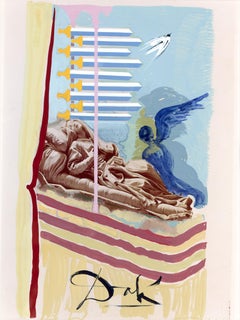
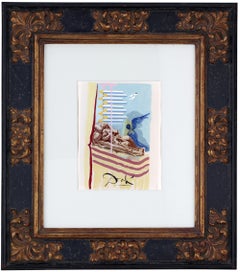
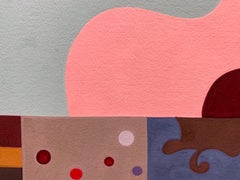
Salvador Dalí 1904-1989 Spanish Nine of Swords Signed “Dalí” (lower center) Gouache on photographic background Representing a unique blend of spiritualism and Surrealism, this gouache hails from Salvador Dalí’s fascinating and highly inventive deck of custom-made tarot cards. The original commission for the design came from Albert Broccoli, the producer of the James Bond film Live and Let Die, who sought a tarot card deck to use in the film. Though the contractual deal eventually fell through, Dalí continued the project of his own accord, largely thanks to the inspiration of his wife Gala, who had an interest in mysticism. The Surrealist maestro drew upon a number of influences to complete the deck, which comprised 78 cards in total — 22 major arcana and 56 minor. His own self-portrait served as the Magician card, while his beloved wife Gala naturally posed for the Empress. Jan Gossaert’s 1516 Renaissance work Neptune and Amphitrite was the basis for the Lovers card, while the Queen of Cups card represents a fascinating marriage of Duchamp’s iconic Mona Lisa remix, L.H.O.O.Q., with a portrait of Elizabeth of Austria. The iconography of the deck is as eclectic as one would expect from the Surrealist master; it is little wonder that it took him 10 years to complete the project. The present gouache is among the original 56 minor arcana cards, this one depicting the Nine of Swords. The card traditionally depicts a woman on a bed who has suddenly awoken, representing feelings of worry or fear. In the upright position, it urges one to resolve these feelings in order to grow and heal. Reversed, the card suggests one has overcome a period of turmoil and has achieved a more positive frame of mind. Dalí reimagines the visual elements of this card, using the image of a funerary monument by the great Italian Baroque sculptor Gian Lorenzo Bernini located in the Church of San Francesco a Ripa in Rome, Italy. It depicts the Blessed Ludovica Albertoni, a noblewoman who devoted her life to Christian charity. In the sculpture and in Dalí’s card...

Category

21st Century and Contemporary Salvador Dalí Paintings

Materials

Gouache, Photographic Paper
Le Voile de Pénélope

Salvador Dalí­Le Voile de Pénélope, 1970

Sold

H 28.5 in W 26 in D 1.5 in

Le Voile de Pénélope

By Salvador Dalí­

Located in New Orleans, LA

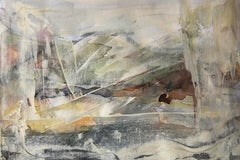
Salvador Dalí 1904-1989 Spanish Le voile de Pénélope Penelope’s Shroud Signed and dated “Dali 1970” (lower right) Gouache, watercolour, and brush and ink o...

Category

21st Century and Contemporary Surrealist Salvador Dalí Paintings

Materials

Paper, Ink, Watercolor, Gouache

Pénélope et Ulysse
Pénélope et Ulysse

Pénélope et Ulysse

By Salvador Dalí­

Located in New Orleans, LA

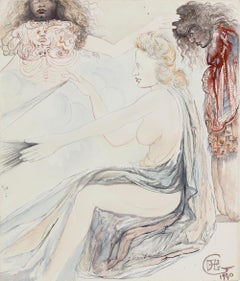
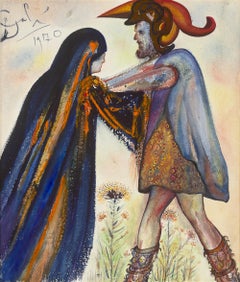
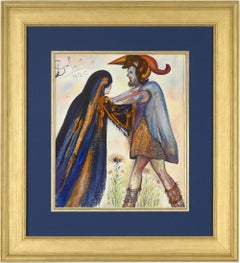
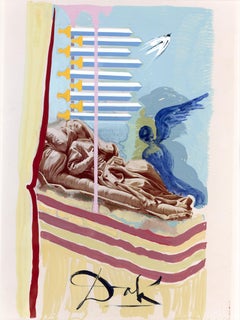
Salvador Dalí 1904-1989 Spanish Pénélope et Ulysse Penelope and Ulysses Signed and dated “Dali 1970” (upper left) Gouache, watercolor, pen and ink and felt-tip pen on paper Compo...
Category

21st Century and Contemporary Surrealist Salvador Dalí Paintings

Materials

Paper, Ink, Watercolor, Gouache, Pen, Felt Pen

Spectacles with Holograms and Computers, Salvador Dali

Spectacles with Holograms and Computers, Salvador Dali

By Salvador Dalí­

Located in Southampton, NY

SALVADOR DALI (1904-1989) Salvador Dali's work is associated with the surrealist movement of the 20th Century. A diverse and multi-talented artist, Dali is considered one of the most...

Category

1970s Surrealist Salvador Dalí Paintings

Materials

Lithograph

Spectacles with Holograms & Computers, Limited Edition Lithograph, Salvador Dali

Spectacles with Holograms & Computers, Limited Edition Lithograph, Salvador Dali

By Salvador Dalí­

Located in Southampton, NY

SALVADOR DALI (1904-1989) Salvador Dali's work is associated with the surrealist movement of the 20th Century. A diverse and multi-talented artist, Dali is considered one of the most...

Category

1970s Surrealist Salvador Dalí Paintings

Materials

Lithograph

Les Yeux Fleuris
Les Yeux Fleuris

Les Yeux Fleuris

By Salvador Dalí­

Located in Palm Desert, CA

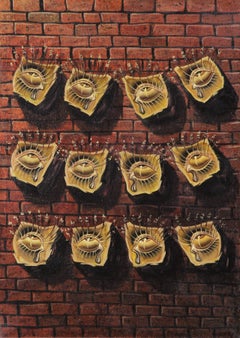
An oil on canvas painting by Surrealist artist Salvador Dali´. "Les Yeux Fleuris" is executed mainly in reds and ochre and depicts crying eyes against a red brick wall. Dali´ often depicted eyes in his painting, sculpture, and fashion (especially jewelry) as both a symbol for the act of perception and as an allusion, and to promote a new way of seeing. Dali´ parlayed the idea of accumulated, or “flowering,” eyes into a grand oil and tempera painting for the set of his 1944 ballet Mad Tristan...

Category

1940s Surrealist Salvador Dalí Paintings

Materials

Canvas, Oil

Salvador Dalí paintings for sale on 1stDibs.

Find a wide variety of authentic Salvador Dalí paintings available for sale on 1stDibs. You can also browse by medium to find art by Salvador Dalí in lithograph and more. Much of the original work by this artist or collective was created during the 1970s and is mostly associated with the Surrealist style. Not every interior allows for large Salvador Dalí paintings, so small editions measuring 22 inches across are available. Customers who are interested in this artist might also find the work of Jaume Genovart, Elisabeth Sabala, and Clayton Anderson. Salvador Dalí paintings prices can differ depending upon medium, time period and other attributes. On 1stDibs, the price for these items starts at $2,950 and tops out at $2,950, while the average work can sell for $2,950.
Questions About Salvador Dalí Paintings
  • 1stDibs ExpertApril 5, 2022
    Yes, Salvador Dali did create jewelry. Dali liked to explore different art mediums and jewelry definitely caught his fancy at one point in his life. His jewelry pieces were works of art in themselves and not mass produced—it was more like wearable miniature art. On 1stDibs, find a variety of original artwork from top artists.
  • 1stDibs ExpertApril 5, 2022
    After Dali was forced into involuntary retirement, fake prints flooded the market. Very few of Dali’s works were signed after 1980. Arjomari paper, the paper on which Dali worked, changed their mark by adding an infinity symbol. So if you see the infinity symbol and Dali’s signature, the print is a fake. On 1stDibs, find a collection of Salvador Dali’s pieces from some of the world’s top sellers.
  • 1stDibs ExpertApril 5, 2022
    Yes, Salvador Dalí made sculptures. Salvador Dalí was known for his work in Surrealism and his work spans a multitude of repertoires including painting, graphic art, film, photography and sculpture. Some of Salvador Dalí’s most famous sculptures include Lobster Telephone and Mae West Lips Sofa. Shop a selection of Salvador Dali art on 1stDibs.