Art Nouveau Knife Boxes

1 Result
ART NOUVEAU STYLE

In its sinuous lines and flamboyant curves inspired by the natural world, antique Art Nouveau furniture reflects a desire for freedom from the stuffy social and artistic strictures of the Victorian era. The Art Nouveau movement developed in the decorative arts in France and Britain in the early 1880s and quickly became a dominant aesthetic style in Western Europe and the United States.

ORIGINS OF ART NOUVEAU FURNITURE DESIGN

CHARACTERISTICS OF ART NOUVEAU FURNITURE DESIGN

  • Sinuous, organic and flowing lines
  • Forms that mimic flowers and plant life
  • Decorative inlays and ornate carvings of natural-world motifs such as insects and animals 
  • Use of hardwoods such as oak, mahogany and rosewood

ART NOUVEAU FURNITURE DESIGNERS TO KNOW

ANTIQUE ART NOUVEAU FURNITURE ON 1STDIBS

Art Nouveau — which spanned furniture, architecture, jewelry and graphic design — can be easily identified by its lush, flowing forms suggested by flowers and plants, as well as the lissome tendrils of sea life. Although Art Deco and Art Nouveau were both in the forefront of turn-of-the-20th-century design, they are very different styles — Art Deco is marked by bold, geometric shapes while Art Nouveau incorporates dreamlike, floral motifs. The latter’s signature motif is the "whiplash" curve — a deep, narrow, dynamic parabola that appears as an element in everything from chair arms to cabinetry and mirror frames.

The visual vocabulary of Art Nouveau was particularly influenced by the soft colors and abstract images of nature seen in Japanese art prints, which arrived in large numbers in the West after open trade was forced upon Japan in the 1860s. Impressionist artists were moved by the artistic tradition of Japanese woodblock printmaking, and Japonisme — a term used to describe the appetite for Japanese art and culture in Europe at the time — greatly informed Art Nouveau. 

The Art Nouveau style quickly reached a wide audience in Europe via advertising posters, book covers, illustrations and other work by such artists as Aubrey Beardsley, Henri de Toulouse-Lautrec and Alphonse Mucha. While all Art Nouveau designs share common formal elements, different countries and regions produced their own variants.

In Scotland, the architect Charles Rennie Mackintosh developed a singular, restrained look based on scale rather than ornament; a style best known from his narrow chairs with exceedingly tall backs, designed for Glasgow tea rooms. Meanwhile in France, Hector Guimard — whose iconic 1896 entry arches for the Paris Metro are still in use — and Louis Majorelle produced chairs, desks, bed frames and cabinets with sweeping lines and rich veneers. 

The Art Nouveau movement was known as Jugendstil ("Youth Style") in Germany, and in Austria the designers of the Vienna Secession group — notably Koloman Moser, Josef Hoffmann and Joseph Maria Olbrich — produced a relatively austere iteration of the Art Nouveau style, which mixed curving and geometric elements.

Art Nouveau revitalized all of the applied arts. Ceramists such as Ernest Chaplet and Edmond Lachenal created new forms covered in novel and rediscovered glazes that produced thick, foam-like finishes. Bold vases, bowls and lighting designs in acid-etched and marquetry cameo glass by Émile Gallé and the Daum Freres appeared in France, while in New York the glass workshop-cum-laboratory of Louis Comfort Tiffany — the core of what eventually became a multimedia decorative-arts manufactory called Tiffany Studios — brought out buoyant pieces in opalescent favrile glass. 

Jewelry design was revolutionized, as settings, for the first time, were emphasized as much as, or more than, gemstones. A favorite Art Nouveau jewelry motif was insects (think of Tiffany, in his famed Dragonflies glass lampshade).

Like a mayfly, Art Nouveau was short-lived. The sensuous, languorous style fell out of favor early in the 20th century, deemed perhaps too light and insubstantial for European tastes in the aftermath of World War I. But as the designs on 1stDibs demonstrate, Art Nouveau retains its power to fascinate and seduce.

There are ways to tastefully integrate a touch of Art Nouveau into even the most modern interior — browse an extraordinary collection of original antique Art Nouveau furniture on 1stDibs, which includes decorative objects, seating, tables, garden elements and more.
to
1
1
1
33
23
12
8
4
2
2
1
1
1
1
1
1
1
1
1
1
1
1
1
1
1
Style: Art Nouveau
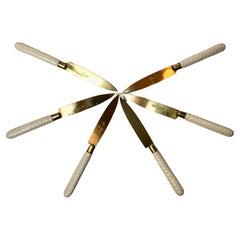
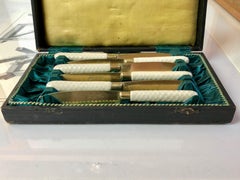
1900s Art Nouveau Fruit Knifes, Set of 6, Bronze & Porcelain Handles, Germany

1900s Art Nouveau Fruit Knifes, Set of 6, Bronze & Porcelain Handles, Germany

Located in Andernach, DE

Absolutely beautiful fruit knifes from ''Uchatius Bronce''. Germany or Sweden. Beautifully worked originals from the 1900, these 6 knifes come with porcelain handles featuring a wove...

Category

Early 20th Century German Art Nouveau Knife Boxes

Materials

Bronze, Steel

Related Items
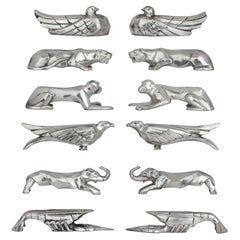
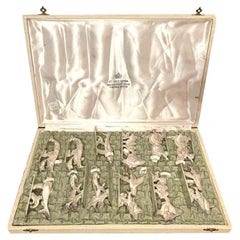
12-Piece Art Deco Silver-Plated Knife Rests Set in the Manner of Christofle

12-Piece Art Deco Silver-Plated Knife Rests Set in the Manner of Christofle

By Christofle

Located in London, GB

A 12-piece Art Deco silver-plated knife rests set in the manner of Christofle French, Early 20th Century Case: 5cm high x 24cm wide x 24 in depth. Elephant: 3cm high x 9cm wide x ...

Category

Early 20th Century French Art Nouveau Knife Boxes

Materials

Silver, Silver Plate

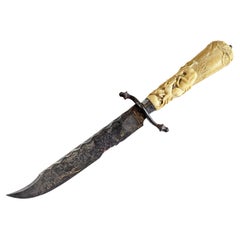
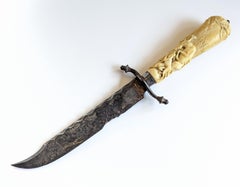
Antique Hand Carved Bone Knife Hunting Scene Damascene Blade Possibly German

Antique Hand Carved Bone Knife Hunting Scene Damascene Blade Possibly German

Located in Greer, SC

Exquisite antique hand carved bone knife with intricate hunting scene design. European made, possibly south German circa 1700s to 1800s, though we are not completely certain. The bla...

Category

19th Century European Antique Art Nouveau Knife Boxes

Materials

Bone

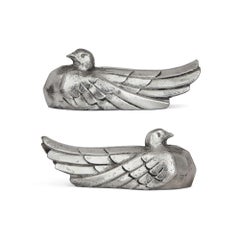
Signed Art Deco Knife Rests by Gallia, Silver-Plated Bronze, 1930s

Signed Art Deco Knife Rests by Gallia, Silver-Plated Bronze, 1930s

By Gallia

Located in Wiesbaden, DE

Signed Knife Rests “Gallia” Signed knife rests by “Gallia” are highly collectible decorative objects known for their exquisite craftsmanship and Art Deco design. The company “Gallia”...

Category

1930s Vintage Art Nouveau Knife Boxes

Materials

Silver Plate, Bronze

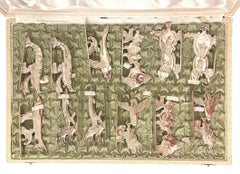
Art Deco Silver-Plated Knife Rest Set with Sea Creatures, France 1930

Art Deco Silver-Plated Knife Rest Set with Sea Creatures, France 1930

Located in Wiesbaden, DE

Art Deco Knife rest These knife rests were not only practical but also served as decorative elements on a well-dressed dining table. The use of silver or silver-plated materials adde...

Category

1930s Vintage Art Nouveau Knife Boxes

Materials

Silver Plate, Bronze

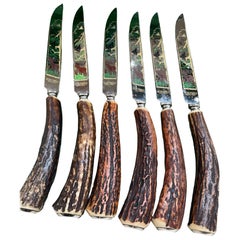
Early 20th Century Anton Wingen Jr. Solingen Germany Stag-Handled Knife Set

Early 20th Century Anton Wingen Jr. Solingen Germany Stag-Handled Knife Set

Located in Northport, MI

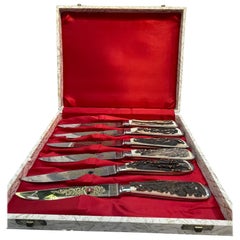
A handsome boxed set of six early 20th-century German steak knives by Anton Wingen Jr., renowned Solingen cutlers celebrated for their fine craftsmanship and decorative blade etching...

Category

Early 20th Century European Art Nouveau Knife Boxes

Materials

Stainless Steel

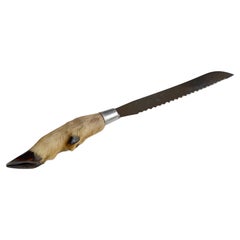
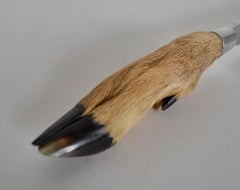
French Bread Knife with Deer Hoof Handle, Stainless Steel Blade, 1950s

French Bread Knife with Deer Hoof Handle, Stainless Steel Blade, 1950s

Located in SOTTEVILLE-LÈS-ROUEN, FR

A distinctive French bread knife dating from the 1950s, featuring a stainless steel serrated blade and an authentic deer hoof handle. This rare piece reflects mid-20th-century French...

Category

1950s French Vintage Art Nouveau Knife Boxes

Materials

Stainless Steel

Set of Six German Stag-Handled Knives by Wingen Solingen, West Germany

Set of Six German Stag-Handled Knives by Wingen Solingen, West Germany

Located in Northport, MI

A finely crafted mid-century set of six decorative knives by Wingen Solingen, made in West Germany. Each stainless-steel blade is richly etched and gilded with ornate scrolling motif...

Category

1950s German Vintage Art Nouveau Knife Boxes

Materials

Stainless Steel

Early 20th Century Anton Wingen Jr. Solingen Germany Stag-Handled Knife Set

Early 20th Century Anton Wingen Jr. Solingen Germany Stag-Handled Knife Set

Located in Northport, MI

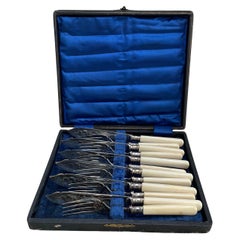
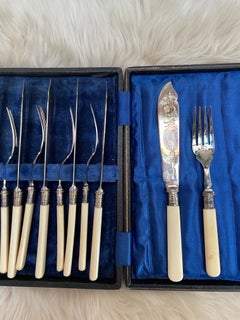
An elegant early 20th-century English fish service for six, featuring engraved silver-plated blades and tines paired with smooth, polished bone handles. Each piece is finely detaile...

Category

Early 20th Century English Art Nouveau Knife Boxes

Materials

Silver Plate, Nickel

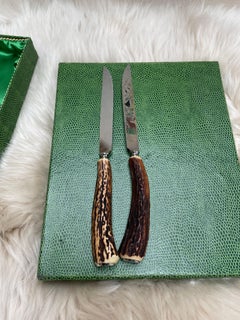
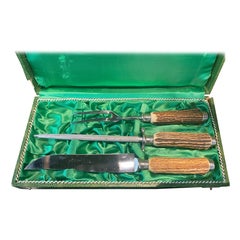
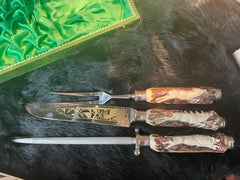
German Stag Handle Carving Set in Original Presentation Case, Mid-20th Century

German Stag Handle Carving Set in Original Presentation Case, Mid-20th Century

Located in Northport, MI

A beautifully preserved three-piece German carving set, likely dating to the mid-20th century, presented in its original green faux snakeskin case lined with ruched emerald satin. Th...

Category

Mid-20th Century German Art Nouveau Knife Boxes

Materials

Stainless Steel

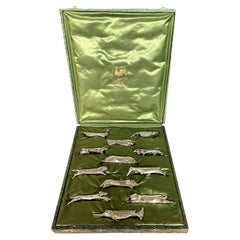
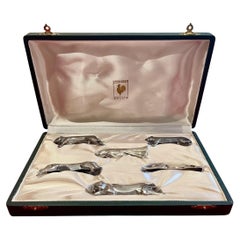
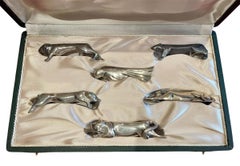
GALLIA & CHRISTOFLE - 6-piece Knife Rest Set

GALLIA & CHRISTOFLE - 6-piece Knife Rest Set

$623

H 0.79 in W 3.94 in D 0.6 in

GALLIA & CHRISTOFLE - 6-piece Knife Rest Set

By Christofle

Located in Beaune, FR

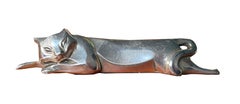
A set of six silver-plated GALLIA animal-shaped knife rests by Christofle: cat, pig, dog, lion, bear and bird. Designed by Marcel Sandoz. Dimensions Length approximately 10cm W...

Category

20th Century French Art Nouveau Knife Boxes

Materials

Silver Plate

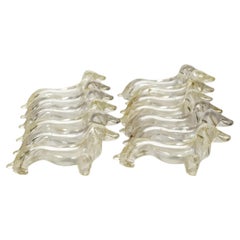
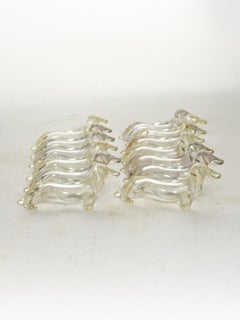
Set of 13 Plastic knife rests dog shaped, France, 1970

Set of 13 Plastic knife rests dog shaped, France, 1970

$315 / set

H 1.97 in W 1.58 in D 4.34 in

Set of 13 Plastic knife rests dog shaped, France, 1970

Located in Auribeau sur Siagne, FR

Set of clear plastic dog-shaped knife rests, dating from the 1970s and of French origin. These playful and decorative little tableware items feature a stylized dachshund silhouette, ...

Category

1970s French Vintage Art Nouveau Knife Boxes

Materials

Metal

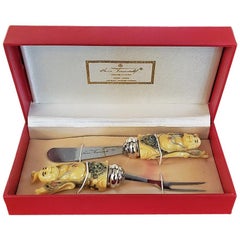
Hans Turnwald Bone Buddha Butter Knife Set

Hans Turnwald Bone Buddha Butter Knife Set

$260

H 1.8 in W 7.1 in D 3.6 in

Hans Turnwald Bone Buddha Butter Knife Set

By Hans Turnwald

Located in Dallas, TX

Presenting a lovely Hans Turnwald Bone Buddha butter knife set. 20th Century, circa 1980. By the World renowned Hans Turnwald of Miami and Paris. Part ...

Category

20th Century French Art Nouveau Knife Boxes

Materials

Stainless Steel

Art Nouveau knife boxes for sale on 1stDibs.

Find a broad range of unique Art Nouveau knife boxes for sale on 1stDibs. Many of these items were first offered in the 19th Century, but contemporary artisans have continued to produce works inspired by this style. If you’re looking to add vintage knife boxes created in this style to your space, the works available on 1stDibs include serveware, ceramics, silver and glass and other home furnishings, frequently crafted with brass, metal and other materials. If you’re shopping for used Art Nouveau knife boxes made in a specific country, there are Europe, and Spain pieces for sale on 1stDibs. It’s true that these talented designers have at times inspired knockoffs, but our experienced specialists have partnered with only top vetted sellers to offer authentic pieces that come with a buyer protection guarantee. Prices for knife boxes differ depending upon multiple factors, including designer, materials, construction methods, condition and provenance. On 1stDibs, the price for these items starts at $381 and tops out at $381 while the average work can sell for $381.