Lion Sculptures

to
3
43
13
5
1
4
Overall Width
to
Overall Height
to
5
19
20
22
2
2
4
1
1
1
1
9
3
2
1
1
1
605
4,796
2,775
2,621
1,961
1,859
1,645
1,227
1,035
930
716
518
497
480
445
437
435
425
335
323
48
47
12
8
6
3
2
2
2
2
34
31
Art Subject: Lion
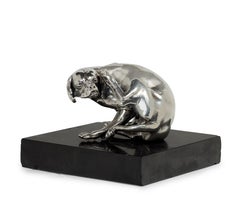
Dog scratching its ear
Located in PARIS, FR
This amusing naturalistic sculpture in silver-plated pewter was probably made in the 17th century by Georg Schweigger. Inspired by a model created by another Nuremberg sculptor, Peter Flötner, it bears witness to the persistence during the baroque era of the naturalistic taste that emerged in the Renaissance. Intended as an ornament for some Kunstkammer, or cabinet of curiosities, this sculpture was a great success, as can be seen from the presence of similar works in many European museums. 1. Georg Schweigger Georg Schweigger was a baroque sculptor and medal founder from Nuremberg, known mainly for his small-scale works in stone, carved wood and cast metal. His only large-scale work, the Neptune Fountain, has been in the Petershof Palace, the summer residence of the Tsars near St. Petersburg, since 1797. This monumental sculpture demonstrates his taste for the representation of movement, which we find in this small piece, inspired, as we shall see, by earlier models. 2. The success of a naturalistic theme As is often the case in the history of art, the source of the Dog scratching his ear theme probably comes from an engraving, and more precisely from one made in Strasbourg in 1480 or in Aschaffenburg in 1481 by the Master of the Housebook, an anonymous engraver working in southern Germany at the end of the 15th century. This engraving seems to have been Peter Flötner’s (1490 - 1546) source of inspiration. Peter Flötner was a sculptor and engraver who settled in Nuremberg in 1522. The Louvre Museum also has a gilded lead statuette dated between 1500 and 1515 (on deposit at the Musée de L'Œuvre in Strasbourg), which in turn is thought to have served as a model for other known statuettes. This model was later taken up by the Frenchman Barthélemy Prieur...
Category

17th Century Naturalistic Figurative Sculptures

Materials

Marble, Silver

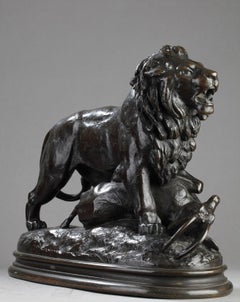
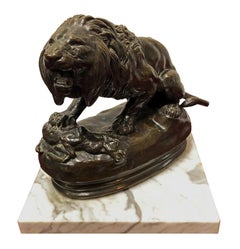
Lion strucking a wildboar
Located in PARIS, FR
Lion strucking a wildboar by Antoine-Louis BARYE (1796-1875) A bronze sculpture with dark brown patina Signed on the base with moulding " Barye " Posthumous cast probably by Graux-M...
Category

Late 19th Century French School Figurative Sculptures

Materials

Bronze

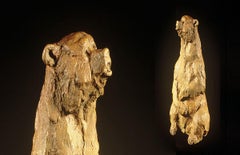
Honey on the Wind
Located in Colorado Springs, CO
Bronze sculpture by artist Andrea Wilkinson. Edition 8/30.
Category

21st Century and Contemporary Contemporary Figurative Sculptures

Materials

Bronze

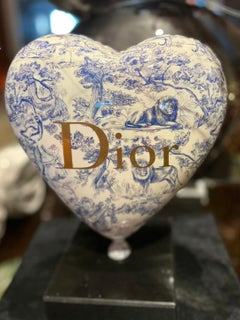
NAOR - CD Tribute Heart
Located in PARIS, FR
About the artist : Naor is a French artist from Lyon born in 1988. Completely anchored in his time, he has always traveled a lot around the world. If travels form youth, Naor was ins...
Category

21st Century and Contemporary Pop Art Figurative Sculptures

Materials

Resin

Mother and Child, Modern Bronze Sculpture by Boris Lovet-Lorski
Located in Long Island City, NY
Boris Lovet-Lorski, American (1894 - 1973) - Mother and Child, Medium: Bronze sculpture, signature inscribed on base, Size: 9.5 x 22 x 8 in. (24.13 x 55.88 x 20.32 cm), Reference: ...
Category

Mid-20th Century Modern Figurative Sculptures

Materials

Bronze

Lion and Antelope (No. 23)
Located in Missouri, MO
Alfred Barye (1839-1882) "Lion and Antelope" Bronze Approx. 7.5H x 9W x 4D inches Signed "BARYE.ALF" and Inscribed under base "NO. 23 LION AND ANTELOPE" The son of a goldsmith, Parisian born Antoine-Louis Bayre was a sculptor of animal subjects and acclaimed, not only for his apparent skill, but as the founder of what became known as the French Animaliers School. Among his patrons were representatives of the state government and royalty including the Duke of Orleans and the Dukes of Luynes, Montpensier and Nemours. Well compensated financially, he was able to buy the best of materials and hire the country's most skilled foundry craftsmen. The foundry he hired was owned by Ferdinand Barbedienne, and casts from this period were stamped with the letters, FB. However, he did not make a lot of money from his work because he was such a perfectionist that often he would not sell his work because he thought it was not 'quite right'. In 1848, he declared bankruptcy, and his molds and plaster casts were sold along with the copyrights. Bayre's specialty was aroused, angry seeming wild game such as lions and tigers and elephants, but he also did equestrian groups and mythology figures. In order to do realistic depictions of animal anatomy, he spent much time at the Jardin de Plantes in Paris. His early training was as an apprentice to a metal engraver, but being drafted in the army in 1812, ended that education. In 1832, he had established his own studio, and unique at that time was his method of cold stamping his bronze casts, so that each one had a special number. He had his first entry, The Milo of Croton...
Category

19th Century Realist Figurative Sculptures

Materials

Bronze

Read More

At Hosfelt Gallery, Bertoia Masterworks Complement Dynamic Contemporary Art

For nearly three decades, San Francisco–based Todd Hosfelt has curated against the grain — with a show on the legendary modernist Harry Bertoia the latest case in point.

This Weathered-Steel Sculpture Distills a Form of Protest into a Minimalist Monument

Part of Alejandro Vega Beuvrin’s “Barricada” series, the work is a subversive tribute to the street smarts of citizen activists.

How the Chunky, Funky Ceramics of 5 Mid-Century American Artists Balanced Out Slick Modernism

Get to know the innovators behind the pottery countercultural revolution.

Art Brings the Drama in These Intriguing 1stDibs 50 Spaces

The world’s top designers explain how they display art to elicit the natural (and supernatural) energy of home interiors.

Chryssa’s 1962 Neon Sculpture Was Way ahead of the Art-World Curve

By working with lettering, neon and Pop imagery, Chryssa pioneered several postmodern themes at a time when most male artists detested commercial mediums.

How to Spot a Fake KAWS Figure

KAWS art toys have developed an avid audience in recent decades, and as in any robust collectible market, counterfeiters have followed the mania. Of course, you don’t have to worry about that on 1stDibs, where all our sellers are highly vetted.

A Giant Wedding Cake Has Us Looking at Portuguese Tiles in a New Light

At Waddesdon Manor, artist Joana Vasconcelos has installed a three-tiered patisserie inspired by the narrative tile work of her homeland. We take a look at the cake sculpture and how Portuguese tiles have been used in architecture from the 17th century to today.

These Soft Sculptures Are Childhood Imaginary Friends Come to Life

Miami artist and designer Gabriela Noelle’s fantastical creations appeal to the Peter Pan in all of us.

Still Thinking About These?

All Recently Viewed