1960s Wire Chairs

Authentic 1960's Harry Bertoia for Knoll Bird Lounge Chair in Black Metal Wire

Authentic 1960's Harry Bertoia for Knoll Bird Lounge Chair in Black Metal Wire

By Harry Bertoia

Located in Bedford Hills, NY

An icon of 20th-century furniture, the Bird Chair (Model 423LU) is crafted from bent and welded steel rods in a black powder-coated finish. Its organic, high-backed form is designed ...

Category

Vintage 1960s American Mid-Century Modern Lounge Chairs

Materials

Metal

Original 1960's Herman Miller Charles & Ray Eames Bikini Wire Chairs set of 4

Original 1960's Herman Miller Charles & Ray Eames Bikini Wire Chairs set of 4

By Charles and Ray Eames

Located in Las Vegas, NV

Set of 4 Herman Miller "Bikini" chairs in factory white with aluminum bases and dark green vinyl cover. Circa early 1960's. Well loved and cared for. One has been reweld repaired and...

Category

Mid-20th Century American Mid-Century Modern Dining Room Chairs

Materials

Aluminum, Iron

Mid-Century Bistro Set with Scrolling Wire Chairs, 1940s-1960s

Mid-Century Bistro Set with Scrolling Wire Chairs, 1940s-1960s

Located in London, England

A sweet Mid-Century bistro set. Featuring 3 scrolling wire detail chairs and an accompanying table. Recently repainted in brilliant white. Table: H76 x D60 cm Chair Dimensions: D37...

Category

Mid-20th Century Chairs

Materials

Iron

Bent Steel Wire & Wicker Modernist Lounger by Frederic Weinberg - USA 1960's

Bent Steel Wire & Wicker Modernist Lounger by Frederic Weinberg - USA 1960's

By Frederic Weinberg

Located in New York, NY

Modernist armchair made of bent steel wire and rattan core painted off-white. In good vintage condition. A few strands of rattan are broken or missing. This chair will ship from Fran...

Category

Vintage 1960s Slipper Chairs

Materials

Steel

Post-Modern Pair of Easy Chairs in Chrome & Plastic Wire, 1960s

Post-Modern Pair of Easy Chairs in Chrome & Plastic Wire, 1960s

By René Herbst

Located in Antwerp, BE

Postmodern piece, reminiscent of a closed chaise longue, with its sleek design. The subtle translucency of the plastic wire imparts an elegant nude color effect, evoking the image of...

Category

Vintage 1960s European Post-Modern Side Chairs

Materials

Chrome

Pastoe "Sm05" Black Wire Chair by Cees Braakman, Netherlands 1960

Pastoe "Sm05" Black Wire Chair by Cees Braakman, Netherlands 1960

By Knoll, Harry Bertoia, Pastoe, Cees Braakman

Located in DE MEERN, NL

PASTOE "SM05" BLACK WIRE CHAIR BY CEES BRAAKMAN, NETHERLANDS 1960S The PASTOE SM05 black wire chair by renowned Dutch designer Cees Braakman is a mid-century modern masterpiece that...

Category

Vintage 1960s Dutch Mid-Century Modern Dining Room Chairs

Materials

Metal, Metallic Thread

Original Eames DKX-1 Side Chair in Orange Leather for Herman Miller, 1960s

Original Eames DKX-1 Side Chair in Orange Leather for Herman Miller, 1960s

By Charles and Ray Eames, Herman Miller

Located in Aramits, Nouvelle-Aquitaine

Charles and Ray Eames side chair DKX-1 in orange leather for Herman Miller, circa 1960s. The chair is in very good vintage condition, no damage to the leather, very solid chair.

Category

Vintage 1960s American Mid-Century Modern Side Chairs

Materials

Wire

Set of Two (2) Mid Century Modern Iron Wire Swiveling Patio Chairs, c. 1960's

Set of Two (2) Mid Century Modern Iron Wire Swiveling Patio Chairs, c. 1960's

Located in Deland, FL

Constructed from steel wire this set of two period patio chairs boast the original plaid outdoor cushions.

Category

Vintage 1960s American Mid-Century Modern Patio and Garden Furniture

Materials

Metal

Pair of Russell Woodard Style Black Wrought Iron Linai Lounge Chairs, 1960's

Pair of Russell Woodard Style Black Wrought Iron Linai Lounge Chairs, 1960's

By Russell Woodard

Located in Bainbridge, NY

Pair of Russell Woodard Style black enamel Wrought Iron Linai Armchairs. Featuring rugged, balanced frameworks, handcrafted in black enameled wrought iron, with comfortable woven wir...

Category

Mid-20th Century American Mid-Century Modern Patio and Garden Furniture

Materials

Wrought Iron, Wire

John Risley Sculptural Patio Set with Two Lady Chairs and Wire Tulip Table 1960s

John Risley Sculptural Patio Set with Two Lady Chairs and Wire Tulip Table 1960s

By John Risley

Located in Dallas, TX

Two solid steel lady chairs by mid-century sculptor John Risley (1919-2002). Handmade in his studio in Middletown, Ct circa 1960. Freshly powder-coated in a Calder red finish and r...

Category

Mid-20th Century American Mid-Century Modern Patio and Garden Furniture

Materials

Steel

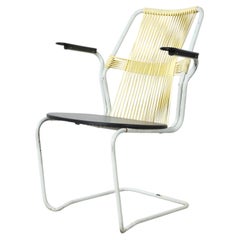
Swedish Mid-Century Brio Ferie Cantilever Patio Chair, 1960s

Swedish Mid-Century Brio Ferie Cantilever Patio Chair, 1960s

By BRIO - Bröderna Ivarsson i Osby

Located in Los Angeles, CA

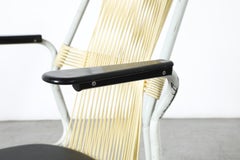
White painted tubular metal cantilever armchair from the Brio Ferie outdoor line, attributed to the Swedish Brio company, 1960s. The frame forms a continuous cantilever loop from fro...

Category

Vintage 1960s Swedish Mid-Century Modern Patio and Garden Furniture

Materials

Metal, Wire

Recent Sales

You May Also Like

People Also Browsed

Get Updated with New Arrivals
Save "1960s Wire Chairs", and we’ll notify you when there are new listings in this category.

1960s Wire Chairs For Sale on 1stDibs

Find a variety of 1960s wire chairs available on 1stDibs. Frequently made of metal, fabric and steel, all 1960s wire chairs available were constructed with great care. 1960s wire chairs have long been popular, with older editions for sale from the 20th Century and newer versions made as recently as the 20th Century. Mid-Century Modern, Scandinavian Modern and Victorian 1960s wire chairs are consistently popular styles. 1960s wire chairs have been a part of the life’s work for many furniture makers, but those produced by Harry Bertoia, Knoll and Charles and Ray Eames are consistently popular.

How Much are 1960s Wire Chairs?

Prices for 1960s wire chairs start at $350 and top out at $32,000 with the average selling for $2,000.

A Close Look at Mid-century Modern Furniture

Organically shaped, clean-lined and elegantly simple are three terms that well describe vintage mid-century modern furniture. The style, which emerged primarily in the years following World War II, is characterized by pieces that were conceived and made in an energetic, optimistic spirit by creators who believed that good design was an essential part of good living.

ORIGINS OF MID-CENTURY MODERN FURNITURE DESIGN

CHARACTERISTICS OF MID-CENTURY MODERN FURNITURE DESIGN

MID-CENTURY MODERN FURNITURE DESIGNERS TO KNOW

ICONIC MID-CENTURY MODERN FURNITURE DESIGNS

VINTAGE MID-CENTURY MODERN FURNITURE ON 1STDIBS

The mid-century modern era saw leagues of postwar American architects and designers animated by new ideas and new technology. The lean, functionalist International-style architecture of Le Corbusier and Bauhaus eminences Ludwig Mies van der Rohe and Walter Gropius had been promoted in the United States during the 1930s by Philip Johnson and others. New building techniques, such as “post-and-beam” construction, allowed the International-style schemes to be realized on a small scale in open-plan houses with long walls of glass.

Materials developed for wartime use became available for domestic goods and were incorporated into mid-century modern furniture designs. Charles and Ray Eames and Eero Saarinen, who had experimented extensively with molded plywood, eagerly embraced fiberglass for pieces such as the La Chaise and the Womb chair, respectively. 

Architect, writer and designer George Nelson created with his team shades for the Bubble lamp using a new translucent polymer skin and, as design director at Herman Miller, recruited the Eameses, Alexander Girard and others for projects at the legendary Michigan furniture manufacturer. 

Harry Bertoia and Isamu Noguchi devised chairs and tables built of wire mesh and wire struts. Materials were repurposed too: The Danish-born designer Jens Risom created a line of chairs using surplus parachute straps for webbed seats and backrests.

The Risom lounge chair was among the first pieces of furniture commissioned and produced by celebrated manufacturer Knoll, a chief influencer in the rise of modern design in the United States, thanks to the work of Florence Knoll, the pioneering architect and designer who made the firm a leader in its field. The seating that Knoll created for office spaces — as well as pieces designed by Florence initially for commercial clients — soon became desirable for the home.

As the demand for casual, uncluttered furnishings grew, more mid-century furniture designers caught the spirit.

Classically oriented creators such as Edward Wormley, house designer for Dunbar Inc., offered such pieces as the sinuous Listen to Me chaise; the British expatriate T.H. Robsjohn-Gibbings switched gears, creating items such as the tiered, biomorphic Mesa table. There were Young Turks such as Paul McCobb, who designed holistic groups of sleek, blond wood furniture, and Milo Baughman, who espoused a West Coast aesthetic in minimalist teak dining tables and lushly upholstered chairs and sofas with angular steel frames.

Generations turn over, and mid-century modern remains arguably the most popular style going. As the collection of vintage mid-century modern chairs, dressers, coffee tables and other furniture for the living room, dining room, bedroom and elsewhere on 1stDibs demonstrates, this period saw one of the most delightful and dramatic flowerings of creativity in design history.

Finding the Right Seating for You

With entire areas of our homes reserved for “sitting rooms,” the value of quality antique and vintage seating cannot be overstated.

Fortunately, the design of side chairs, armchairs and other lounge furniture — since what were, quite literally, the early perches of our ancestors — has evolved considerably.

Among the earliest standard seating furniture were stools. Egyptian stools, for example, designed for one person with no seat back, were x-shaped and typically folded to be tucked away. These rudimentary chairs informed the design of Greek and Roman stools, all of which were a long way from Sori Yanagi's Butterfly stool or Alvar Aalto's Stool 60. In the 18th century and earlier, seats with backs and armrests were largely reserved for high nobility.

The seating of today is more inclusive but the style and placement of chairs can still make a statement. Antique desk chairs and armchairs designed in the style of Louis XV, which eventually included painted furniture and were often made of rare woods, feature prominently curved legs as well as Chinese themes and varied ornaments. Much like the thrones of fairy tales and the regency, elegant lounges crafted in the Louis XV style convey wealth and prestige. In the kitchen, the dining chair placed at the head of the table is typically reserved for the head of the household or a revered guest.

Of course, with luxurious vintage or antique furnishings, every chair can seem like the best seat in the house. Whether your preference is stretching out on a plush sofa, such as the Serpentine, designed by Vladimir Kagan, or cozying up in a vintage wingback chair, there is likely to be a comfy classic or contemporary gem for you on 1stDibs.

With respect to the latest obsessions in design, cane seating has been cropping up everywhere, from sleek armchairs to lounge chairs, while bouclé fabric, a staple of modern furniture design, can be seen in mid-century modern, Scandinavian modern and Hollywood Regency furniture styles.

Admirers of the sophisticated craftsmanship and dark woods frequently associated with mid-century modern seating can find timeless furnishings in our expansive collection of lounge chairs, dining chairs and other items — whether they’re vintage editions or alluring official reproductions of iconic designs from the likes of Hans Wegner or from Charles and Ray Eames. Shop our inventory of Egg chairs, designed in 1958 by Arne Jacobsen, the Florence Knoll lounge chair and more.

No matter your style, the collection of unique chairs, sofas and other seating on 1stDibs is surely worthy of a standing ovation.

Questions About 1960s Wire Chairs

  • 1stDibs ExpertFebruary 13, 2023
    Yes, there were watches in the 1960s. The first recorded wristwatch dates back to 1868, when Patek Philippe, a watchmaker founded in Geneva in 1839 by Polish expats Antoni Patek and Franciszek Czapek, designed a timepiece for Countess Koscowicz of Hungary. Shop a collection of vintage watches from some of the world’s top sellers on 1stDibs.
  • 1stDibs ExpertFebruary 13, 2023
    A caftan from the 1960s or any other era refers to a long ankle-length variation on a robe or a tunic. Caftans, which are sometimes referred to as kaftans, feature full sleeves and usually have a deep, open neck. While these garments can be made from any fabric, most caftans are made of wool, silk or cotton. Find a selection of caftans from top fashion boutiques around the world on 1stDibs.
  • 1stDibs ExpertFebruary 22, 2021
    Fashion in the 1960s progressed toward a more casual look for men and for women during the decade. For women, the skirt suits of the 1950s prevailed during the early ‘60s and eventually miniskirts came along. Late-1960s fashion included ponchos, peace signs, chain belts, puffed “bubble” sleeves, frayed bell-bottom jeans for men and women, tie-dyed shirts, work shirts, sandals, headbands and moccasins.
  • 1stDibs ExpertApril 5, 2022
    The comfort of an Eames wire chair is a matter of preference, but the chair was designed to be comfortable. That said, the company did design pads to be used with this chair to boost the comfort level for some. The initial pads were found to be too moveable so more stable pads were created in later models. Shop a collection of Eames chairs from some of the world’s top sellers on 1stDibs.
  • 1stDibs ExpertFebruary 13, 2023
    Furniture from the 1960s is often called mid-century modern. This style emphasizes the importance of good design that looks attractive and performs its function well. Notable mid-century modern designers include Eero Saarinen, George Nelson, Florence Knoll and Charles and Ray Eames. On 1stDibs, shop a selection of mid-century modern furniture.
  • 1stDibs ExpertFebruary 21, 2024
    The dresses they wore in the 1960s varied depending on the time of day and the occasion. For everyday wear, many women opted for simply tailored frocks called shift dresses. They often featured bold geometric prints in eye-catching colors. In the evening, women tended to opt for gowns with plunging necklines, fitted waists and flowing full skirts. On 1stDibs, shop a diverse assortment of vintage dresses from the 1960s.
  • 1stDibs ExpertApril 26, 2024
    What men wore in the 1960s varied over the course of the decade. At the start of the ’60s, when the Mod style was all the rage, men often sported boxy Italian-style suits with tight-fitting trousers for work and dressier occasions and polo shirts and turtlenecks paired with fitted trousers for casual dress. As the decade progressed, the Peacock Revolution occurred, with menswear becoming flashier with bright colors and bold prints. Fedoras and trilby hats were common in the early ’60s, but by the start of the 1970s, hats for men were much less common, marking a major departure from the style conventions of the 1930s, ’40s and ’50s. Explore an assortment of 1960s men's apparel and accessories on 1stDibs.
  • 1stDibs ExpertApril 5, 2022
    To tell if a dress is from the 1960s or 1970s, first look for a label. You may be able to determine the approximate date of the dress simply by researching the designer using reputable online sources. Also, check the zippers. Dresses from the 1960s will usually have metal or nylon zippers. Ones from the 1970s are more likely to be plastic. You'll find a large selection of vintage dresses on 1stDibs.
  • 1stDibs ExpertApril 5, 2022
    Go-go boots were fashionable in the late 1960s through the 1970s. A calf-length to knee-length boot became synonymous with 1960s and 1970s fashion and is still highly coveted today by fashion enthusiasts. Shop a wide range of vintage go-go boots on 1stDibs.
  • 1stDibs ExpertFebruary 21, 2024
    Who the most famous fashion designer of the 1960s was is open to debate. Many designers helped define the looks of the decade, each influencing style in their own way. Among these notable designers were Mary Quant, André Courrèges, Pierre Cardin, Yves Saint Laurent, Bonnie Cashin, Hubert de Givenchy, Emilio Pucci, Paco Rabanne and Ossie Clark. On 1stDibs, shop a variety of vintage apparel and accessories from the 1960s.
  • 1stDibs ExpertFebruary 1, 2024
    Generally, 1960s-style furniture is called mid-century modern. The style, which emerged primarily in the years following World War II, is characterized by pieces that were conceived and made in an energetic, optimistic spirit by creators who believed that good design was an essential part of good living. Some of the most notable furniture designers of the time include Charles and Ray Eames, Arne Jacobsen, Eero Saarinen and Hans J. Wegner. On 1stDibs, shop a variety of mid-century modern furniture.
  • 1stDibs ExpertSeptember 27, 2024
    What the dress style was called in the 1960s varied, as there were several types of dresses that were fashionable during the decade. At the start of the 1960s, many women wore swing dresses featuring fitted bodices and full skirts. Collared, button-up belted dresses called shirtwaist dresses were also popular, as were loose-fitting, flowy shift dresses. By the late 1960s, new styles emerged, such as flared, flowing tent dresses, sleeveless jumpers usually styled over sweaters and blouses and drop-waist dresses, which had their waist seams at the hips rather than the natural waist. Find a variety of 1960s dresses and other vintage dresses on 1stDibs.
  • 1stDibs ExpertJanuary 27, 2025
    Frank Stella is the artist who became famous for his series of black paintings in the late 1950s and early 1960s. These works featured bands of black paint separated by thin, precise stripes of bare canvas. At a time when contemporary painting was all about wild gestures, thick paint and formal abandon, the “Black Paintings” created a sensation. Explore a range of Frank Stella art on 1stDibs.