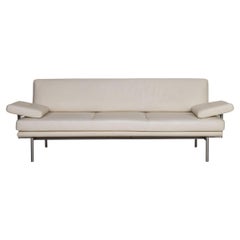
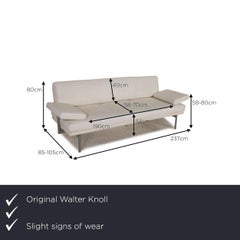
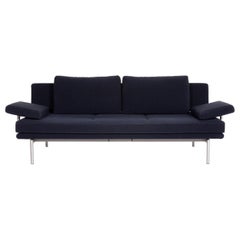
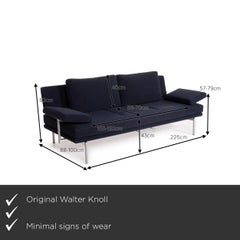
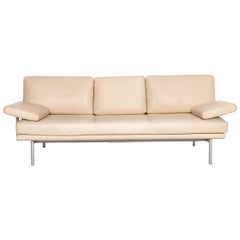
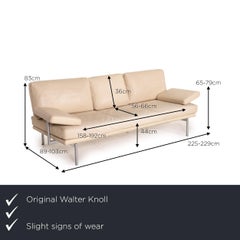
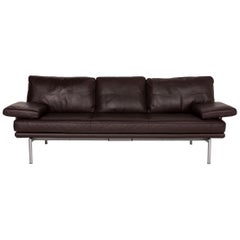
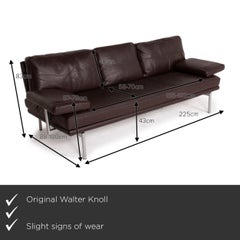
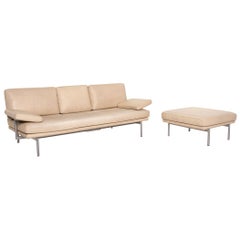
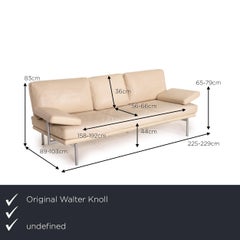
Choose from an assortment of styles, material and more with respect to the knoll living platform you’re looking for at 1stDibs. Frequently made of
animal skin,
leather and
metal, every knoll living platform was constructed with great care. You’ve searched high and low for the perfect knoll living platform — we have versions that date back to the 18th Century alongside those produced as recently as the 20th Century are available. A knoll living platform, designed in the
mid-century modern,
Art Deco or
modern style, is generally a popular piece of furniture. A well-made knoll living platform has long been a part of the offerings for many furniture designers and manufacturers, but those produced by
Knoll,
Ludwig Mies van der Rohe and
Carlo Hauner are consistently popular.
A knoll living platform can differ in price owing to various characteristics — the average selling price 1stDibs is $10,951, while the lowest priced sells for $2,134 and the highest can go for as much as $18,500.
Inspired by the Bauhaus — founded in 1919 by Walter Gropius — Walter Knoll decided to bet big on modernism. He launched his eponymous German furniture maker in 1925, and the company has been going strong ever since.
Most design lovers are familiar with Knoll, the manufacturer of furniture by Eero Saarinen, Harry Bertoia, Marcel Breuer, Ludwig Mies van der Rohe and other modernist giants. It was founded by Hans Knoll in 1941 and led after his death by his wife, Florence Knoll, the doyenne of postwar American office interiors. In recent years, the company has added collections by Maya Lin, Rem Koolhaas, Frank Gehry and David Adjaye, among others, and encouraged customers to do what some of them had been doing all along: use Knoll’s “office furniture” at home.
Fewer Americans are familiar with Walter Knoll, the company Hans’s father founded in Stuttgart, Germany, in 1925 and later moved to nearby Herrenberg. That company has existed in the shadow of the larger U.S.-based Knoll for decades.
Both companies descended from the German manufacturer of ornate leather goods established by Wilhelm Knoll in 1866. In 1907, Wilhelm’s sons, Willy and Walter, took over the father’s business and started producing leather club chairs. Five years later, the company introduced its Nestra line of stripped-down wood and leather seating, foreshadowing the family’s future innovations.
In 1925, when he was 50, Walter Knoll launched the Walter Knoll Company, which soon released the revolutionary Prodomo line of chairs, whose upholstered seats and backs are supported by tubular metal frames. Other lightweight Walter Knoll pieces were used in the passenger compartment of the Hindenburg zeppelin.
In 1927, Walter Knoll furnished five apartments designed by Ludwig Mies van der Rohe for the Weissenhof Estate, 21 prototypes of “workers’ housing of the future” constructed as part of an exhibition in Stuttgart. A decade later, Walter’s son Hans, then 24, traveled to the United States to market his father’s furniture and to make a new life for himself in the New World. But inspired by his encounters with Jens Risom — a Danish-born designer who furthered Scandinavian modernism in the United States — Hans broke away from Walter, creating Knoll Associates (now known simply as Knoll). Florence Schust (later to become Hans’s wife) joined him in the company in 1943, and soon they were working with mid-century modern icons such as Saarinen and Bertoia on new designs and licensing Mies’s Barcelona chair.
After the war, with his factories destroyed and labor and materials in short supply, Walter Knoll turned to Hans for help. Hans sent over several pieces from his Vostra line, designed by Risom. Walter replaced the web seats with upholstery and launched his version of the Vostra at the New Living exhibition in Cologne in 1949. It became hugely successful, persuading many Germans still accustomed to traditional furniture to give modernism a go.
Walter Knoll retired in 1964, but his namesake firm continued growing in Germany. Just like the American Knoll, Walter Knoll has found that some customers want to use pieces originally meant as office furniture in their houses. In fact, these pieces give living and dining rooms a crispness that almost no residential furniture can match.
Find vintage Walter Knoll lounge chairs, sofas, tables and other furniture on 1stDibs.
The late 19th and early 20th centuries saw sweeping social change and major scientific advances — both of which contributed to a new aesthetic: modernism. Rejecting the rigidity of Victorian artistic conventions, modernists sought a new means of expression. References to the natural world and ornate classical embellishments gave way to the sleek simplicity of the Machine Age. Architect Philip Johnson characterized the hallmarks of modernism as “machine-like simplicity, smoothness or surface [and] avoidance of ornament.”
Early practitioners of modernist design include the De Stijl (“The Style”) group, founded in the Netherlands in 1917, and the Bauhaus School, founded two years later in Germany.
Followers of both groups produced sleek, spare designs — many of which became icons of daily life in the 20th century. The modernists rejected both natural and historical references and relied primarily on industrial materials such as metal, glass, plywood, and, later, plastics. While Bauhaus principals Marcel Breuer and Ludwig Mies van der Rohe created furniture from mass-produced, chrome-plated steel, American visionaries like Charles and Ray Eames worked in materials as novel as molded plywood and fiberglass. Today, Breuer’s Wassily chair, Mies van der Rohe’s Barcelona chair — crafted with his romantic partner, designer Lilly Reich — and the Eames lounge chair are emblems of progressive design and vintage originals are prized cornerstones of collections.
It’s difficult to overstate the influence that modernism continues to wield over designers and architects — and equally difficult to overstate how revolutionary it was when it first appeared a century ago. But because modernist furniture designs are so simple, they can blend in seamlessly with just about any type of décor. Don’t overlook them.
Vintage couches and antique sofas have anchored living rooms for generations. The pieces most sought after today carry the deep-buttoned tufting of a Chesterfield or the low, sculptural ease of mid-century modern and Hollywood Regency design.
Styles to Know
Rolled arms and tufted backs point to Mid-Century Modern or Hollywood Regency pieces, while tight backs and turned legs skew more traditional. Velvet is enjoying a renewed moment across most of these silhouettes; see our velvet chesterfield sofa trend report for examples. A mid-century modern coffee table within reach and a vintage mirror nearby round out the seating area.
How to Choose the Right Vintage Sofa
A sofa's frame and upholstery history can be difficult to judge from photographs alone. Ask a seller for more information when a listing doesn't show the fabric or joinery clearly, and confirm whether the upholstery is original or has been redone. Each piece comes from a vetted 1stDibs seller, with era, designer and condition detailed, and the 1stDibs Promise stands behind every purchase.