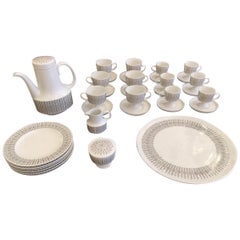
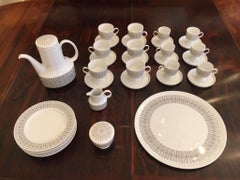
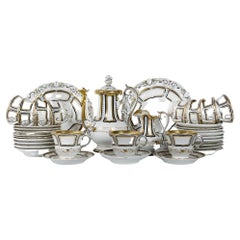
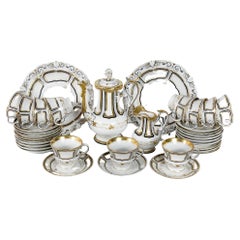
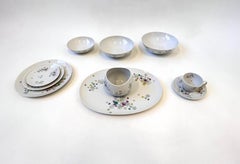
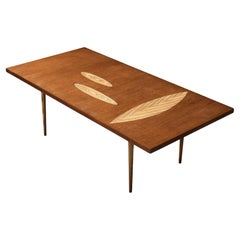
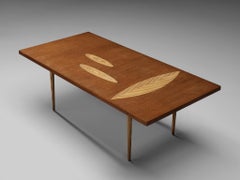
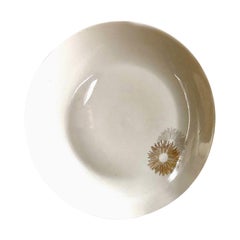
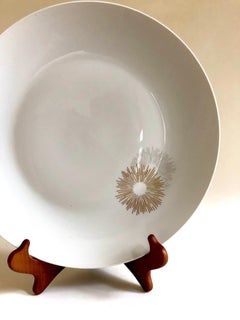
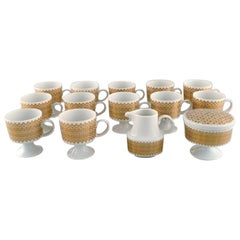
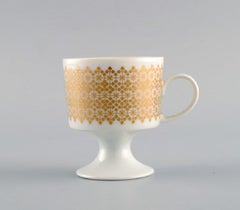
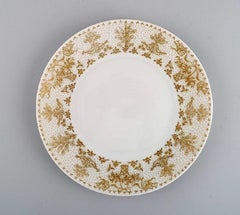
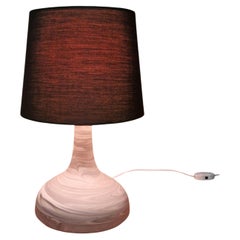
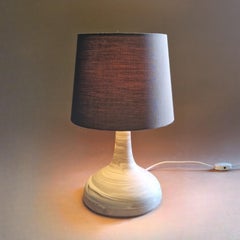
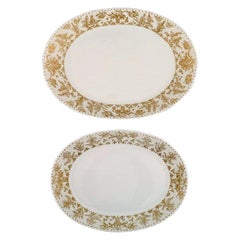
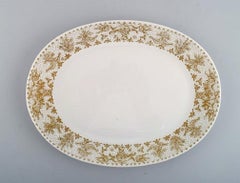
While the Rosenthal Porcelain Factory grew from humble decorating roots — as many pottery companies do — it eventually built a list of universally revered designer and artist partners that included Andy Warhol and Salvador Dalí. And after securing an enviable position as a top manufacturer of serveware and dominating the porcelain and bone china markets, Rosenthal expanded into furniture production, working with influential designers Verner Panton, Luigi Colani and Günther Ferdinand Ris and Herbert Selldorf.
German-born Jewish businessman Philipp Rosenthal founded the company in 1879 in Bavaria. It began as his modest workshop where he painted porcelain and encountered success with porcelain ashtrays. Rosenthal hired the best designers and clay modelers he could find. Adolf Oppel designed figurative Art Nouveau pieces, while Eleonore (Lore) Friedrich-Gronau produced decorative objects, namely her graceful porcelain dancer figurines, for the company.
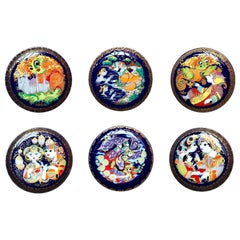
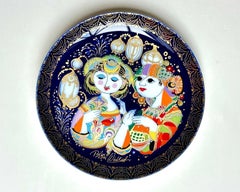
Dinnerware, though, would be a Rosenthal mainstay. Between 1904 and 1910, Rosenthal produced its renowned dinnerware lines such as Donatello, Darmstadt and Isolde. These were introduced as unornamented white pieces — only later were they given their underglaze designs.
Rosenthal founder Philipp, a Catholic of Jewish ancestry, resigned in 1934 as the company’s president due to pressures owing to discriminatory German laws that took shape during the rise of the Nazi regime. Rosenthal died in 1937, and the family fled to America. The company would not regain its footing until 1950 when Rosenthal’s son, Philip, joined the firm and, in 1958, became chairman and dubbed Germany’s “China King.” At its peak, the company had 10,000 employees.
In the 1950s, Rosenthal’s modernist dinnerware was a significant part of the brand’s offerings, and by 1961 they introduced the famed Rosenthal Studio Line. Although furniture designers and ceramicists would lead the list of individuals working with Rosenthal — among them Tapio Wirkkala, Max Weber and Lisa Larson — the company eventually reached out to fine artists, not only Dalí and Warhol but Sandro Chia and Kenny Scharf. Rosenthal also collaborated with fashion designers Gianni Versace and Donatella Versace.
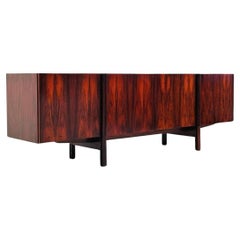
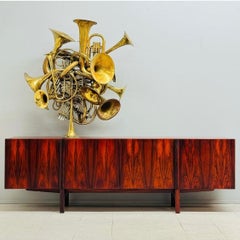
In a daring move in 1972, the company diversified into furniture, collaborating with some of the giants of mid-century modern design. The revolutionary Sunball chair, an icon of Space Age seating crafted by Selldorf and Ris, was among Rosenthal’s stellar successes in this venture.
On 1stDibs, find vintage Rosenthal ceramics, porcelain, tableware, seating and more.
Scandinavian modernism is perhaps the warmest and most organic iteration of modernist design. The work of the designers associated with vintage Scandinavian modern furniture was founded on centuries-old beliefs in both quality craftsmanship and the ideal that beauty should enhance even the humblest accessories of daily life.
ORIGINS OF SCANDINAVIAN MODERN FURNITURE DESIGN
CHARACTERISTICS OF SCANDINAVIAN MODERN FURNITURE DESIGN
- Bold, clean lines and simple, sturdy symmetries
- Use of natural materials — native woods such as pine, ash and beech
- Open, airy spaces
- Promotion of functionality
- Emphasis on craftsmanship; rooted in cabinetry profession and traditional construction techniques
- Minimal ornamentation (little to no embellishment)
- A neutral or light color palette owing to prominence of light woods
SCANDINAVIAN MODERN FURNITURE DESIGNERS TO KNOW
ICONIC SCANDINAVIAN MODERN FURNITURE DESIGNS
VINTAGE SCANDINAVIAN MODERN FURNITURE ON 1STDIBS
The gentle, organic contours that are typical of Scandinavian design appear in the furnishings and decor created by Danish, Finnish and Swedish designers not as a stylistic gesture, but rather as a practical, ergonomic — and, as importantly, elegant — response to the human form.
Each nation produced exceptional talents in all areas of the applied arts, yet each had its forté. Sweden was home to Greta Magnusson Grossman and Bruno Mathsson — creators of the classic Grasshopper lighting series and Berlin daybed, respectively — but the country excelled most notably at ceramics. In the 1920s at the great Gustavsberg porcelain manufactory, Wilhelm Kåge introduced pieces in the Scandinavian style based on influences from folklore to Cubism; his skills were passed on to his versatile and inspired pupils Berndt Friberg and Stig Lindberg.
Likewise, Finland produced a truly ingenious Scandinavian modern furniture designer in the architect Alvar Aalto, a master at melding function and artistic form in works like the Paimio chair, created in collaboration with his first wife, Aino. Yet Finnish glassware was pre-eminent, crafted in expressive, sculptural designs by Tapio Wirkkala and Timo Sarpaneva.
The Danes excelled at chairs. Hans Wegner and Arne Jacobsen were exemplars of the country’s facility with wood, particularly teak.
Wegner created such iconic pieces as the Round chair and the Wishbone chair; Jacobsen — while the revolutionary architect and furniture innovator produced the best-selling plywood Ant chair — designed two classic upholstered pieces of the 1950s: the Swan chair and Egg chair. The list of great Danes could go on and on, including Finn Juhl, a stylistic maverick and maker of the bold Chieftain chair; Poul Kjaerholm, with his lean metal-and-rattan aesthetic; and Verner Panton, who introduced a vibrant Pop note into international design.
Today, decades after their heyday, the prolific, ever-evolving Scandinavian modernists continue to amaze and delight, and interior designers all over the world use their pieces to bring warmth to any given space.
On 1stDibs, you will note both instantly recognizable vintage Scandinavian modern chairs, sofas, rugs and tables — those that have earned iconic status over time — and many new discoveries.
Today you’re likely to bring out your antique and vintage porcelain in order to dress up your dining table for a special meal.
Porcelain, a durable and nonporous kind of pottery made from clay and stone, was first made in China and spread across the world owing to the trade routes to the Far East established by Dutch and Portuguese merchants. Given its origin, English speakers called porcelain “fine china,” an expression you still might hear today. "Fine" indeed — for over a thousand years, it has been a highly sought-after material.
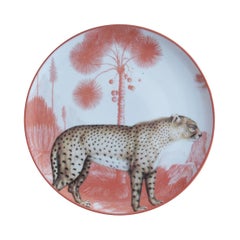
Meissen Porcelain, one of the first factories to create real porcelain outside Asia, popularized figurine centerpieces during the 18th century in Germany, while works by Capodimonte, a porcelain factory in Italy, are synonymous with flowers and notoriously hard to come by. Modern porcelain houses such as Maison Fragile of Limoges, France — long a hub of private porcelain manufacturing — keep the city’s long tradition alive while collaborating with venturesome contemporary artists such as illustrator Jean-Michel Tixier.
Porcelain is not totally clumsy-guest-proof, but it is surprisingly durable and easy to clean. Its low permeability and hardness have rendered porcelain wares a staple in kitchens and dining rooms as well as a common material for bathroom sinks and dental veneers. While it is tempting to store your porcelain behind closed glass cabinet doors and reserve it only for display, your porcelain dinner plates and serving platters can safely weather the “dangers” of the dining room and be used during meals.
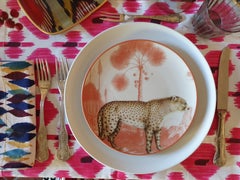
Add different textures and colors to your table with dinner plates and pitchers of ceramic and silver or a porcelain lidded tureen, a serving dish with side handles that is often used for soups. Although porcelain and ceramic are both made in a kiln, porcelain is made with more refined clay and is stronger than ceramic because it is denser.
On 1stDibs, browse an expansive collection of antique and vintage porcelain made in a variety of styles, including Regency, Scandinavian modern and other examples produced during the mid-century era, plus Rococo, which found its inspiration in nature and saw potters crafting animal figurines and integrating organic motifs such as floral patterns in their work.