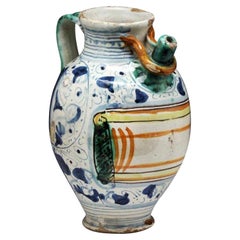
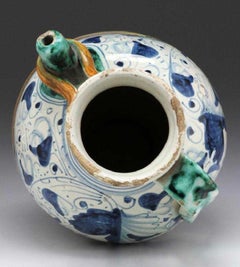
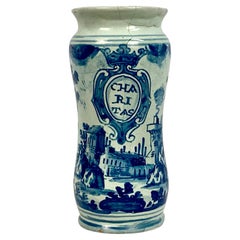
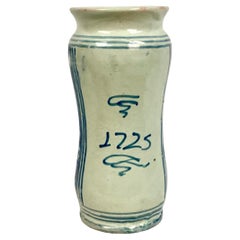
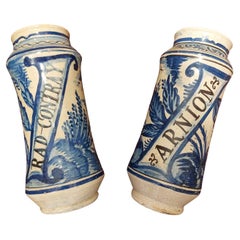
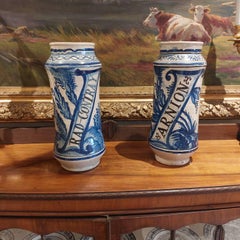
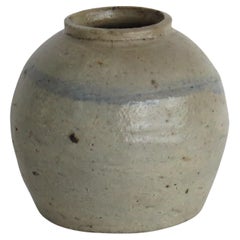
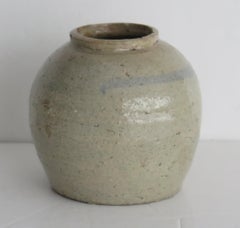
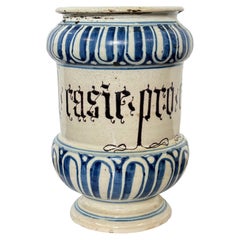
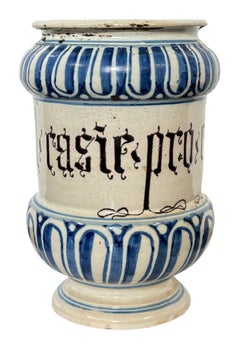
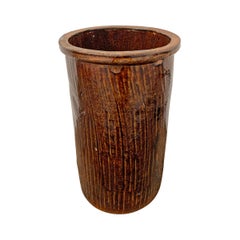
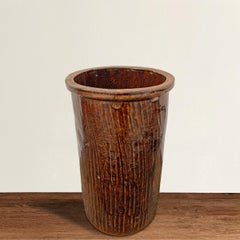
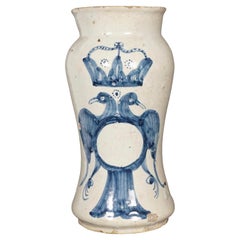
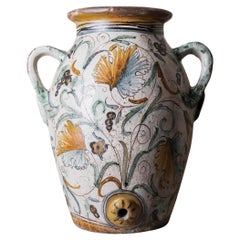
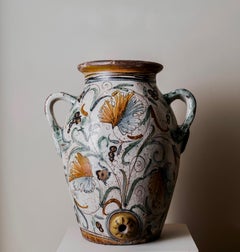
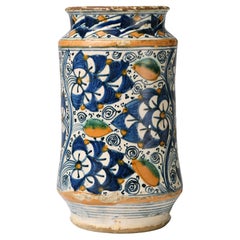
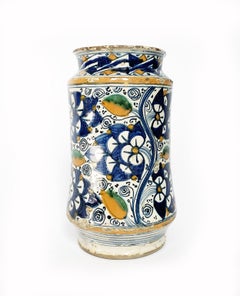
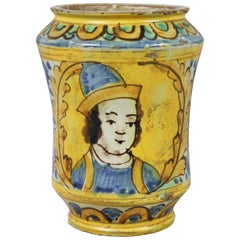
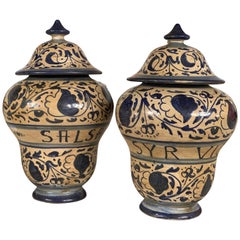
Tin-glazed earthenware drag jar (albarello)
Montelupo, 1490-1510
It measures: mouth diameter 3.54 in (9 cm), foot diameter 3.46 in (8.8 cm), height 7.48 in (19 cm)
Weight: 1.34 lb (612 g)
State of conservation: intact, signs of use on the rim and slight chips on the raised areas. Kiln-support marks.
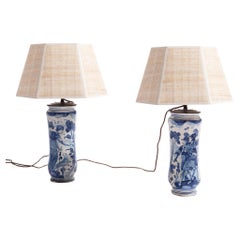
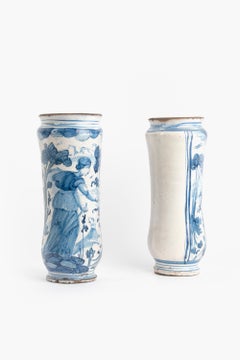
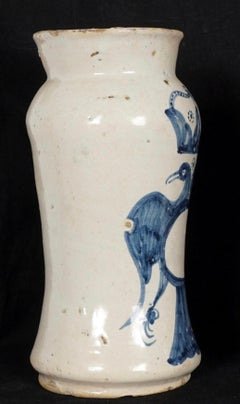
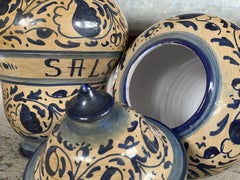
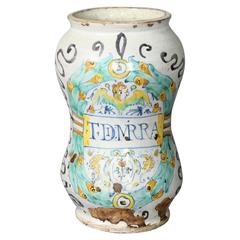
The small apothecary container for unguents has a cylindrical body which tapers towards the base and the flat foot. The shoulder is narrow and high, with elegant lines. The mouth is wide with a rounded edge and turned-out lip.
The vase has an enameled interior. The exterior shows a white enamel surface entirely covered with "palmetta persiana" motifs (pinecone motifs). These are arranged symmetrically and horizontally. A series of double sinuous lines encircle an area where, along with the main decoration, there are "alla porcellana" (porcelain) motifs combined with green and orange oval leaves. A "nastro spezzato" (broken ribbon) decoration, usually found on the brim of plates, runs along the neck to complete the decoration.
All the ornaments attest to an oriental inspiration that can be traced back relatively accurately to the Iranian or Syrian area. This decoration was also very successful in other contemporary Italian manufacturers (C. Ravanelli Guidotti, Thesaurus di opere della tradizione di Faenza, Faenza 1998, pp. 169-174), but in Montelupo it was interpreted in various ways due to the eclectic nature of its painters.
There is an abundant use of the precious cobalt blue, almost in relief, and is often associated with yellow-orange inserts. This imitates the metallic luster in symmetrical points between the petals.
The background is decorated with thin sinuous lines, which, for Fausto Berti (Berti F., Il Museo della ceramica di Montelupo, Firenze 2008, pp. 270-272, n. 22 g e Berti F., Storia della ceramica di Montelupo, Montelupo Fiorentino 1999, p. 140), might suggest the presence of a stem that supports the corollas and two-colored leaves. These, pointed and accompanied by dots, spirals and subtle "alla porcellana" (porcelain) motifs, fill the white background.
The form and the decorative synthesis described above lead us to an even earlier dating, between the end of the fifteenth century and the first twenty years of the sixteenth century, when the palette chosen by the workshops was still rich and marked and the pictorial ductus was sought after. (Berti F., Storia della ceramica di Montelupo. Montelupo Fiorentino, 1999, p. 138-140).
The documentation of this decoration is more common in open forms than in closed ones. For this reason, our albarello finds rare examples of comparison, three of which are very close: an albarello, similar in size, is kept at the Museé du Louvre in Paris (Giacomotti. J., Catalogue des majoliques des musées nationaux, Parigi 1974, p. 39 cat. 143); another one is at the Victoria & Albert Museum in London (Sani E. P., Italian Renaissance Maiolica...
Category
16th Century Italian Antique Renaissance Jars