Canvas Decorative Art

to
184
498
265
698
60
42
Height
to
Width
to
102
59
28
24
24
23
13
8
6
4
4
3
2
2
2
2
69
159
470
102
74
150
149
11
6
12
11
7
18
25
45
26
12
82,501
8,023
2,873
2,389
2,384
458
169
157
154
78
800
764
799
13
8
8
5
5
Material: Canvas
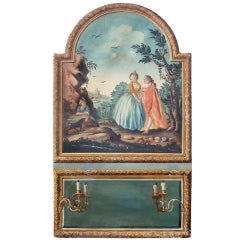
Louis XVI Style Trumeau Panel with Trompe L'oeil Mirror Panel
Located in Nashville, TN
Possibly late 18th century but most likely 19th century painted arched painted panel. Either a panel intended for a trumeau or to be inset into wall boiserie as a trumeau. The upper ...
Category

1830s French Louis XVI Antique Canvas Decorative Art

Materials

Canvas, Paint

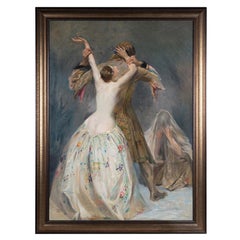
Hamilton Hamilton Oil on Canvas "Othello and Desdemona"
Located in Los Angeles, CA
Hamilton Hamilton (American, 1847-1928) A large and impressive oil on canvas "Othello and Desdemona" after the William Shakespeare's play "Othe...
Category

1920s American Art Nouveau Vintage Canvas Decorative Art

Materials

Canvas, Giltwood

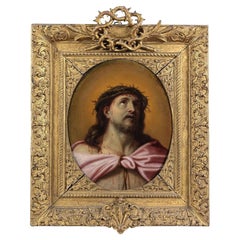
Italian 17th Century Oil on Canvas Head of Christ Crowned with Thorns, Mignard
By (circle of) Pierre Mignard
Located in Los Angeles, CA
A very fine Italian 17th century oval oil on canvas "Head of Christ Crowned with Thorns" Circle of Pierre Mignard (French, 1612-1695) within...
Category

17th Century French Baroque Antique Canvas Decorative Art

Materials

Canvas, Giltwood

20th Century Blue-Green Abstract Books, French Painting by Daniel Clesse
Located in West Palm Beach, FL
A French blue, green abstract portrait of books, oil on wood in canvas by Daniel Clesse, painted in France, signed and dated in 1964. Measures: Without the frame: 18" H x 21.5" W x ...
Category

Mid-20th Century French Mid-Century Modern Canvas Decorative Art

Materials

Canvas, Wood, Paint

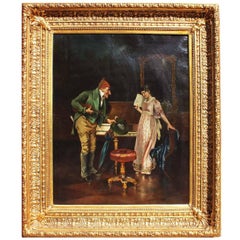
Italian 19th Century Oil on Canvas "The Music Professor" Carlo Sassi
By Carlo Sassi
Located in Los Angeles, CA
Italian 19th century oil on canvas titled "The Music Professor" depicting a mid-19th century music-room scene of an elder man, the music professor, holding his violin, hat and umbrel...
Category

19th Century Italian Other Antique Canvas Decorative Art

Materials

Gesso, Canvas, Wood

"Shibori Sky" Kite by Michael Thompson
Located in Chicago, IL
Based in Chicago, IL, contemporary artist Michael Thompson creates unique kites, collages and mixed media works assembled from material fragments of past and present collected in his...
Category

21st Century and Contemporary American Organic Modern Canvas Decorative Art

Materials

Canvas, Bamboo, Silk

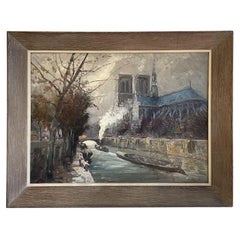
20th Century Russian Oil Painting of the Notre Dame by Vladimir Volodia Lazarev
By Vladimir Volodia Lazarev
Located in West Palm Beach, FL
A blue-grey, white vintage Russian, French oil on canvas painting, portraying a cloudy day of the Notre Dame Cathedral from across the Seine river in Paris, painted by Vladimir Volod...
Category

Mid-20th Century Russian Mid-Century Modern Canvas Decorative Art

Materials

Canvas, Wood

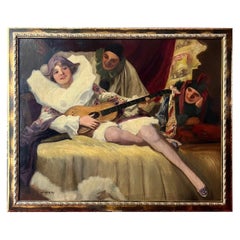
Richard Geiger Large Oil on Canvas Master Painting Scene, Commedia Dell’arte
Located in Vero Beach, FL
Richard Geiger Large Oil on Canvas Master Painting Scene of the Commedia dell’arte. The Commedia dell’arte is an early form of theater in Italy. Various performers in the troupe w...
Category

1920s Austrian Belle Époque Vintage Canvas Decorative Art

Materials

Canvas

George Gach 'Hungarian-American, NY, 1909-1996' Oil On Canvas, "Jones Beach 1968
Located in Bridgeport, CT
Signed and dated 1968 on the lower right and on verso with title and date. Christies labels on the stretcher- 10-JAN 07, sale 1786 lot 23. A wonderful view of the crowded beach with some women wearing two-piece bathing suits...
Category

1960s American Mid-Century Modern Vintage Canvas Decorative Art

Materials

Canvas

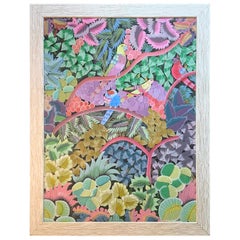
Parrots in the Jungle Haitian Acrylic on Canvas Painting
Located in Delray Beach, FL
Exceptional oil painting on canvas by Haitian artist depicts lush green jungle with bright and vivid colorful parrots overlooking beautiful lush jungle, acrylic paint on canvas, with...
Category

1970s Haitian Vintage Canvas Decorative Art

Materials

Canvas, Acrylic, Wood

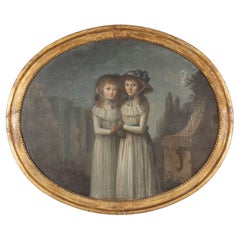
Early 19th Century English Oil on Canvas Painting of Regency Twin Sisters
Located in Gloucestershire, GB
Wonderful early 19th Century English oil on canvas oval painting of sisters. In the naive style, the two central girls are dress in Regency clothes and standing together in a classi...
Category

Early 19th Century English Regency Antique Canvas Decorative Art

Materials

Canvas, Paint

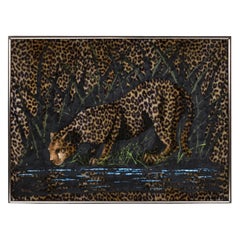
Vintage 1970s Tiki Safari Leopard Painting Hand Painted On Faux Fur
Located in Chattanooga, TN
A captivating and unconventional 1970s mixed-media painting signed “Rodriguez,” this work fuses painterly technique with tactile surface art. The “canvas” is faux leopard fur, its ve...
Category

1970s American Mid-Century Modern Vintage Canvas Decorative Art

Materials

Canvas, Paint, Fabric

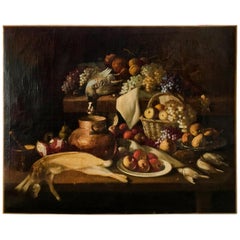
17th Century Large Dutch Painting Still Life with Fruit and Game, Oil on Canvas
Located in Vero Beach, FL
This large, old master still life painting is a perfectly balanced composition of fruit and game birds. In the foreground a rabbit is stretched out. A copper kettle and a basket are ...
Category

17th Century Dutch Baroque Antique Canvas Decorative Art

Materials

Canvas, Paint

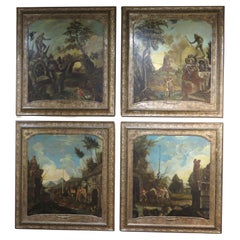
A Set of Four Late 18th Century / Early 19th Century Allegorical Paintings
Located in Dallas, TX
A set of four (4) Late 18th Century / Early 19th Century allegorical paintings amongst landscapes amongst classical ruins, relived frames contemporary pictures most likely. Italian. ...
Category

Early 18th Century Italian Neoclassical Antique Canvas Decorative Art

Materials

Canvas

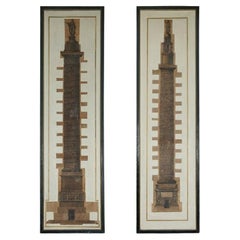
PAIR OF TROFEO O SIA MAGNIFICA COLONNA PIRANESI GIOVANNI BATTISTA PRINTs 337CM
Located in West Sussex, Pulborough
Royal House Antiques Royal House Antiques is delighted to offer for sale this stunning pair of absolutely massive Engravings on Canvas of the Italian Trajan column and one other Rom...
Category

1860s European Victorian Antique Canvas Decorative Art

Materials

Canvas, Oak

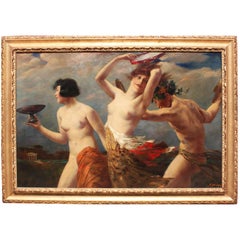
19th Century Oil on Canvas Bacchante Group Attributed to Leopold Schmutzler
Located in Los Angeles, CA
A large 19th century oil on canvas Bacchante group depicting two allegorical young semi-nude maidens dancing with pan, attributed to Leopold Schmutzler...
Category

Early 20th Century German Greco Roman Canvas Decorative Art

Materials

Canvas, Giltwood

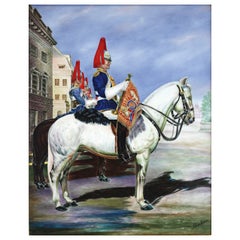
Boehm Porcelain Equestrian Plaque
Located in West Palm Beach, FL
Boehm Porcelain Equestrian Plaque Titled, Royal Horse Guard, 1996 by A.L. Fritchey, edition limited, number 5, dated 1996 sight 14 by 11 in. (35.56...
Category

20th Century Canvas Decorative Art

Materials

Canvas, Cane

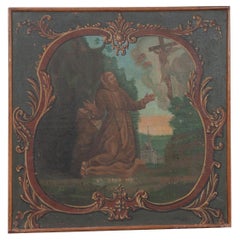
Framed Painting of St. Francis of Assisi
Located in Baton Rouge, LA
A beautiful depiction of St. Francis of Assisi kneeling before a vision of a crucified Jesus Christ. A slim wood frame supports the oil on canvas pai...
Category

19th Century French Other Antique Canvas Decorative Art

Materials

Canvas, Wood, Paint

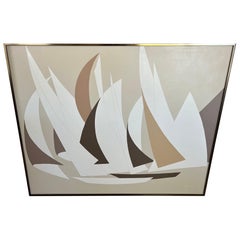
Monumental Sailboat Painting by Lee Reynolds Vanquard Studios
Located in Redding, CT
Monumental Sailboat Painting by Lee Reynolds of Vanguard studios. Minimalist design of sailboats in muted cream and brown tones. Framed in a gun metal colored frame. White glove ship...
Category

1970s Mid-Century Modern Vintage Canvas Decorative Art

Materials

Canvas, Wood, Paint

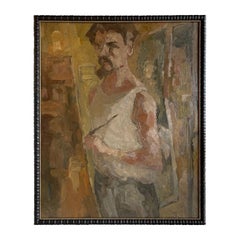
20th Century Grey-Brown French Landscape Painting by Daniel Clesse
Located in West Palm Beach, FL
A French painting, self-portrait on wood by Daniel Clesse, painted in Paris, France, signed and dated circa in 1963. Daniel Clesse was a French pain...
Category

Mid-20th Century French Mid-Century Modern Canvas Decorative Art

Materials

Canvas, Wood, Paint

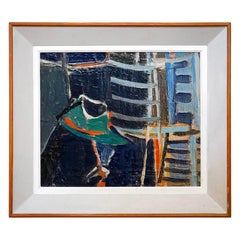
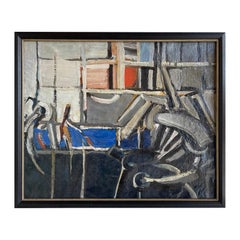
20th Century Dark-Blue Abstract Interior, French Painting by Daniel Clesse
Located in West Palm Beach, FL
A dark-blue, black abstract interior with chairs and window surround, oil on wood in canvas on a blue frame by Daniel Clesse, painted in France, signed and dated circa in 1970. Dani...
Category

Mid-20th Century French Mid-Century Modern Canvas Decorative Art

Materials

Canvas, Wood, Paint

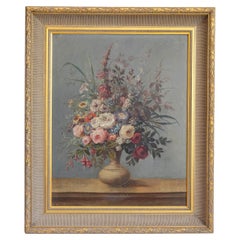
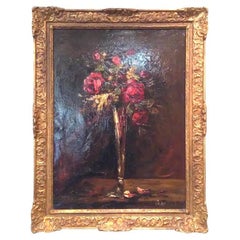
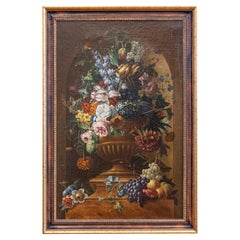
Italian Rococo 1770s Framed Still-Life Painting Depicting a Bouquet of Flowers
Located in Atlanta, GA
An Italian Rococo period framed still-life oil on canvas painting from the late 18th century, depicting a colorful bouquet. Created in Italy during the third quarter of the 18th cent...
Category

Late 18th Century Italian Rococo Antique Canvas Decorative Art

Materials

Canvas, Paint

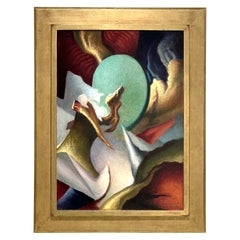
"FANTASY" Oil on Canvas by Thomas Hart Benton
By Thomas Hart Benton
Located in New York, NY
"FANTASY" by Thomas Hart Benton. Oil on canvas laid on wood with a gorgeous gold gilded frame. Price upon request.
Category

1940s American Mid-Century Modern Vintage Canvas Decorative Art

Materials

Canvas, Paint

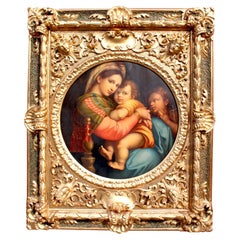
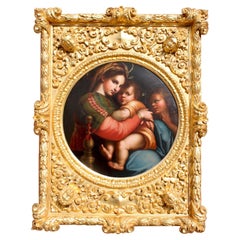
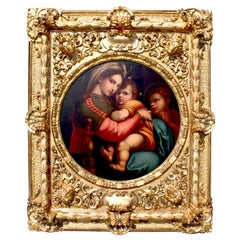
After Raffaello Sanzio 1483-1520 Raphael La Madonna della Seggiola Oil on Canvas
Located in Los Angeles, CA
A Fine Italian 19th Century Oil Painting on Canvas "La Madonna della Seggiola" after Raphael (Raffaello Sanzio da Urbino 1483-1520). The circular painted canvas depicting a seated Madonna holding an infant Jesus Christ next to a child Saint John the Baptist, all within a massive carved two-tone gilt wood, gilt-patinated and gesso frame, which is identical to the frame on Raphael's original artwork. This painting is a 19th Century copy of Raphael's Madonna della Seggiola painted in 1514 and currently exhibited and part of the permanent collection at the Palazzo Pitti, Galleria Palatina, Florence, Italy. The bodies of the Virgin, Christ, and the boy Baptist fill the whole picture. The tender, natural looking embrace of the Mother and Child, and the harmonious grouping of the figures in the round, have made this one of Raphael's most popular Madonnas. The isolated chair leg is reminiscent of papal furniture, which has led to the assumption that Leo X himself commissioned the painting. Circa: 1890-1900. Subject: Religious painting Painting diameter: 28 inches (71.1 cm) Frame height: 55 1/8 inches (140 cm) Frame width: 46 inches (116.8 cm) Frame depth: 5 1/8 inches (13 cm) Raffaello Sanzio da Urbino (Italian, March 28 or April 6, 1483 - April 6, 1520), known as Raphael, was an Italian painter and architect of the High Renaissance. His work is admired for its clarity of form, ease of composition, and visual achievement of the Neoplatonic ideal of human grandeur. Together with Michelangelo and Leonardo da Vinci, he forms the traditional trinity of great masters of that period. Raphael was enormously productive, running an unusually large workshop and, despite his death at 37, leaving a large body of work. Many of his works are found in the Vatican Palace, where the frescoed Raphael Rooms were the central, and the largest, work of his career. The best known work is The School of Athens in the Vatican Stanza della Segnatura. After his early years in Rome much of his work was executed by his workshop from his drawings, with considerable loss of quality. He was extremely influential in his lifetime, though outside Rome his work was mostly known from his collaborative printmaking. After his death, the influence of his great rival Michelangelo was more widespread until the 18th and 19th centuries, when Raphael's more serene and harmonious qualities were again regarded as the highest models. His career falls naturally into three phases and three styles, first described by Giorgio Vasari: his early years in Umbria, then a period of about four years (1504–1508) absorbing the artistic traditions of Florence, followed by his last hectic and triumphant twelve years in Rome, working for two Popes and their close associates. Raphael was born in the small but artistically significant central Italian city of Urbino in the Marche region, where his father Giovanni Santi was court painter to the Duke. The reputation of the court had been established by Federico III da Montefeltro, a highly successful condottiere who had been created Duke of Urbino by the Pope - Urbino formed part of the Papal States - and who died the year before Raphael was born. The emphasis of Federico's court was rather more literary than artistic, but Giovanni Santi was a poet of sorts as well as a painter, and had written a rhymed chronicle of the life of Federico, and both wrote the texts and produced the decor for masque-like court entertainments. His poem to Federico shows him as keen to show awareness of the most advanced North Italian painters, and Early Netherlandish artists as well. In the very small court of Urbino he was probably more integrated into the central circle of the ruling family than most court painters. Federico was succeeded by his son Guidobaldo da Montefeltro, who married Elisabetta Gonzaga, daughter of the ruler of Mantua, the most brilliant of the smaller Italian courts for both music and the visual arts. Under them, the court continued as a centre for literary culture. Growing up in the circle of this small court gave Raphael the excellent manners and social skills stressed by Vasari. Court life in Urbino at just after this period was to become set as the model of the virtues of the Italian humanist court through Baldassare Castiglione's depiction of it in his classic work The Book of the Courtier, published in 1528. Castiglione moved to Urbino in 1504, when Raphael was no longer based there but frequently visited, and they became good friends. He became close to other regular visitors to the court: Pietro Bibbiena and Pietro Bembo, both later cardinals, were already becoming well known as writers, and would be in Rome during Raphael's period there. Raphael mixed easily in the highest circles throughout his life, one of the factors that tended to give a misleading impression of effortlessness to his career. He did not receive a full humanistic education however; it is unclear how easily he read Latin. Early Life and Works His mother Màgia died in 1491 when Raphael was eight, followed on August 1, 1494 by his father, who had already remarried. Raphael was thus orphaned at eleven; his formal guardian became his only paternal uncle Bartolomeo, a priest, who subsequently engaged in litigation with his stepmother. He probably continued to live with his stepmother when not staying as an apprentice with a master. He had already shown talent, according to Vasari, who says that Raphael had been "a great help to his father". A self-portrait drawing from his teenage years shows his precocity. His father's workshop continued and, probably together with his stepmother, Raphael evidently played a part in managing it from a very early age. In Urbino, he came into contact with the works of Paolo Uccello, previously the court painter (d. 1475), and Luca Signorelli, who until 1498 was based in nearby Città di Castello. According to Vasari, his father placed him in the workshop of the Umbrian master Pietro Perugino as an apprentice "despite the tears of his mother". The evidence of an apprenticeship comes only from Vasari and another source, and has been disputed—eight was very early for an apprenticeship to begin. An alternative theory is that he received at least some training from Timoteo Viti, who acted as court painter in Urbino from 1495.Most modern historians agree that Raphael at least worked as an assistant to Perugino from around 1500; the influence of Perugino on Raphael's early work is very clear: "probably no other pupil of genius has ever absorbed so much of his master's teaching as Raphael did", according to Wölfflin. Vasari wrote that it was impossible to distinguish between their hands at this period, but many modern art historians claim to do better and detect his hand in specific areas of works by Perugino or his workshop. Apart from stylistic closeness, their techniques are very similar as well, for example having paint applied thickly, using an oil varnish medium, in shadows and darker garments, but very thinly on flesh areas. An excess of resin in the varnish often causes cracking of areas of paint in the works of both masters. The Perugino workshop was active in both Perugia and Florence, perhaps maintaining two permanent branches. Raphael is described as a "master", that is to say fully trained, in December 1500. His first documented work was the Baronci altarpiece for the church of Saint Nicholas of Tolentino in Città di Castello, a town halfway between Perugia and Urbino. Evangelista da Pian di Meleto, who had worked for his father, was also named in the commission. It was commissioned in 1500 and finished in 1501; now only some cut sections and a preparatory drawing remain. In the following years he painted works for other churches there, including the Mond Crucifixion (about 1503) and the Brera Wedding of the Virgin (1504), and for Perugia, such as the Oddi Altarpiece. He very probably also visited Florence in this period. These are large works, some in fresco, where Raphael confidently marshals his compositions in the somewhat static style of Perugino. He also painted many small and exquisite cabinet paintings in these years, probably mostly for the connoisseurs in the Urbino court, like the Three Graces and St. Michael, and he began to paint Madonnas and portraits. In 1502 he went to Siena at the invitation of another pupil of Perugino, Pinturicchio, "being a friend of Raphael and knowing him to be a draughtsman of the highest quality" to help with the cartoons, and very likely the designs, for a fresco series in the Piccolomini Library in Siena Cathedral. He was evidently already much in demand even at this early stage in his career. Influence of Florence Raphael led a "nomadic" life, working in various centres in Northern Italy, but spent a good deal of time in Florence, perhaps from about 1504. Although there is traditional reference to a "Florentine period...
Category

Early 1900s Italian Baroque Antique Canvas Decorative Art

Materials

Canvas, Giltwood

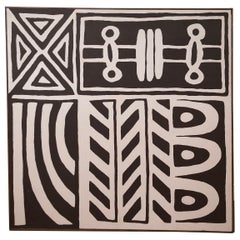
Large Mid Century Geometric Abstract Painting
Located in Redding, CT
Large Mid Century abstract geometric painting. African tribal vibes and colors. Brown with an off-white creamy blush/mauve background. This item can parcel ship for $55
Category

1970s African Mid-Century Modern Vintage Canvas Decorative Art

Materials

Canvas, Wood

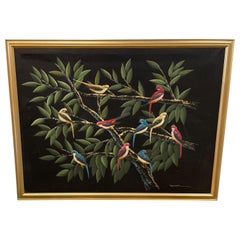
Decorative Oil Painting of Colorful Birds on Black Ground
Located in West Palm Beach, FL
Oil painting of colorful birds in a tree on a black background. A very dramatic and unique piece.
Category

20th Century American Canvas Decorative Art

Materials

Canvas

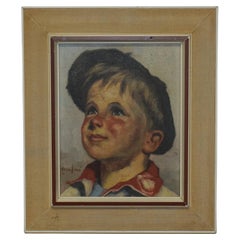
Antique Signed Brandsma Belgium Oil on Canvas Painting of Young Boy Part Set
Located in West Sussex, Pulborough
We are delighted to offer for sale this lovely original circa 1930s Belgium oil on canvas of young boy in a cap which is part of a suite I have seven of these lifestyle, natural D...
Category

1930s Belgian Art Deco Vintage Canvas Decorative Art

Materials

Canvas

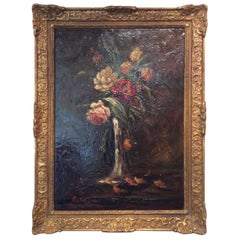
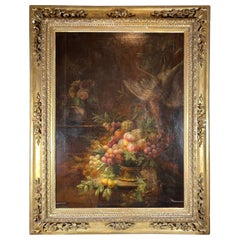
Ornately Giltwood Framed Floral Painting by Charles Franzini D’issoncourt
Located in Miami, FL
Magnificent French Floral Oil Painting by Charles Henri Franzini d’Issoncourt A striking original oil on canvas by the distinguished French artist Charles Henri Franzini d’Issoncour...
Category

Early 1900s French Baroque Antique Canvas Decorative Art

Materials

Canvas, Paint, Giltwood

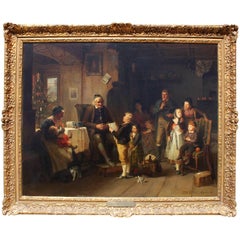
Friedrich Ortlieb Oil on Canvas Children Celebrate Christmas
By Friedrich Ortlieb
Located in Los Angeles, CA
Friedrich Ortlieb (German, 1839-1909) A fine and large oil on canvas titled "New Year's Day at The grandfather's". The joyful indoor family scene depicting a Christmas and new year's celebration with an elder seated couple, the grandparents, the grandmother holding a toddler on her arms, the grandfather with his smoking pipe by his side, both enjoying a young boy's (grandson) poem recital, while other children await their turn with gifts as the mesmerized young parents Stand and watch in awe. A Christmas tree by the window, a cat sneaking by and a basket with wine and bread awaits being delivered as a gift to the elders. A young boy sits patiently on a chair, an apple and an umbrella by his side. Signed: Fried Ortlieb, München 1873 - (lower right). An engraved brass plaque reads "New Year's at the grandfathers - Friederich Ortlieb 1839-1909) Munich, circa 1873. Friedrich Ortlieb was an accomplished artist, born in Stuttgart in 1839 and died in Munich on the 4th October 1909. He received his formal art training at the L’Ecole des Beaux-Arts in Stuttgart and also at Steffeck, Berlin. He exhibited widely, though most notably in Dresden and Vienna from 1871. He is best remembered for his genre scenes with children as shown in this finely detailed example of his work. Epitomizing the very best in this genre, Ortlieb depicts the character and personality of the children in joyful situations with accuracy and great sensitivity to the subject matter, a frozen moment in time with so much detail and emotion expressed in the children’s and elder's faces. Related literature: E. Benezit, Dictionnaire des Peintres, Sculpteurs, Dessinateurs et Graveurs by Gründ, Volume 8, Page 41 Provenance: Grogan & Company, Dedham, December 5, 1999 - Sale No. 81, Lot 13 Gallerie in Paris, 2000 Christie's New York 2003 Paris art gallery...
Category

19th Century German Country Antique Canvas Decorative Art

Materials

Giltwood, Canvas

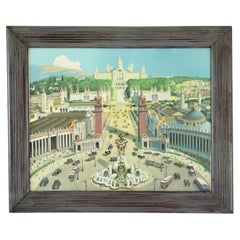
Hand-Coloured Print on Canvas, 1929 Barcelona International Exposition
Located in Barcelona, ES
Framed print on canvas: " Exposición Internacional de Barcelona, Año 1929 " The 1929 International Exposition was one of the most important events to have shaped the urban landsca...
Category

20th Century Spanish Canvas Decorative Art

Materials

Canvas, Wood

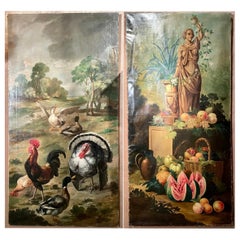
Pair Antique 19th Century French Oil on Canvas Painting Wall Panels, circa 1880
Located in New Orleans, LA
Pair antique 19th century French oil on canvas painting wall panels, circa 1880.
Category

Late 19th Century French Antique Canvas Decorative Art

Materials

Canvas, Paint

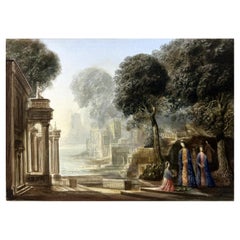
Antique English Italianate Framed Watercolor attr Harold Hitchcock George Stubbs
Located in Dublin, Ireland
ERROR IN LISTING: This listing is for ONE Painting, we are trying to fix this currently. Stunning Continental View possibly Venice, Italy. Watercolour on Artists board, first quarter of the Twentieth Century. Allthough not signed this beautiful Watercolour is firmly attributed to the work of English Artist Harold Hitchcock, who did not always add signature. Depicting Mountainous and Landscape views with three ladies...
Category

Early 20th Century Italian Edwardian Canvas Decorative Art

Materials

Canvas, Giltwood

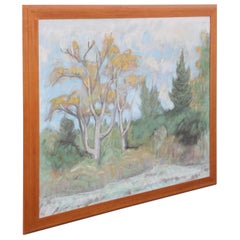
Original Oil Painting of Maine Landscape by Henry Varnum Poor
Located in West Palm Beach, FL
Large original oil painting of Maine landscape by Henry Varnum Poor.
Category

20th Century American Canvas Decorative Art

Materials

Canvas

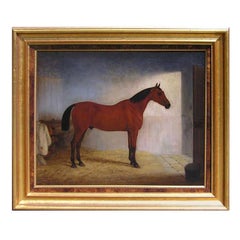
English Oil on Canvas Horse Portrait in Burl Walnut Gilt Frame, Signed. C. 1866
Located in Charleston, SC
English oil on canvas horse portrait in burl walnut giltwood and beaded molded edge frame. Signed & Dated by Artist "J. Brown Coventry 1866"
Category

1860s English William IV Antique Canvas Decorative Art

Materials

Canvas, Wood, Giltwood, Paint

After Raffaello Sanzio 1483-1520 Raphael La Madonna della Seggiola Oil on Canvas
Located in Los Angeles, CA
A Fine Italian 19th Century Oil Painting on Canvas "La Madonna della Seggiola" after Raphael (Raffaello Sanzio da Urbino 1483-1520). The circular painted canvas depicting a seated Madonna holding an infant Jesus Christ next to a child Saint John the Baptist, all within a massive carved gilt wood and gesso frame, which is identical to the frame on Raphael's original artwork. This painting is a 19th Century copy of Raphael's Madonna della Seggiola painted in 1514 and currently exhibited and part of the permanent collection at the Palazzo Pitti, Galleria Palatina, Florence, Italy. The bodies of the Virgin, Christ, and the boy Baptist fill the whole picture. The tender, natural looking embrace of the Mother and Child, and the harmonious grouping of the figures in the round, have made this one of Raphael's most popular Madonnas. The isolated chair leg is reminiscent of papal furniture, which has led to the assumption that Leo X himself commissioned the painting. A retailer's label reads " Fred K/ Keer's Sons - Framers and Fine Art Dealers - 917 Broad St. Newark, N.J." - Another label from the gilder reads "Carlo Bartolini - Doratore e Verniciatori - Via Maggio 1924 - Firenze". Circa: 1890-1900. Subject: Religious painting Canvas diameter: 28 inches (71.1 cm) Frame height: 54 inches (137.2 cm) Frame width: 42 1/2 inches (108 cm) Frame depth: 5 1/2 inches (14 cm) Raffaello Sanzio da Urbino (Italian, March 28 or April 6, 1483 - April 6, 1520), known as Raphael, was an Italian painter and architect of the High Renaissance. His work is admired for its clarity of form, ease of composition, and visual achievement of the Neoplatonic ideal of human grandeur. Together with Michelangelo and Leonardo da Vinci, he forms the traditional trinity of great masters of that period. Raphael was enormously productive, running an unusually large workshop and, despite his death at 37, leaving a large body of work. Many of his works are found in the Vatican Palace, where the frescoed Raphael Rooms were the central, and the largest, work of his career. The best known work is The School of Athens in the Vatican Stanza della Segnatura. After his early years in Rome much of his work was executed by his workshop from his drawings, with considerable loss of quality. He was extremely influential in his lifetime, though outside Rome his work was mostly known from his collaborative printmaking. After his death, the influence of his great rival Michelangelo was more widespread until the 18th and 19th centuries, when Raphael's more serene and harmonious qualities were again regarded as the highest models. His career falls naturally into three phases and three styles, first described by Giorgio Vasari: his early years in Umbria, then a period of about four years (1504–1508) absorbing the artistic traditions of Florence, followed by his last hectic and triumphant twelve years in Rome, working for two Popes and their close associates. Raphael was born in the small but artistically significant central Italian city of Urbino in the Marche region, where his father Giovanni Santi was court painter to the Duke. The reputation of the court had been established by Federico III da Montefeltro, a highly successful condottiere who had been created Duke of Urbino by the Pope - Urbino formed part of the Papal States - and who died the year before Raphael was born. The emphasis of Federico's court was rather more literary than artistic, but Giovanni Santi was a poet of sorts as well as a painter, and had written a rhymed chronicle of the life of Federico, and both wrote the texts and produced the decor for masque-like court entertainments. His poem to Federico shows him as keen to show awareness of the most advanced North Italian painters, and Early Netherlandish artists as well. In the very small court of Urbino he was probably more integrated into the central circle of the ruling family than most court painters. Federico was succeeded by his son Guidobaldo da Montefeltro, who married Elisabetta Gonzaga, daughter of the ruler of Mantua, the most brilliant of the smaller Italian courts for both music and the visual arts. Under them, the court continued as a centre for literary culture. Growing up in the circle of this small court gave Raphael the excellent manners and social skills stressed by Vasari. Court life in Urbino at just after this period was to become set as the model of the virtues of the Italian humanist court through Baldassare Castiglione's depiction of it in his classic work The Book of the Courtier, published in 1528. Castiglione moved to Urbino in 1504, when Raphael was no longer based there but frequently visited, and they became good friends. He became close to other regular visitors to the court: Pietro Bibbiena and Pietro Bembo, both later cardinals, were already becoming well known as writers, and would be in Rome during Raphael's period there. Raphael mixed easily in the highest circles throughout his life, one of the factors that tended to give a misleading impression of effortlessness to his career. He did not receive a full humanistic education however; it is unclear how easily he read Latin. Early Life and Works His mother Màgia died in 1491 when Raphael was eight, followed on August 1, 1494 by his father, who had already remarried. Raphael was thus orphaned at eleven; his formal guardian became his only paternal uncle Bartolomeo, a priest, who subsequently engaged in litigation with his stepmother. He probably continued to live with his stepmother when not staying as an apprentice with a master. He had already shown talent, according to Vasari, who says that Raphael had been "a great help to his father". A self-portrait drawing from his teenage years shows his precocity. His father's workshop continued and, probably together with his stepmother, Raphael evidently played a part in managing it from a very early age. In Urbino, he came into contact with the works of Paolo Uccello, previously the court painter (d. 1475), and Luca Signorelli, who until 1498 was based in nearby Città di Castello. According to Vasari, his father placed him in the workshop of the Umbrian master Pietro Perugino as an apprentice "despite the tears of his mother". The evidence of an apprenticeship comes only from Vasari and another source, and has been disputed—eight was very early for an apprenticeship to begin. An alternative theory is that he received at least some training from Timoteo Viti, who acted as court painter in Urbino from 1495.Most modern historians agree that Raphael at least worked as an assistant to Perugino from around 1500; the influence of Perugino on Raphael's early work is very clear: "probably no other pupil of genius has ever absorbed so much of his master's teaching as Raphael did", according to Wölfflin. Vasari wrote that it was impossible to distinguish between their hands at this period, but many modern art historians claim to do better and detect his hand in specific areas of works by Perugino or his workshop. Apart from stylistic closeness, their techniques are very similar as well, for example having paint applied thickly, using an oil varnish medium, in shadows and darker garments, but very thinly on flesh areas. An excess of resin in the varnish often causes cracking of areas of paint in the works of both masters. The Perugino workshop was active in both Perugia and Florence, perhaps maintaining two permanent branches. Raphael is described as a "master", that is to say fully trained, in December 1500. His first documented work was the Baronci altarpiece for the church of Saint Nicholas of Tolentino in Città di Castello, a town halfway between Perugia and Urbino. Evangelista da Pian di Meleto, who had worked for his father, was also named in the commission. It was commissioned in 1500 and finished in 1501; now only some cut sections and a preparatory drawing remain. In the following years he painted works for other churches there, including the Mond Crucifixion (about 1503) and the Brera Wedding of the Virgin (1504), and for Perugia, such as the Oddi Altarpiece. He very probably also visited Florence in this period. These are large works, some in fresco, where Raphael confidently marshals his compositions in the somewhat static style of Perugino. He also painted many small and exquisite cabinet paintings in these years, probably mostly for the connoisseurs in the Urbino court, like the Three Graces and St. Michael, and he began to paint Madonnas and portraits. In 1502 he went to Siena at the invitation of another pupil of Perugino, Pinturicchio, "being a friend of Raphael and knowing him to be a draughtsman of the highest quality" to help with the cartoons, and very likely the designs, for a fresco series in the Piccolomini Library in Siena Cathedral. He was evidently already much in demand even at this early stage in his career. Influence of Florence Raphael led a "nomadic" life, working in various centres in Northern Italy, but spent a good deal of time in Florence, perhaps from about 1504. Although there is traditional reference to a "Florentine period...
Category

Early 1900s Italian Baroque Antique Canvas Decorative Art

Materials

Canvas, Giltwood

Italian 17th Century Still Life Painting in Period Carved Gilt Frame
Located in Vero Beach, FL
Italian 17th century still life painting in period carved gilt frame Italian school still life painting from the workshop of a great master. The 17th century Baroque painting in oil...
Category

17th Century Italian Baroque Antique Canvas Decorative Art

Materials

Canvas, Giltwood

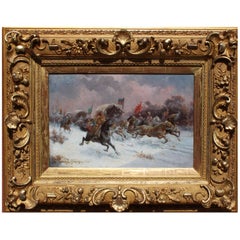
Adolf Constantin Baumgartner Stoiloff Oil on Board Cossacks Warriors on Horsback
By Adolf Constantin Baumgartner-Stoiloff
Located in Los Angeles, CA
Adolf Constantin Baumgartner Stoiloff (Austrian/Russian, 1850-1924) a fine oil on board "Charging Cossack Warriors on Horseback" within an ornate giltwood frame, circa 1890 Born in 1850 in Linz (Austria) Stoiloff died in Vienna in 1924. According to a research of Russian literature, he studied in the 1880s at St. Petersburg Imperial Academy of Fine Arts. He was very well known for his Russian horse...
Category

Late 19th Century Russian Baroque Antique Canvas Decorative Art

Materials

Gesso, Canvas, Giltwood, Paint

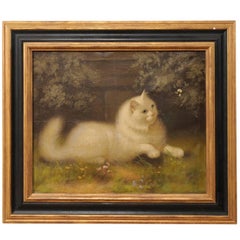
Oil Painting of White Persian Cat by Well Known Hungarian Artist Beno Boleradsky
By Beno Boleradsky
Located in Atlanta, GA
A vintage oil painting of a white Persian cat. This sweet painting, by Beno Boleradsky (a well-known Hungarian artists), depicts a playful white cat, wit...
Category

20th Century Hungarian Canvas Decorative Art

Materials

Canvas, Wood, Paint

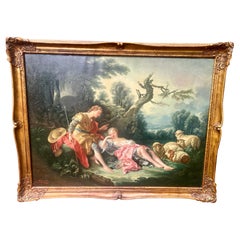
After ‘Spring’ of the Four Seasons Series by Francois Boucher circa 1755
Located in Nashville, TN
A later and large execution of ‘Spring ‘ of the Four Seasons series by Francois Boucher in the Rococo taste , the originals around 1755. (and for Madame Pompadour). A Shepherd conver...
Category

Early 20th Century French Rococo Canvas Decorative Art

Materials

Canvas

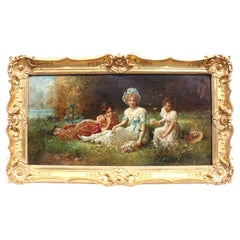
Hans Zatzka 'Austrian, 1859-1945' a Very Fine Oil on Canvas "Spring Beauties"
Located in Los Angeles, CA
Hans Zatzka (Austrian, 1859-1945) a very fine and charming oil on canvas "Spring Beauties", depicting three young maidens picking flowers by a lake. The three young girls sitting, kneeling and laying on a grassy area of the forest, her wicker basket filled with the freshly picked flowers, the middle one wearing a bonnet and a straw-hat laying on the ground behind with butterflies flying by, within a gilt-wood and gesso carved frame. Signed (l/r): H. Zatzka. Circa: 1890-1900's, Hans Zatzka (Austrian, 1859-1945) was a well known and regarded Austrian fantasy artist whose most popular and valuable works depicted figures of young maidens with angels, floral and other cheerful and warm scenes, including Orientalist themes. In the past thirty years alone, the high quality and detail of his beautiful paintings has caught the attention of International collectors and art dealers alike, creating a highly sought after market and demand for his instantly recognizable body of work. In the late 19th and early 20th century, many of Zazka's charming works were photographed for commercial and collectable postcards. Though no information about his works being exhibited in museums is currently available, most of Zatzka's paintings are in private collections and, in the past century, very few of them have become available on the open market. At the young age of eighteen Zatzka joined Austria's Academy of Fine Arts under the leadership of Professor Blaas. For his fine early works, in 1880 he received The Golden Fügermedal award. Zatzka, like many other artists of the era, traveled around Europe working and selling his art and, in one of his many trips to Italy, he developed a special interest in Religious themes, decorating churches with frescos as well as painting several religious scenes of Madonna's and Child, Saints, Angels and others. In 1885 Zatzka was commissioned to paint "The Naiad of Baden" a ceiling fresco at Kurhaus Baden. Most of Zatzka's income came from his work in religious art and special church commissions. Numerous leading art dealers from around the world that specialize in late 19th and early 20th century European genre paintings have come to the conclusion that the painter signing his works Bernard Zatzka, Joseph Bernard or J. Bernard is almost certainly the artist Hans Zatzka. The consensus seems quite plausible when comparing works known to have been executed by Hans Zatzka together with similar works displaying the signature; Joseph Bernard, J. Bernard or Bernard Zatzka. Lohengrin refers to the knight of the swan, hero of German versions of a legend widely known in variant forms from the European Middle Ages onward. It seems to bear some relation to the northern European folktale of “The Seven Swans,” but its actual origin is uncertain. It is also a character in German Arthurian literature. The son of Parzival (Percival), he is a knight of the Holy Grail sent in a boat pulled by swans...
Category

Late 19th Century Austrian Belle Époque Antique Canvas Decorative Art

Materials

Canvas, Giltwood

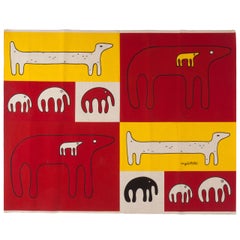
Angelo Testa Print on Canvas
Located in Pawtucket, RI
Whimsical print on canvas by noted artist and textile designer Angelo Testa. Large print depicting dogs and other biomorphic shaped animals.
Category

1940s American Mid-Century Modern Vintage Canvas Decorative Art

Materials

Canvas

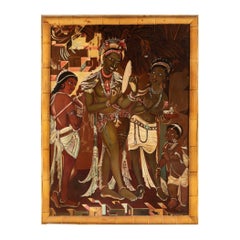
Mid-20th Century Indian School Painting "Musicians" Oil on Canvas
Located in Marbella, ES
Indian school of the mid-20th century. "Musicians". Oil on canvas. With perforation. Size: 174 x 110 cm; 150 x 112.5 cm (frame). Formally, the piece follows the language of Indi...
Category

Mid-20th Century Indian Canvas Decorative Art

Materials

Canvas

French Still Life Floral Painting by Charles Franzini d'Issoncourt
Located in Miami, FL
Magnificent French Floral Oil Painting from Paris Universal Exposition in 1900. This captivating 19th-century still life oil painting by the award-winning French artist Charles Henr...
Category

Early 1900s French Baroque Antique Canvas Decorative Art

Materials

Canvas, Paint, Giltwood

After Raffaello Sanzio 1483-1520 Raphael La Madonna della Seggiola Oil on Canvas
Located in Los Angeles, CA
A fine Italian 19th century oil painting on canvas "La Madonna della Seggiola" after Raphael (Raffaello Sanzio da Urbino 1483-1520) The circular canvas depicting a seated Madonna holding an infant Jesus Christ next to a child Saint John the Baptist, all within a massive carved gilt wood and gesso frame (all high quality gilt is original) which is identical to the frame on Raphael's original artwork. This painting is a 19th Century copy of Raphael's Madonna della Seggiola painted in 1514 and currently exhibited and part of the permanent collection at the Palazzo Pitti, Galleria Palatina, Florence, Italy. The bodies of the Virgin, Christ, and the boy Baptist fill the whole picture. The tender, natural looking embrace of the Mother and Child, and the harmonious grouping of the figures in the round, have made this one of Raphael's most popular Madonnas. The isolated chair leg is reminiscent of papal furniture, which has led to the assumption that Leo X himself commissioned the painting, circa 1890-1900. Subject: Religious painting Measures: Canvas height: 29 1/4 inches (74.3 cm) Canvas width: 29 1/4 inches (74.3 cm) Painting diameter: 28 1/4 inches (71.8 cm) Frame height: 57 7/8 inches (147 cm) Frame width: 45 1/2 inches (115.6 cm) Frame depth: 5 1/8 inches (13 cm).   Raffaello Sanzio da Urbino (Italian, March 28 or April 6, 1483 - April 6, 1520), known as Raphael, was an Italian painter and architect of the High Renaissance. His work is admired for its clarity of form, ease of composition, and visual achievement of the Neoplatonic ideal of human grandeur. Together with Michelangelo and Leonardo da Vinci, he forms the traditional trinity of great masters of that period. Raphael was enormously productive, running an unusually large workshop and, despite his death at 37, leaving a large body of work. Many of his works are found in the Vatican Palace, where the frescoed Raphael Rooms were the central, and the largest, work of his career. The best known work is The School of Athens in the Vatican Stanza della Segnatura. After his early years in Rome much of his work was executed by his workshop from his drawings, with considerable loss of quality. He was extremely influential in his lifetime, though outside Rome his work was mostly known from his collaborative printmaking. After his death, the influence of his great rival Michelangelo was more widespread until the 18th and 19th centuries, when Raphael's more serene and harmonious qualities were again regarded as the highest models. His career falls naturally into three phases and three styles, first described by Giorgio Vasari: his early years in Umbria, then a period of about four years (1504–1508) absorbing the artistic traditions of Florence, followed by his last hectic and triumphant twelve years in Rome, working for two Popes and their close associates. Raphael was born in the small but artistically significant central Italian city of Urbino in the Marche region, where his father Giovanni Santi was court painter to the Duke. The reputation of the court had been established by Federico III da Montefeltro, a highly successful condottiere who had been created Duke of Urbino by the Pope - Urbino formed part of the Papal States - and who died the year before Raphael was born. The emphasis of Federico's court was rather more literary than artistic, but Giovanni Santi was a poet of sorts as well as a painter, and had written a rhymed chronicle of the life of Federico, and both wrote the texts and produced the decor for masque-like court entertainments. His poem to Federico shows him as keen to show awareness of the most advanced North Italian painters, and Early Netherlandish artists as well. In the very small court of Urbino he was probably more integrated into the central circle of the ruling family than most court painters. Federico was succeeded by his son Guidobaldo da Montefeltro, who married Elisabetta Gonzaga, daughter of the ruler of Mantua, the most brilliant of the smaller Italian courts for both music and the visual arts. Under them, the court continued as a centre for literary culture. Growing up in the circle of this small court gave Raphael the excellent manners and social skills stressed by Vasari. Court life in Urbino at just after this period was to become set as the model of the virtues of the Italian humanist court through Baldassare Castiglione's depiction of it in his classic work The Book of the Courtier, published in 1528. Castiglione moved to Urbino in 1504, when Raphael was no longer based there but frequently visited, and they became good friends. He became close to other regular visitors to the court: Pietro Bibbiena and Pietro Bembo, both later cardinals, were already becoming well known as writers, and would be in Rome during Raphael's period there. Raphael mixed easily in the highest circles throughout his life, one of the factors that tended to give a misleading impression of effortlessness to his career. He did not receive a full humanistic education however; it is unclear how easily he read Latin. Early Life and Works His mother Màgia died in 1491 when Raphael was eight, followed on August 1, 1494 by his father, who had already remarried. Raphael was thus orphaned at eleven; his formal guardian became his only paternal uncle Bartolomeo, a priest, who subsequently engaged in litigation with his stepmother. He probably continued to live with his stepmother when not staying as an apprentice with a master. He had already shown talent, according to Vasari, who says that Raphael had been "a great help to his father". A self-portrait drawing from his teenage years shows his precocity. His father's workshop continued and, probably together with his stepmother, Raphael evidently played a part in managing it from a very early age. In Urbino, he came into contact with the works of Paolo Uccello, previously the court painter (d. 1475), and Luca Signorelli, who until 1498 was based in nearby Città di Castello. According to Vasari, his father placed him in the workshop of the Umbrian master Pietro Perugino as an apprentice "despite the tears of his mother". The evidence of an apprenticeship comes only from Vasari and another source, and has been disputed—eight was very early for an apprenticeship to begin. An alternative theory is that he received at least some training from Timoteo Viti, who acted as court painter in Urbino from 1495.Most modern historians agree that Raphael at least worked as an assistant to Perugino from around 1500; the influence of Perugino on Raphael's early work is very clear: "probably no other pupil of genius has ever absorbed so much of his master's teaching as Raphael did", according to Wölfflin. Vasari wrote that it was impossible to distinguish between their hands at this period, but many modern art historians claim to do better and detect his hand in specific areas of works by Perugino or his workshop. Apart from stylistic closeness, their techniques are very similar as well, for example having paint applied thickly, using an oil varnish medium, in shadows and darker garments, but very thinly on flesh areas. An excess of resin in the varnish often causes cracking of areas of paint in the works of both masters. The Perugino workshop was active in both Perugia and Florence, perhaps maintaining two permanent branches. Raphael is described as a "master", that is to say fully trained, in December 1500. His first documented work was the Baronci altarpiece for the church of Saint Nicholas of Tolentino in Città di Castello, a town halfway between Perugia and Urbino. Evangelista da Pian di Meleto, who had worked for his father, was also named in the commission. It was commissioned in 1500 and finished in 1501; now only some cut sections and a preparatory drawing remain. In the following years he painted works for other churches there, including the Mond Crucifixion (about 1503) and the Brera Wedding of the Virgin (1504), and for Perugia, such as the Oddi Altarpiece. He very probably also visited Florence in this period. These are large works, some in fresco, where Raphael confidently marshals his compositions in the somewhat static style of Perugino. He also painted many small and exquisite cabinet paintings in these years, probably mostly for the connoisseurs in the Urbino court, like the Three Graces and St. Michael, and he began to paint Madonnas and portraits. In 1502 he went to Siena at the invitation of another pupil of Perugino, Pinturicchio, "being a friend of Raphael and knowing him to be a draughtsman of the highest quality" to help with the cartoons, and very likely the designs, for a fresco series in the Piccolomini Library in Siena Cathedral. He was evidently already much in demand even at this early stage in his career. Influence of Florence Raphael led a "nomadic" life, working in various centres in Northern Italy, but spent a good deal of time in Florence, perhaps from about 1504. Although there is traditional reference to a "Florentine period...
Category

19th Century Italian Baroque Antique Canvas Decorative Art

Materials

Gesso, Canvas, Wood

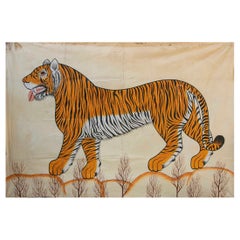
1970s Jaime Parlade Designer Hand Painting "Tiger" Oil on Canvas
Located in Marbella, ES
1970s Jaime Parlade designer hand painting "Tiger" oil on canvas.
Category

Late 20th Century Indian Canvas Decorative Art

Materials

Canvas

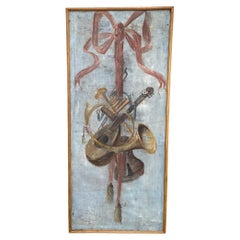
18th Century Italian Trompe L'Oeil Painting On Canvas Of Musical Instruments
Located in Stamford, CT
Lovely 18th century Italian framed painting on canvas of a group of musical instruments, including a French horn, lute, violin and pan flute, all hanging from a ribbon with a big bow...
Category

Late 18th Century Italian Neoclassical Antique Canvas Decorative Art

Materials

Canvas, Oak

Swedish 1780s Floral Painting in the Manner of Paulus Theodorus van Brussel
Located in Atlanta, GA
A Swedish still life floral oil on canvas painting from the late 18th century, painted in the manner of Dutch artist Paulus Theodorus van Brussel. This exquisite Swedish floral paint...
Category

Late 18th Century Swedish Rococo Antique Canvas Decorative Art

Materials

Canvas, Paint

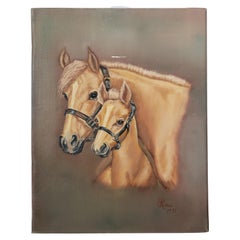
Mother and Colt Horse Painting
Located in Los Angeles, CA
Mother and Colt Horse painting. Signed and dated 1971.
Category

20th Century American Adirondack Canvas Decorative Art

Materials

Canvas, Paint

Mother and Colt Horse Painting
$716 Sale Price
20% Off
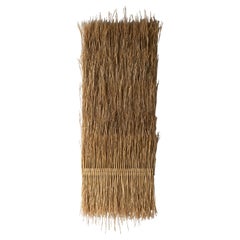
Arko Wall Art 5, Contemporary Art Craft Rice Straw
By ARKO
Located in Shibuya-ku, Tokyo
Hand-sewed rice straw art by Arko. Title: Composition Accelerando #01 This work has the feelings of contemporary, tribal art, contemporary craft art, ...
Category

2010s Japanese Organic Modern Canvas Decorative Art

Materials

Canvas, Thread, Straw

Painting by Hermann Baisch
By Hermann Baisch
Located in Belmont, MA
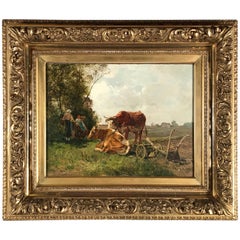
Painting by Hermann Baisch (Dresden 1846-Karlsruhe 1894), “Farmers taking a Rest”, oil on canvas Hermann Baisch was a German painter and illustrator ...
Category

1880s German Barbizon School Antique Canvas Decorative Art

Materials

Canvas

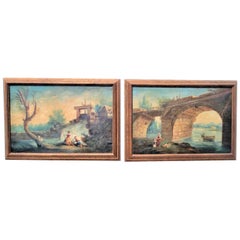
Pair of Rococo Style Landscapes After Francois Boucher Oils on Canvas
Located in Nashville, TN
Early to Mid-19th century. Very colorful. The Bridge The Mill Craquelure throughout as visible in photos. Later frames. Later frames (mid-20th century), typical wear Sight of ca...
Category

Early 19th Century Italian Baroque Antique Canvas Decorative Art

Materials

Canvas

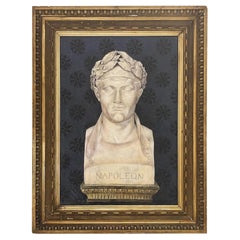
20th Century French Oil Painting of Napoleon Bonaparte as Emperor by S. Chapin
By Chapin
Located in West Palm Beach, FL
A vintage French oil on canvas painting of Napoleon Bonaparte as Emperor in a hand carved original gilded wooden frame, painted by S. Chapin in good condition. The wall décor art pie...
Category

Early 20th Century French Empire Canvas Decorative Art

Materials

Canvas, Giltwood

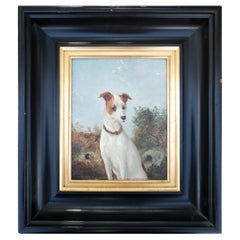
19th Century English Oil on Canvas Hunting Dog Portrait Painting w/ Frame
Located in Marbella, ES
Antique 19th century English oil on canvas hunting dog portrait painting with black and giltwood frame. Dimensions including frame: 43 x 38 x 8cm.
Category

19th Century English Antique Canvas Decorative Art

Materials

Canvas

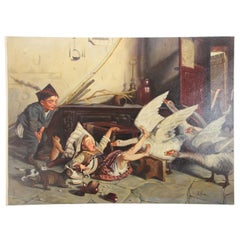
19th Century Style Painting of Children Playing with Geese
Located in Moreno Valley, CA
Countryside children from the late 19th century playing and attacked by geese on a farm. 19th century style oil on canvas style painting. Stretched on a piece of wood frame. Left sid...
Category

Late 20th Century Unknown Country Canvas Decorative Art

Materials

Canvas

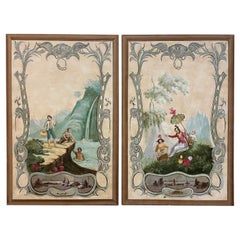
Pair of Large Painted French Pastoral Canvas Panels
Located in West Palm Beach, FL
Decorative pair of French Pastoral painted panels on wood stretchers.
Category

20th Century French Canvas Decorative Art

Materials

Canvas

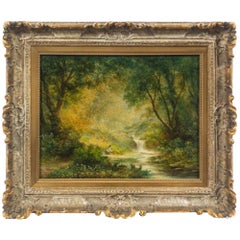
Continental School 'Late 19th century' Forest Landscape with Figure
Located in Buchanan, MI
Continental school (Late 19th century) Forest landscape with figure Oil on canvas Dimensions: 15 3/4 x 19 3/4 inches.
Category

19th Century Antique Canvas Decorative Art

Materials

Canvas, Giltwood

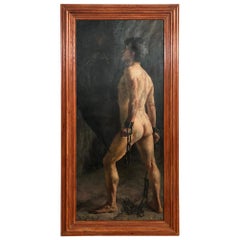
Large Scale Italian Oil on Canvas Painting
Located in Round Top, TX
An outstanding and grand scale oil on canvas painting of a nude male. Entitled "La Vittoria Della Verita' Sull'Insidia" - "The Victory Of Truth Over The Trap"..... Expertly executed ...
Category

Early 20th Century Italian Canvas Decorative Art

Materials

Canvas

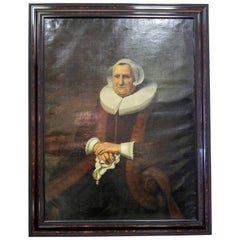
19th century Dutch Portrait Oil on Canvas
By Ferdinand Bol 1
Located in Savannah, GA
Early copy of Dutch painting. Oil on canvas in antique style wooden frame. “Elisabeth Bas (1571, in Kampen – 2 August 1649 in Amsterdam) was a figure in the Dutch Republic. She was the wife of Jochem Hendrickszoon Swartenhont, an admiral in the navy of the Dutch Republic and military hero. The portrait is now in the Rijksmuseum Amsterdam, where it is known as Elisabeth Bas and attributed to Ferdinand Bol...
Category

Early 19th Century Dutch Baroque Antique Canvas Decorative Art

Materials

Canvas, Wood

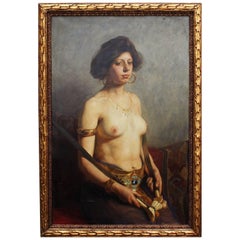
Karl Viktor Mayr, Austrian Oil on Canvas "An Exotic Nude Girl"
By Karl Viktor Mayr
Located in Los Angeles, CA
Karl Viktor Mayr (Austrian, 1882-1974) a very fine Austrian oil on canvas "An Exotic Nude Girl" depicting a young semi-nude woman, revealing her breast...
Category

Early 1900s Austrian Folk Art Antique Canvas Decorative Art

Materials

Canvas, Giltwood

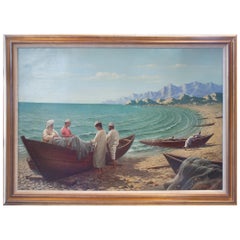
Antonio Fuertes 1986, Oil on Canvas Painting of Moroccan Fishermen
Located in Marbella, ES
Antonio Fuertes 1986, oil on canvas painting of Moroccan fishermen.
Category

Late 20th Century European Canvas Decorative Art

Materials

Canvas

Still Thinking About These?

All Recently Viewed