Tempera Paintings

to
117
349
196
182
83
127
Overall Width
to
Overall Height
to
23
24
401
490
3
2
17
23
37
38
54
49
37
45
10
220
144
125
33
27
12
9
9
5
5
2
476
396
60
392
244
125
119
109
81
74
72
52
43
41
32
31
30
30
29
23
23
20
19
1,361
160,103
96,228
75,678
71,796
28
24
22
22
17
370
182
466
404
Medium: Tempera
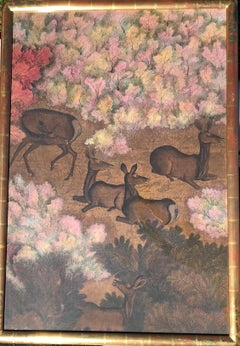
Thai Illuminated Manuscript Leaves, 19th C.

Thai Illuminated Manuscript Leaves, 19th C.

Located in Astoria, NY

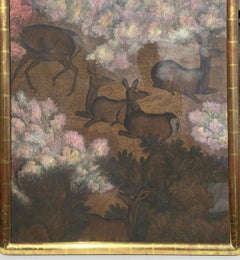
Thai Illuminated Manuscript Leaves, 19th century, ink and tempera on paper, five folded leaves together in a giltwood frame. Image: 51.5" H x 16.25" W; frame: 67.5" H x 36.5" W. Prov...

Category

19th Century Other Art Style Tempera Paintings

Materials

Paper, Ink, Tempera

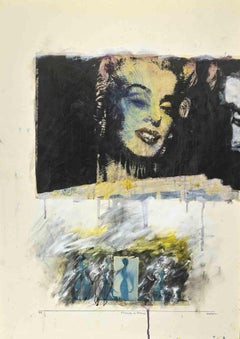
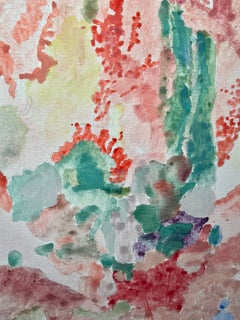
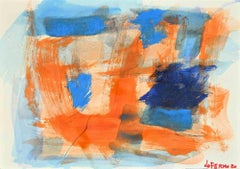
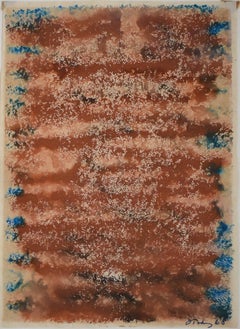
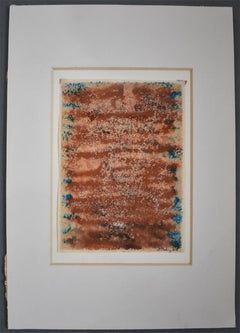
Abstract Composition - Painting by Lucian - 20th century

Abstract Composition - Painting by Lucian - 20th century

Located in Roma, IT

Abstract Composition is an Original tempera and watercolor on Paper applied on wood realized by Lucian in the 20th century. Hand-signed , also the stamp of Atelier Montmartre.

Category

Late 20th Century Modern Tempera Paintings

Materials

Tempera, Paper

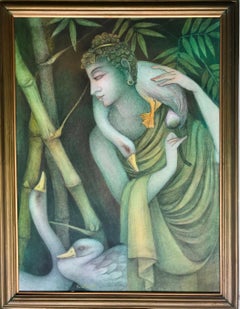
Krishna, Mythology, Acrylic, Tempera, Green, Yellow by Indian Artist "In Stock"

Krishna, Mythology, Acrylic, Tempera, Green, Yellow by Indian Artist "In Stock"

By Aditya Basak

Located in Kolkata, West Bengal

Aditya Basak - Untitled - 36 x 30 inches (unframed size) Acrylic & Tempera on Canvas ** This work will be shipped in a roll form. "Through the medium of the fantasy, Basak probes...

Category

2010s Conceptual Tempera Paintings

Materials

Canvas, Acrylic, Tempera

Letter to Hieronymus Bosch - XX century, Colourful figurative painting

Letter to Hieronymus Bosch - XX century, Colourful figurative painting

By Adam Niemczyc 1

Located in Warsaw, PL

ADAM NIEMCZYC (born in 1914) Painter, graphic artist, poet, novelist. He practiced easel, mural painting and book illustration. Since 1958 he participated in numerous exhibitions in ...

Category

1980s Other Art Style Tempera Paintings

Materials

Tempera, Gouache, Board

Cuernavaca Procession 1935, Figurative Landscape

Cuernavaca Procession 1935, Figurative Landscape

By Goldie Anita Powell Harding

Located in Soquel, CA

Early work of figures moving along the street in Cuernavaca to the Cathedral in Mexico by Goldie Anita Powell Harding (American, 1892-1974). Circa 1935. Tempera on Masonite. In a per...

Category

1930s American Impressionist Tempera Paintings

Materials

Masonite, Tempera

Autumn Harvest Still Life #2

Autumn Harvest Still Life #2

Located in Soquel, CA

Wonderful autumnal still life with pumpkin, apples and violets by an unknown artist (American, 20th Century). Signed illegibly ("Barbara ...") and dated "Spring 1990" lower edge. Pre...

Category

1990s American Impressionist Tempera Paintings

Materials

Tempera, Archival Paper

Large-Scale Tropical Secret Garden, Mid-Century Botanical Diptych with Waterfall

Large-Scale Tropical Secret Garden, Mid-Century Botanical Diptych with Waterfall

Located in Soquel, CA

Large-Scale Tropical Secret Garden, Mid-Century Botanical Diptych with Waterfall A stunning large-scale, substantial diptych depicting a post-impressionistic tropical nocturnal garden scene by an unknown artist, c.1960s. This diptych is comprised of two pieces; the first panel depicts a group of blooming orchids surrounded by glossy tropical leaves, big boulders, and trees, under a blue night sky. The lush garden continues onto the second panel, which reveals a gorgeous waterfall. In the style of Paul Gauguin's Tahitian period. Unsigned. Measurements: This diptych (2 panels) measures in total: 48"H x 100.50"W. Orchid panel measures 48"H x 52.50"W. Waterfall panel...

Category

1960s Post-Impressionist Tempera Paintings

Materials

Masonite, Tempera

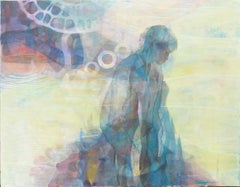
Floating Woman - Paint by Sergio Barletta - 1974

Floating Woman - Paint by Sergio Barletta - 1974

By Sergio Barletta

Located in Roma, IT

Floating Woman is a painting artwork, realized by Sergio Barletta in 1974. Tempera and white lead on cardboard. Hand-signed on the lower margin. Good conditions with foxing on t...

Category

1990s Contemporary Tempera Paintings

Materials

Tempera, Cardboard

1941 Impressionist Pikes Peak by Charles Bunnell, Autumn Colorado Landscape

1941 Impressionist Pikes Peak by Charles Bunnell, Autumn Colorado Landscape

By Charles Ragland Bunnell

Located in Denver, CO

This exceptional 1941 egg tempera landscape by renowned Colorado modernist Charles Bunnell (1897–1968) captures the grandeur of the Front Range in peak autumn color. A snow-capped Pi...

Category

1930s American Impressionist Tempera Paintings

Materials

Tempera

"Motion, " Victor Arnautoff, San Francisco Lighthouse, World's Fair WPA Painting

"Motion, " Victor Arnautoff, San Francisco Lighthouse, World's Fair WPA Painting

By Victor Michail Arnautoff

Located in New York, NY

Victor Mikhail Arnautoff (1896 - 1979) Motion (Mile Rocks Lighthouse), San Francisco, 1939 Oil and tempera on board 60 x 40 inches Signed lower left Provenance: The artist California School of Fine Arts (CFSA) John & Lynne Bolen Fine Arts, Huntington Beach, California Exhibited: New York, World's Fair, Exhibition of Contemporary American Art, 1939. San Francisco Museum of Art, 1962. Literature: American Art from the New York World's Fair 1939, Poughkeepsie, 1987, no. 11, p. 41, illustrated. Robert W. Cherny, Victor Arnautoff and the Politics of Art, Urbana, Illinois, 2017. The lighthouse in the distance is the Mile Rocks Lighthouse in San Francisco Bay, built in 1906 after many shipwrecks made the lighthouse necessary. In 1962 the lighthouse was reduced in size to make room for a helipad. Arnautoff was the son of a Russian Orthodox priest. He showed a talent for art from an early age and hoped to study art after graduating from the gymnasium in Mariupol. With the outbreak of World War I, he enrolled in the Yelizavetgrad Cavalry School. He went on to hold military leadership positions in the army of Nicholas II and the White Siberian army. With the defeat of the Whites in Siberia, he crossed into northeastern China and surrendered his weapons. Arnautoff remained in China for five years. He again tried to pursue art, but was impoverished and took a position training the cavalry of the warlord Zhang Zuolin. He met and married Lydia Blonsky and they had two sons, Michael and Vasily. In November 1925 Arnautoff went to San Francisco on a student visa to study at the California School of Fine Arts. There he studied sculpture with Edgar Walter and painting with several instructors. His wife and children joined him, and they all continued to Mexico in 1929, where, on Ralph Stackpole...

Category

1930s American Realist Tempera Paintings

Materials

Canvas, Oil, Tempera

The Magician oil and tempera painting by Julio de Diego

The Magician oil and tempera painting by Julio de Diego

By Julio de Diego

Located in Hudson, NY

Julio De Diego’s Atomic Series paintings made an extraordinary statement regarding the shock and fear that accompanied the dawn of the nuclear age. In the artist’s own words, “Scientists were working secretly to develop formidable powers taken from the mysterious depths of the earth - with the power to make the earth useless! Then, the EXPLOSION! . . . we entered the Atomic Age, and from there the neo-Atomic war begins. Explosions fell everywhere and man kept on fighting, discovering he could fight without flesh.” To execute these works, De Diego developed a technique of using tempera underpainting before applying layer upon layer of pigmented oil glazes. The result is paintings with surfaces which were described as “bonelike” in quality. The forms seem to float freely, creating a three-dimensional visual effect. In the 1954 book The Modern Renaissance in American Art, author Ralph Pearson summarizes the series as “a fantastic interpretation of a weighty theme. Perhaps it is well to let fantasy and irony appear to lighten the devastating impact. By inverse action, they may in fact increase its weight.” Exhibited 1964 Marion Koogler McNay Art Institute, San Antonio, Texas This work retains its original frame which measures 54" x 42" x 2" About this artist: Julio De Diego crafted a formidable persona within the artistic developments and political struggles of his time. The artist characterized his own work as “lyrical,” explaining, “through the years, the surrealists, the social-conscious painters and the others tried to adopt me, but I went my own way, good, bad or indifferent.” [1] His independence manifested early in life when de Diego left his parent’s home in Madrid, Spain, in adolescence following his father’s attempts to curtail his artistic aspirations. At the age of fifteen he held his first exhibition, set up within a gambling casino. He managed to acquire an apprenticeship in a studio producing scenery for Madrid’s operas, but moved from behind the curtains to the stage, trying his hand at acting and performing as an extra in the Ballet Russes’ Petrouchka with Nijinsky. He spent several years in the Spanish army, including a six-month stretch in the Rif War of 1920 in Northern Africa. His artistic career pushed ahead as he set off for Paris and became familiar with modernism’s forays into abstraction, surrealism, and cubism. The artist arrived in the U.S. in 1924 and settled in Chicago two years later. He established himself with a commission for the decoration of two chapels in St. Gregory’s Church. He also worked in fashion illustration, designed magazine covers and developed a popular laundry bag for the Hotel Sherman. De Diego began exhibiting through the Art Institute of Chicago in 1929, and participated in the annual Chicago Artists Exhibitions, Annual American Exhibitions, and International Water Color Exhibitions. He held a solo exhibition at the Art Institute of Chicago in the summer of 1935. Though the artist’s career was advancing, his family life had deteriorated. In 1932 his first marriage dissolved, and the couple’s young daughter Kiriki was sent to live with friend Paul Hoffman. De Diego continued to develop his artistic vocabulary with a growing interest in Mexican art. He traveled throughout the country acquainting himself with the works of muralists such as Carlos Merida, and also began a collection of small native artifacts...

Category

1940s American Modern Tempera Paintings

Materials

Masonite, Oil, Tempera

The game. 1973, paper, tempera, 19x18 cm

The game. 1973, paper, tempera, 19x18 cm

By Atis Ievins

Located in Riga, LV

Touch 1974, photo screen printing, 53x49 cm Atis Ievins (1946) The exhibition by artist Atis Ieviņš reminds the very origins of serigraphy technique in Latvian art in the time of t...

Category

1970s Contemporary Tempera Paintings

Materials

Paper, Tempera

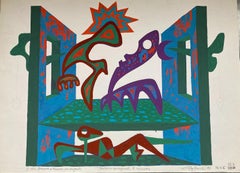
The Room of Metamorphosis - Tempera by Leo Guida - 1998

The Room of Metamorphosis - Tempera by Leo Guida - 1998

By Leo Guida

Located in Roma, IT

The Room of Metamorphosis is an original contemporary artwork realized in 1998 by the italian artist Leo Guida (1992-2017). Original mixed colored tempera. Study of colors for the ...

Category

1990s Abstract Tempera Paintings

Materials

Tempera

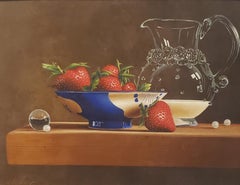
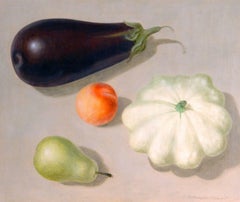
Summer Peaches

Summer Peaches

Located in Fairfield, CT

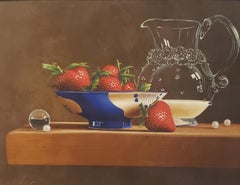
Botanical subjects are my primary inspiration. I find immense joy in capturing the colors and textures of nature through still-life settings. Exhibiting them at the George Billis Gal...

Category

2010s Realist Tempera Paintings

Materials

Egg Tempera

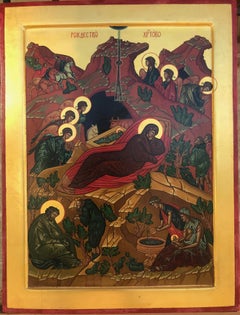
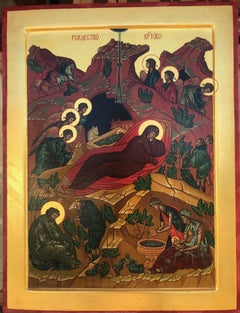
"Birth of Christ" after a Russian icon of the 15th century. Oliver Samsinger

"Birth of Christ" after a Russian icon of the 15th century. Oliver Samsinger

Located in Segovia, ES

"Birth of Christ", after a Russian icon of the 15th century. Tempera and gold leaves on gesso, wooden board. Dimensions: (H) 68 x (W) 52 x (D) 4 cm. The Nativity of Christ. This icon, created by the Viennese artist Oliver...

Category

1990s Byzantine Tempera Paintings

Materials

Gold Leaf

Mother With Child:  Contemporary Figurative Oil painting

Mother With Child: Contemporary Figurative Oil painting

By Sax Berlin

Located in Brecon, Powys

Few artists have mastered the use of pigments in the way that Sax Berlin has and his delicate touch with them imbues this painting with warmth and love. The dark inked lines surround...

Category

Early 2000s Contemporary Tempera Paintings

Materials

Ink, Oil, Egg Tempera

Portrait of Blue Boy

Portrait of Blue Boy

By Anastasia Aureum

Located in London, London

original hand painted one of a kind hand signed will be shipped FRAMED 'Like Henri Matisse and Italian Renaissance painters like Giotto, I experiment with the vibrant pow...

Category

21st Century and Contemporary Vienna Secession Tempera Paintings

Materials

Canvas, Cotton Canvas, Oil, Acrylic, Tempera

Kibbutz Abstract Jerusalem Nightscape Israeli Tempera Collage Painting Judaica

Kibbutz Abstract Jerusalem Nightscape Israeli Tempera Collage Painting Judaica

Located in Surfside, FL

Abstract Expressionist cityscape of Old City of Jerusalem in moody blues and gold. Yitzhak Greenfield, painter, born 1932, Brooklyn, New York His focus is on the heavenly and the terrestrial Jerusalem; on the Hebrew alphabet; and on central themes in Jewish tradition and culture. He deals with the tension between figurative and abstract. Education 1946 Educational Alliance Art School, New York City, with Abba Ostrowsky, Chaim Gross, and Louis Lozowick. 1948 Thomas Jefferson High School, Brooklyn, New York, Art 1953 Drawing and Drawing Wall Murals,Seminar at Givat Haviva with P. Pelzig, Yohanan Simon, and Naftali Bezem. 1960 Printmaking with the artist and printmaker Borin, Venice, Italy 1979-1981 Morris Blackburn Print Workshop, New York City, U.S.A. Teaching Art Kibbutz Gal-On and Gat 1961-1963 Arts, regional school at Mateh-Yehuda Regional school, Mate-Yehuda Anglican school, Jerusalem 1965–70 Bet Ha'am, Popular University Outreach Program, Jerusalem Ruth Youth Wing, Israel Museum, Jerusalem Shira Mushkin: Majestic scenes in blue, gold and indigo, radiating spheres and grand expanses hover above architectural forms and clusters of Hebrew letters, revealing dreamlike realities. These are the creations of the artist Yitzhak Greenfield who works in watercolor and acrylic paints layered with collages of painted papers, discarded book materials, and fragments of his own prints. Applying parts of broken furniture, clock springs, iron locks and keys, the artist forms assemblages that hint at familiar settings, resonating the past. For Brooklyn born, Israeli artist Yitzhak Greenfield, these visions are the essence of the Jerusalem landscape, inspired by the city’s ever-changing magical scenery. For generations, Jerusalem has been a focal point for the Jewish people. It is the center of Jewish life, faith, hope, history, and consciousness. Jerusalem holds a particular significance for Greenfield, who moved to Ein Kerem, Jerusalem over fifty years ago, after living on a kibbutz. Greenfield is a Jerusalem artist, and he remarks: “Living and working in Jerusalem is a special journey for me. My works are visionary landscapes, which are reconstructions of Jerusalem, not always relating to specific sites.” The artist has always been intrigued by the historical and dynamic nature of the city, as he constantly explores his own connection to the traditional and spiritual forms of Judaism. Greenfield’s art is linked to Jewish and Israeli history and symbols, such as the Hebrew letters, Jewish amulets, and the Ten Sephirot (Kabbalah emanations), containing aesthetic qualities of the material and the spiritual. Working in a distinctive modernist method, Greenfield’s artwork lends itself to rich possibilities of expression. The exhibition Yitzhak Greenfield: Exploring Jerusalem comprises three main series from the artist’s career, which span over the course of many years and continue to this day; Jerusalem Visions, Jerusalem Assemblages, and Landscape and Meditation on the Hebrew Letter. These artworks portray timeless dream-landscapes of Jerusalem. The hidden secrets of the city are locked away in assemblage constructions, and prints depicting Hebrew letters illuminate into mystical meanings. The spectator travels along with Greenfield through his creations, exploring Jerusalem and experiencing a spiritual and living Judaism, in which the artist constantly searches for the expression of his cultural and spiritual legacy as he reconstructs Jerusalem. 1966 General Exhibition - Jerusalem Artists' House Artists: Hirszenberg, Samuel Boris Schatz, Lilien, Ephraim Moses, Joseph Budko, Leopold Krakauer, Meir Gur Arie, Jacob Eisenberg, Ben Zvi, Zeev Palombo...

Category

1960s Abstract Expressionist Tempera Paintings

Materials

Mixed Media, Tempera

St. Atomic oil and tempera painting by Julio de Diego

St. Atomic oil and tempera painting by Julio de Diego

By Julio de Diego

Located in Hudson, NY

Julio De Diego’s Atomic Series paintings made an extraordinary statement regarding the shock and fear that accompanied the dawn of the nuclear age. In the artist’s own words, “Scientists were working secretly to develop formidable powers taken from the mysterious depths of the earth - with the power to make the earth useless! Then, the EXPLOSION! . . . we entered the Atomic Age, and from there the neo-Atomic war begins. Explosions fell everywhere and man kept on fighting, discovering he could fight without flesh.” To execute these works, De Diego developed a technique of using tempera underpainting before applying layer upon layer of pigmented oil glazes. The result is paintings with surfaces which were described as “bonelike” in quality. The forms seem to float freely, creating a three-dimensional visual effect. In the 1954 book The Modern Renaissance in American Art, author Ralph Pearson summarizes the series as “a fantastic interpretation of a weighty theme. Perhaps it is well to let fantasy and irony appear to lighten the devastating impact. By inverse action, they may in fact increase its weight.” Exhibited 1950 University of Illinois at Urbana "Contemporary American Painting" 1964 Marion Koogler McNay Art Institute, San Antonio, Texas This work retains its original frame which measures 54" x 36" x 2". About this artist: Julio De Diego crafted a formidable persona within the artistic developments and political struggles of his time. The artist characterized his own work as “lyrical,” explaining, “through the years, the surrealists, the social-conscious painters and the others tried to adopt me, but I went my own way, good, bad or indifferent.” [1] His independence manifested early in life when de Diego left his parent’s home in Madrid, Spain, in adolescence following his father’s attempts to curtail his artistic aspirations. At the age of fifteen he held his first exhibition, set up within a gambling casino. He managed to acquire an apprenticeship in a studio producing scenery for Madrid’s operas, but moved from behind the curtains to the stage, trying his hand at acting and performing as an extra in the Ballet Russes’ Petrouchka with Nijinsky. He spent several years in the Spanish army, including a six-month stretch in the Rif War of 1920 in Northern Africa. His artistic career pushed ahead as he set off for Paris and became familiar with modernism’s forays into abstraction, surrealism, and cubism. The artist arrived in the U.S. in 1924 and settled in Chicago two years later. He established himself with a commission for the decoration of two chapels in St. Gregory’s Church. He also worked in fashion illustration, designed magazine covers and developed a popular laundry bag for the Hotel Sherman. De Diego began exhibiting through the Art Institute of Chicago in 1929, and participated in the annual Chicago Artists Exhibitions, Annual American Exhibitions, and International Water Color Exhibitions. He held a solo exhibition at the Art Institute of Chicago in the summer of 1935. Though the artist’s career was advancing, his family life had deteriorated. In 1932 his first marriage dissolved, and the couple’s young daughter Kiriki was sent to live with friend Paul Hoffman. De Diego continued to develop his artistic vocabulary with a growing interest in Mexican art. He traveled throughout the country acquainting himself with the works of muralists such as Carlos Merida, and also began a collection of small native artifacts...

Category

1940s American Modern Tempera Paintings

Materials

Masonite, Oil, Tempera

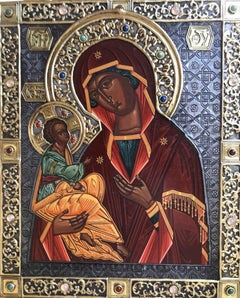
Saint Nicolas in the style of Russian icons of the 18th century. With Oklad

Saint Nicolas in the style of Russian icons of the 18th century. With Oklad

Located in Segovia, ES

Icono of Saint Nicolas in the style of Russian icons of the 18th century. Egg tempera and gesso on wood, covered by a metal oklad made by the artist himself. The oklad, in principle, were made to cover damaged parts of highly revered ancient icons...

Category

1990s Byzantine Tempera Paintings

Materials

Gesso, Wood, Egg Tempera

Baptism of Christ
Baptism of Christ

Baptism of Christ

Located in New York, NY

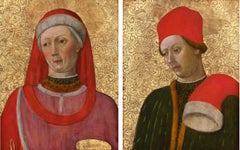
Provenance: Achillito Chiesa, Milan Luigi Albrighi, Florence, by 1 July 1955 with Marcello and Carlo Sestieri, Rome, 1969 Private Collection, Connecticut Exhibited: Mount Holyoke College Art Museum, South Hadley, Massachusetts (on loan, 2012) Literature: Carlo Volpe, “Alcune restituzioni al Maestro dei Santi Quirico e Giulitta,” in Quaderni di Emblema 2: Miscellanea di Bonsanti, Fahy, Francisci, Gardner, Mortari, Sestieri, Volpe, Zeri, Bergamo, 1973, pp. 19-20, fig. 18, as by the Master of Saints Quiricus and Julitta (now identified as Borghese di Piero). This fine predella panel depicting the Baptism...

Category

15th Century and Earlier Old Masters Tempera Paintings

Materials

Tempera, Wood Panel
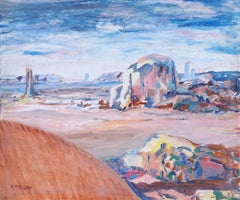
Abstract Composition

Abstract Composition

Located in Sheffield, MA

Andre Lanskoy Russian, 1902-1976 Abstract Composition Pastel and tempera on paper 18 ¼ by 25 ¾ in, w/ frame 26 by 33 ½ in Signed lower right Inventory Number: 01777 Andre Lanskoy ...

Category

Mid-20th Century Abstract Tempera Paintings

Materials

Paper, Pastel, Tempera

7.21 (Abstract Expressionism painting)

7.21 (Abstract Expressionism painting)

By Jill Moser

Located in London, GB

Casein and ink on paper - Unframed Jill Moser is an American abstract artist whose work explores the intersection of “painting, writing and the animated image.” Her work is in the...

Category

21st Century and Contemporary Abstract Tempera Paintings

Materials

Paper, Ink, Casein

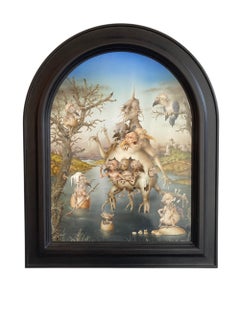
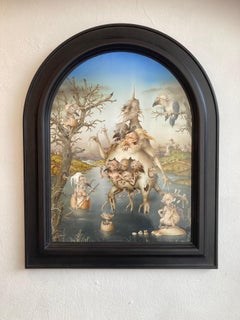
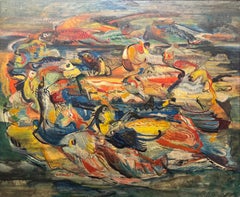
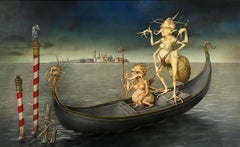
Les Oiseaux du Loch The Birds of Loch Surrealist Creature Landscape Contemporary

Les Oiseaux du Loch The Birds of Loch Surrealist Creature Landscape Contemporary

By Gérard Willemenot

Located in Utrecht, NL

Les Oiseaux du Loch The Birds of Loch Surrealist Creature Landscape Contemporary Gérard Willemenot was born on February 11, 1943. World War II and his father's deportation to Mautha...

Category

21st Century and Contemporary Surrealist Tempera Paintings

Materials

Tempera, Panel
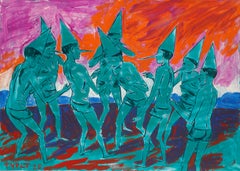
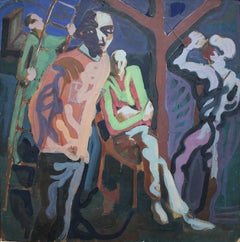
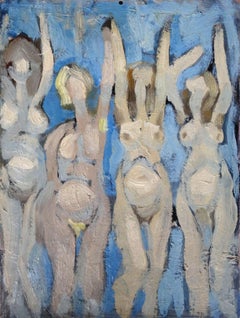
In work/Four figures. Double-sided, cardboard, tempera, 56x47 cm

In work/Four figures. Double-sided, cardboard, tempera, 56x47 cm

By Vladimir Glushenkov

Located in Riga, LV

In work/Four figures. Double-sided, cardboard, tempera, 56x47 cm Vladimir Borisovich Glushenkov (May 21, 1948, Riga - December 26, 2009, Riga.) - painter, graphic artist, poet, translator. Born in Riga in a Russian-Polish-German family. Vladimir Glushenkov...

Category

1970s Surrealist Tempera Paintings

Materials

Mixed Media, Cardboard, Tempera

Sea Shore

Sea Shore

By Susanne Zuehlke

Located in New York, NY

"Sea Shore" (2024) by Susanne Zuehlke (b. 1962) is a tranquil and evocative painting that captures the essence of a coastal landscape. The canvas features a harmonious blend of blues...

Category

2010s Abstract Expressionist Tempera Paintings

Materials

Canvas, Egg Tempera

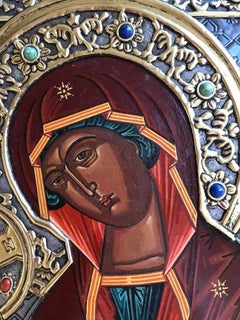
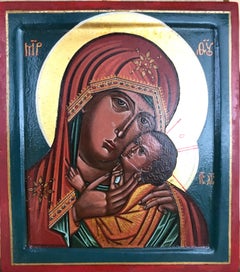
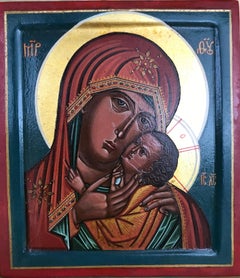
Icon of  The Holy Virgin of  Tenderness (Korsunskaya).

Icon of The Holy Virgin of Tenderness (Korsunskaya).

Located in Segovia, ES

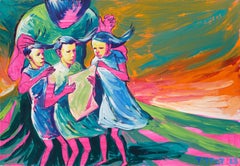
Icon of THE KORSUN VIRGIN (KORSUNSKAYA), egg tempera, and gold leave on gesso, over a piece of wood. Dimensions: (H) 26.5 x (W) 23.5 x (D) 3 cm. Also called The Holy Virgin of Tenderness, represents the Mother of God and infant Christ in a tender cheek-to-cheek embrace. The Virgin's hands tenderly surround the head and hands of the Child Jesus while he takes the cloak of the Mother of God with his left hand and plays with the fingers of his right hand, between his mother's neck and his own. Two very old icons, from the 12th and 13th Centuries, painted on the same theme, are respectively in the Uspenskii Cathedral in Moscow and in the Russian Museum in St. Petersburg. This is how the artist sums up the technique used by him to create the icon: “The aim of these steps is to create a durable painting. The icon is eternal. The first step is to choose a support, traditionally made of wood, from the center of the trunk to avoid warping it. For this purpose, two hardwood bolts were often used on the back to give the picture panel additional stability. Often a frame is milled out. Then the image carrier is sanded smooth and now 12 or 14 thin layers of gesso are applied and sanded smooth as well. Then the preliminary drawing is applied and the drawing board is prepared with a special preparation called bolus. This bolus can be polished to a high gloss. Afterward, the gold leaf is "shot" with special brushes. It dries up within a few hours and can now be polished with agate. Gold leaf is real 24-carat gold. Now, the actual process of painting begins. Egg tempera is made fresh from egg yolk, water and a little vinegar. This is used to prepare the color pigments. Tempera painting is done in numerous layers from dark to light. When the icon is finished, it is left to dry for a few months and varnished with a special varnish called Olifa made from boiled linseed oil and other ingredients”. ABOUT THE ARTIST Oliver Samsinger...
Category

1990s Byzantine Tempera Paintings

Materials

Gold Leaf

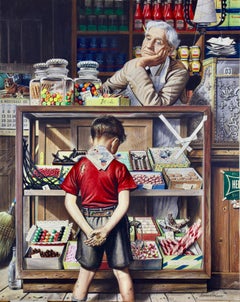
Frozen Custard
Frozen Custard

Frozen Custard

By Reginald Marsh

Located in New York, NY

Reginald Marsh, an urban Realist of the 1930s and 40s, chronicled New York’s working-class life with exuberant, documentary-style paintings that focused on crowds rather than individ...

Category

20th Century Tempera Paintings

Materials

Tempera, Board

Tempera paintings for sale on 1stDibs.

Find a wide variety of authentic Tempera paintings available on 1stDibs. While artists have worked in this medium across a range of time periods, art made with this material during the 21st Century is especially popular. If you’re looking to add paintings created with this material to introduce a provocative pop of color and texture to an otherwise neutral space in your home, the works available on 1stDibs include elements of blue, orange, green, yellow and other colors. There are many well-known artists whose body of work includes ceramic sculptures. Popular artists on 1stDibs associated with pieces like this include Kory Twaddle, Giorgio Lo Fermo, Anastasia Kurakina, and Sergio Barletta. Frequently made by artists working in the Contemporary, Abstract, all of these pieces for sale are unique and many will draw the attention of guests in your home. Not every interior allows for large Tempera paintings, so small editions measuring 0.1 inches across are also available