Cubist Prints and Multiples

CUBIST STYLE

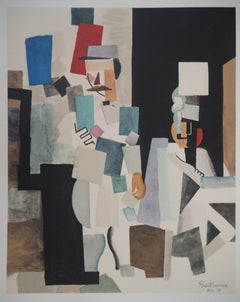
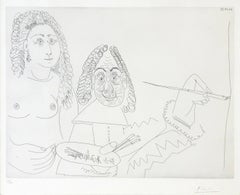
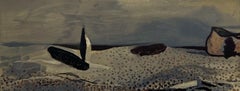
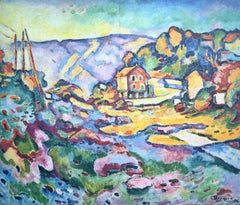
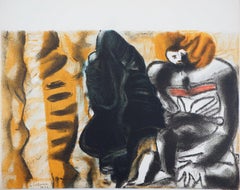
Inspired by the nontraditional ways Postimpressionists like Paul Cézanne and Georges Seurat depicted the world, Pablo Picasso and Georges Braque pioneered an even more abstract style in which reality was fragmented into flat, geometric forms. Cubism majorly influenced 20th-century Western art as it radically broke with the adherence to composition and linear perspectives that dated back to the Renaissance. Its watershed moments are considered Picasso’s 1907 Les Demoiselles d’Avignon, in which nude figures are fractured into angular shapes, and Georges Braque’s 1908 painting show, which prompted a critic to describe his visual reductions as “cubes.”

Although Cubism was a revolutionary art movement for European culture, it was informed by African masks and other tribal art. Its artists, which included Fernand Léger, Alexander Archipenko, Marcel Duchamp, Juan Gris and Jean Metzinger, experimented with compressing space and playing with the tension between solid and void forms in their work. While their subjects were often conventional, such as still lifes, nudes and landscapes, they were distorted without any illusion of realism.

Cubist art evolved through different distinct phases. In Analytic Cubism, from 1908 to 1912, figures or objects were “analyzed” into pieces that were reassembled in paintings and sculptures, as if presenting the same subject matter from many perspectives at once. The palette was usually monochromatic and muted, giving attention to the overlapping planes. Synthetic Cubism, dating from 1912 to 1914, moved to brighter colors and a further flattening of images. This unmooring from formal ideas of art would shape numerous styles that followed, from Dada to Surrealism.

Find a collection of authentic Cubist paintings, prints and multiples, sculptures and more art on 1stDibs.

to
316
316
131
162
61
21
Overall Width
to
Overall Height
to
21,265
18,933
10,759
6,133
5,289
2,722
1,624
1,465
1,383
899
898
437
349
193
95
29
25
20
14
685
31
3
28
40
40
33
147
178
67
44
28
448
228
9
327
176
168
151
136
109
80
72
28
26
26
25
23
21
17
17
15
15
14
13
456
132
82
40
34
121
153
526
171
Style: Cubist
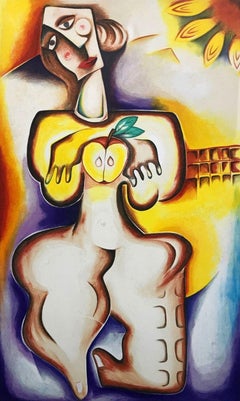
Human Faces Abstract Collection - HFC 29 - Limited Edition Textured Canvas Print
Located in Los Angeles, CA
Faces Abstract Collection by Irena Orlov Introducing "Abstract Cubist Portrait - Human Faces Abstract Collection - HFC 29" - Limited Edition Textured Canvas Print "Abstract Cubist ...
Category

2010s Cubist Prints and Multiples

Materials

Canvas, Paint, Cotton Canvas, Mixed Media, Acrylic, Digital, Inkjet, Giclée

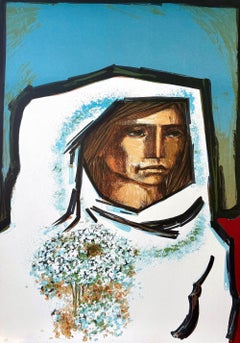
LA NOVIA Original Lithograph, Bride Portrait, Woman with Flowers, Cubist Style
Located in Union City, NJ
LA NOVIA by the South American artist Jorge Dumas, is an original hand drawn lithograph hand proofed and printed using traditional lithography techniques on archival printmaking pape...
Category

1970s Cubist Prints and Multiples

Materials

Lithograph

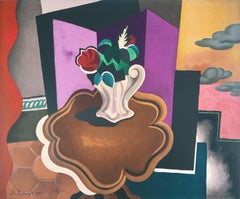
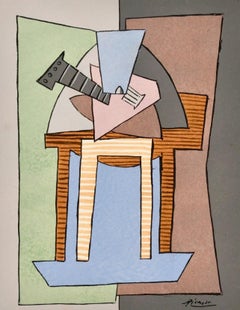
Roger de La Fresnaye, The Louis-Philippe Table, 1968 (after)
Located in Southampton, NY
This exquisite lithograph after Roger de La Fresnaye (1885–1925), titled La table Louis-Philippe (The Louis-Philippe Table), from the album Roger de la Fresnaye, III, Collection Pier...
Category

1960s Cubist Prints and Multiples

Materials

Lithograph

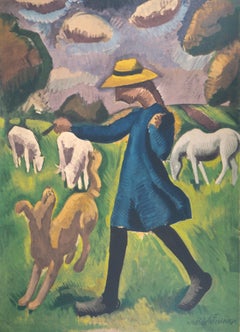
Roger de La Fresnaye, Shepherdess, 1968 (after)
Located in Southampton, NY
This exquisite lithograph after Roger de La Fresnaye (1885–1925), titled Gardeuse de moutons (Shepherdess), from the album Roger de la Fresnaye, III, Collection Pierre Levy, 1968, or...
Category

1960s Cubist Prints and Multiples

Materials

Lithograph

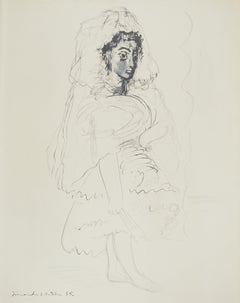
Pablo Picasso, Jacqueline in Spanish Dress, from The Double Flute, 1967 (after)
Located in Southampton, NY
This exquisite lithograph and pochoir after Pablo Picasso (1881–1973), titled Jacqueline en Espagnole (Jacqueline in Spanish Dress), from the folio Picasso, La flute double, 16 Dessi...
Category

1960s Cubist Prints and Multiples

Materials

Lithograph, Stencil

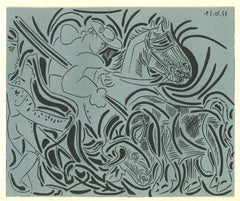
La Pique - Linocut After Pablo Picasso - 1962
Located in Roma, IT
La Pique is a contemporary artwork realized after Pablo Picasso (1881-1973). Color linocut realized in smaller size after a linocut by Pablo Picasso of 1959. Passepartout included...
Category

1960s Cubist Prints and Multiples

Materials

Linocut

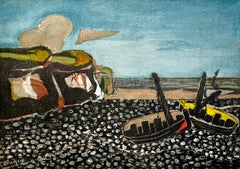
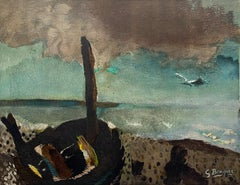
Georges Braque, The Blue Boats, from Varengeville, 1968 (after)
Located in Southampton, NY
This exquisite lithograph after Georges Braque (1882–1963), titled Les barques bleues (The Blue Boats), originates from the 1968 folio Varengeville, published by Maeght Editeur, Pari...
Category

1960s Cubist Prints and Multiples

Materials

Lithograph

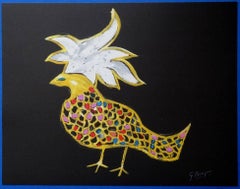
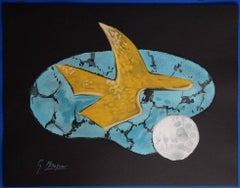
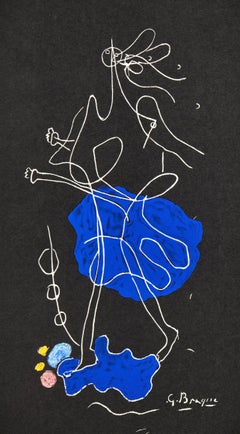
Phoenix : Bird in Fire - Lithograph - Limited /399 copies
Located in Paris, IDF
after Georges BRAQUE Phoenix : Bird in Fire Lithograph (Art-Litho workshop) Printed signature in the plate On Arches vellum 18 x 23" (58 x 45 cm) INFORMATION: Limited edition of 3...
Category

Late 20th Century Cubist Prints and Multiples

Materials

Lithograph

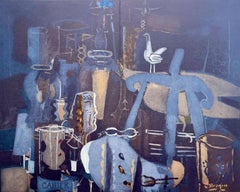
Georges Braque, The Studio, from Derriere le Miroir, 1964 (after)
Located in Southampton, NY
This exquisite lithograph after Georges Braque (1882–1963), titled L’Atelier (The Studio), originates from the 1964 folio Derriere le Miroir, Nos. 144–145–146, L’Hommage a Georges Br...
Category

1960s Cubist Prints and Multiples

Materials

Lithograph

'Descente de Croix' (Descent from the Cross) — 1920s French Cubism
Located in Myrtle Beach, SC
Albert Gleizes, 'Descente de Croix', color pochoir, 1928, edition c. 50. Signed and dated in pencil. A fine, painterly impression, with fresh colors, on heavy, cream wove paper; the full sheet with margins (3 to 4 inches), in very good condition. The publisher's ink stamp 'EDITIONS MOLY-SABATA' beneath the image, lower left. Matted to museum standards, unframed. Image size 12 x 14 inches (305 x 356 mm); sheet size 18 x 22 inches (457 x 559 mm). ABOUT THE IMAGE After the 1927 painting 'Descente de Croix', one of three religious-themed works that Gleizes developed as preliminaries for murals at the church at Serrières, France, the project was terminated at its final phase, and Gleizes commissioned master printer Robert Pouyaud to create prints of the paintings, closely overseeing the production. ABOUT THE MEDIUM Pochoir is a refined stencil-based technique employed to create multiples or to add color to prints produced in other mediums. Characterized by its crisp lines and rich color, the print-making process was most popular from the late 19th century through the 1930s, with its center of activity in Paris. The pochoir process began with the analysis of an image’s composition, including color tones and densities. The numerous stencils (made of aluminum, copper, or zinc) necessary to create a complete image were then designed and hand-cut by the 'découpeur.' The 'coloristes' applied watercolor or gouache pigments through the stencils, skillfully employing a variety of different brushes and methods of paint application to achieve the desired depth of color and textural and tonal nuance. The pochoir process, by its handcrafted methodology, resulted in the finished work producing the effect of an original painting, and in fact, each print was unique. ABOUT THE ARTIST Albert Gleizes (1881-1953), born in Paris, France, was a pioneering figure in the development of abstract art and one of the leading proponents of Cubism. His contributions to the art world extended beyond his paintings; he was also a prolific writer and theoretician, advocating for a new approach to art that emphasized the geometric abstraction of form and a departure from representational traditions. Gleizes initially studied painting at the Académie Julian and the École des Beaux-Arts in Paris, where he was exposed to the academic conventions of the time. However, his artistic vision was profoundly influenced by encounters with avant-garde movements, including Fauvism and the work of Paul Cézanne. These influences led Gleizes to experiment with form and color, gradually moving away from traditional representation toward a more abstract and geometric style. After completing his secondary schooling, Gleizes spent four years in the French army and then began pursuing a career as a painter, primarily doing landscapes. Initially influenced by the Impressionists, he was only twenty-one years of age when his work titled ‘La Seine à Asnières’ was exhibited at the Société Nationale des Beaux-Arts in 1902. The following year, he was part of the first Salon d'Automne and soon came under the influence of Fernand Léger, Robert Delaunay, Jean Metzinger, and Henri Le Fauconnier. In 1907, Gleizes and some of his friends pursued the idea of creating a self-supporting community of artists that would allow them to develop their art free of any commercial concerns. For nearly a year, Gleizes  , with other painters, poets, musicians, and writers, lived at a large house in Créteil, but a lack of funds forced them to give up their facility in early 1908, and Gleizes moved temporarily into La Ruche, the artist commune in the Montparnasse Quarter of Paris. In the early 1910s, Gleizes became associated with the Cubist movement, which was spearheaded by artists such as Pablo Picasso and Georges Braque...
Category

1920s Cubist Prints and Multiples

Materials

Stencil

Pablo Picasso, Guitarist, from Oeuvres 1920-1926 (after)
Located in Southampton, NY
This exquisite lithograph and pochoir after Pablo Picasso (1881–1973), titled Guitariste (Guitarist), from the album, Picasso, Oeuvres 1920-1926, 1926, originates from the 1926 edition published and printed by Editions des Cahiers d'Art, Paris, under the direction of Christian Zervos, Editeur, Paris, December 10, 1926. Guitariste (Guitarist) captures Picasso’s evolving exploration of form, movement, and emotion during the mid-1920s—a pivotal period in which he redefined the relationship between classical representation and modern abstraction. With its bold contouring, stylized anatomy, and rhythmic color balance, the composition embodies the harmony between structural precision and sensual fluidity that characterized Picasso’s work in this era. Executed as a lithograph and pochoir on velin paper, this work measures 11 x 8.75 inches. Signed in the plate and unnumbered as issued. The edition exemplifies the refined craftsmanship of Editions des Cahiers d'Art and the technical excellence of Parisian printmaking in the interwar period. Artwork Details: Artist: After Pablo Picasso (1881–1973) Title: Guitariste (Guitarist), from the album, Picasso, Oeuvres 1920-1926, 1926 Medium: Lithograph and pochoir on velin paper Dimensions: 11 x 8.75 inches (27.94 x 22.23 cm) Inscription: Signed in the plate and unnumbered as issued Date: 1926 Publisher: Editions des Cahiers d'Art, Paris, under the direction of Christian Zervos, Editeur, Paris Printer: Ducros & Colas, Paris Catalogue raisonne references: Cramer, Patrick. Pablo Picasso, The Illustrated Books: Catalogue Raisonne. Patrick Cramer, 1983, illustration 15; Bloch, Georges. Pablo Picasso: Catalogue of the Printed Graphic Work 1904–1967. Kornfeld & Klipstein, 1968, illustration 56 Condition: Well preserved, consistent with age and medium Provenance: From the album, Picasso, Oeuvres 1920-1926, published and printed by Editions des Cahiers d'Art, Paris, under the direction of Christian Zervos, Editeur, Paris, 1926 Notes: Excerpted from the album (translated from French), This volume was completed to be printed by the Ducros & Colas printing house, 7, rue Croulebarbe in Paris, for the Editions des Cahiers d'Art, on December 10th MCMXXVI, DCC numbered examples, VI on Japon Imperial with an etching by Picasso, numbered from I to VI, L examples on paper by papier de Hollande, Van Gelder, with an etching by Picasso, numbered from VII to LVI, DCXL examples on velin, numbered from LVII to DCC, plus II examples intended for legal deposit. About the Publication: The album Picasso, Oeuvres 1920-1926 was issued in 1926 by Editions des Cahiers d'Art under the direction of Christian Zervos, one of the most influential editors, critics, and publishers of 20th-century modernism. Conceived as both a visual and intellectual tribute to Pablo Picasso’s mastery during a crucial transitional period, the volume presents a series of lithographs and pochoirs that chronicle his stylistic evolution from synthetic Cubism toward a renewed engagement with the human figure. Published in conjunction with the legendary Cahiers d'Art journal, the edition reflects Zervos’s vision of uniting scholarship, craftsmanship, and artistic authenticity in the modern book arts. Each composition was executed by the master printers Ducros & Colas and colored using the pochoir technique, faithfully translating the tonal subtleties and compositional balance of Picasso’s original drawings and gouaches. Completed on December 10, 1926, the edition comprised DCC examples—VI on Japon Imperial, L on Hollande Van Gelder, and DCXL on velin paper, plus II copies reserved for legal deposit—each numbered and printed to exacting standards. The volume stands as one of the earliest major Cahiers d'Art collaborations with Picasso, preceding the monumental Catalogue Raisonne des Oeuvres de Picasso that Zervos would later dedicate his life to producing. Today, Picasso, Oeuvres 1920-1926 remains a cornerstone of interwar art publishing, representing the confluence of avant-garde innovation, technical excellence, and intellectual rigor that defined the Parisian art world of the 1920s. About the Artist: Pablo Picasso (1881–1973) was a Spanish painter, sculptor, printmaker, and ceramicist whose extraordinary vision revolutionized modern art and defined the visual language of the 20th century. A child prodigy from Malaga, Spain, Picasso's career spanned more than seven decades and encompassed an astonishing range of styles and innovations—from the melancholic Blue and romantic Rose periods to his pioneering invention of Cubism with Georges Braque, which shattered conventional notions of perspective and form. Influenced by the bold expressiveness of El Greco, the structure of Cezanne, and the vitality of African and Iberian sculpture, Picasso became a central figure of the Paris avant-garde, working in creative dialogue with contemporaries such as Henri Matisse, Alexander Calder, Alberto Giacometti, Salvador Dali, Joan Miro, Wassily Kandinsky, Marcel Duchamp, and Man Ray. His insatiable experimentation extended across painting, drawing, printmaking, ceramics, and sculpture, forever expanding the boundaries of artistic expression. A master of reinvention, Picasso profoundly shaped generations of artists who followed—from Andy Warhol, Roy Lichtenstein, David Hockney, and Jean-Michel Basquiat to Jeff Koons and Banksy—cementing his status as a timeless cultural icon whose works remain among the most sought after worldwide. His landmark painting Les Femmes d'Alger (Version O) achieved a record-breaking sale of 179,365,000 USD at Christie's, New York, on May 11, 2015, affirming Picasso's enduring legacy as one of the most influential and valuable artists in history. Pablo Picasso Guitariste (Guitarist), Picasso Oeuvres 1920-1926, Picasso Zervos Cahiers d'Art, Picasso pochoir...
Category

1920s Cubist Prints and Multiples

Materials

Lithograph, Stencil

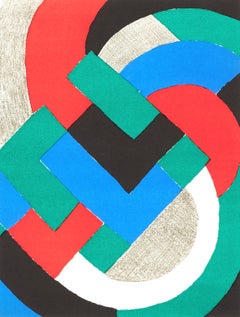
Sonia Delaunay, Color Rhythms, from XXe Siecle, 1969
Located in Southampton, NY
This exquisite lithograph by Sonia Delaunay (1885–1979), titled Rythmes couleur (Color Rhythms), from the album XXe Siecle, Nouvelle serie, XXXIe Annee No. 32, Juin 1969, originates ...
Category

1960s Cubist Prints and Multiples

Materials

Lithograph

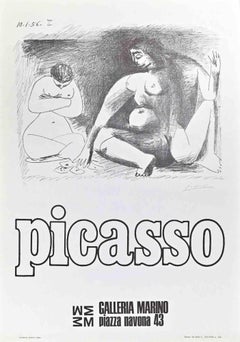
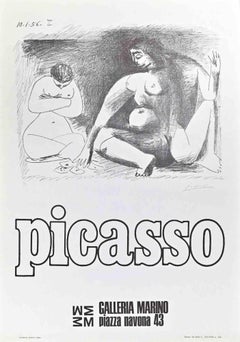
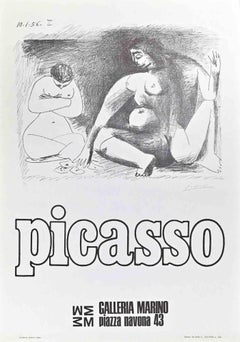
Picasso Poster Exhibition after Pablo Picasso - 1976
Located in Roma, IT
Picasso Poster is an offset  poster about an exhibition of Pablo Picasso's graphic works at Marino Gallery in Rome Piazza Navona. Limited edition of 1.000. Signed in the plate. Ex...
Category

1970s Cubist Prints and Multiples

Materials

Offset

National Day - Lithograph, Mourlot
Located in Paris, IDF
Roger de la Fresnaye National Day Stone lithograph after a painting Printed in Mourlot workshop Printed signature in the plate On Arches vellum 65 x 50 cm (c. 26 x 20 inch) Excelle...
Category

1960s Cubist Prints and Multiples

Materials

Lithograph

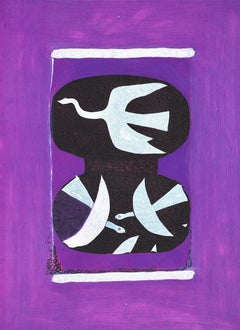
Georges Braque, The Black Bird and the White Bird, Derriere le Miroir (after)
Located in Southampton, NY
This exquisite lithograph after Georges Braque (1882–1963), titled L’Oiseau noir et l’Oiseau blanc (The Black Bird and the White Bird), originates from the 1964 folio Derriere le Mir...
Category

1960s Cubist Prints and Multiples

Materials

Lithograph

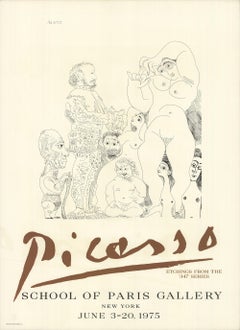
Picasso 'School of Paris Gallery' 1975 Etching Vintage
Located in Brooklyn, NY
This poster was created for the Picasso at the School of Paris Gallery exhibition held from June 3-20, 1975. It features a combination of etching and lithography, with the etching te...
Category

1970s Cubist Prints and Multiples

Materials

Etching

Picasso Poster Exhibition after Pablo Picasso - 1976
Located in Roma, IT
Picasso Poster is an offset  poster about an exhibition of Pablo Picasso's graphic works at Marino Gallery in Rome Piazza Navona. Limited edition of 1.000. Signed in the plate. Ex...
Category

1970s Cubist Prints and Multiples

Materials

Offset

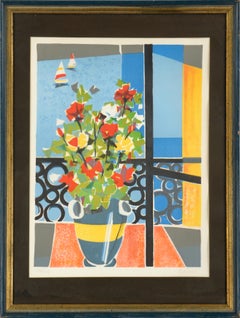
Flowers by the Window, Mid Century Cubist Still-Life Limited Edition Lithograph
By Fausto Maria Casotti
Located in Soquel, CA
Vibrant cubist still life, a hand signed limited edition lithograph print by Fausto Maria Casotti (also known as Cauri) (Italian, b. 1924). Bold colors and blocky shapes characterize...
Category

Mid-20th Century Cubist Prints and Multiples

Materials

Paper, Ink

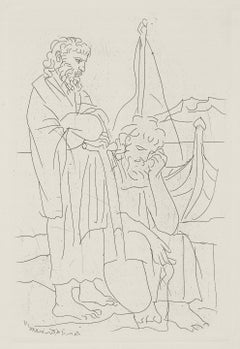
Deux vieux au bord de la mer avec une pelle et une barque (B. 267-272; C. 24)
Located in Southampton, NY
Etching on vélin de Rives BFK paper. Paper Size: 11.5 x 9 inches. Inscription: Unsigned and unnumbered, as issued. Notes: From the album, Lysistrata, 1934. Published by The Limited E...
Category

1930s Cubist Prints and Multiples

Materials

Etching

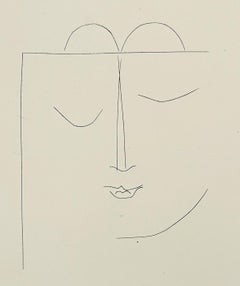
Half-Square Head of a Woman with Closed Eyes and Full Lips (Plate XXVII), Carmen
Located in Washington, DC
Artist: Pablo Picasso Title: Half-Square Head of a Woman with Closed Eyes and Full Lips (Plate XXVII) Portfolio: Carmen Medium: Original etching on Montval wove paper Year: 1949 Edit...
Category

1940s Cubist Prints and Multiples

Materials

Etching

Human Faces Abstract Collection - HFC 9 - Limited Edition Textured Canvas Print
Located in Los Angeles, CA
Human Faces Abstract Collection - HFC 9 - Limited Edition Textured Canvas Print Faces Abstract Collection by Irena Orlov Introducing "Abstract Cubist Portrait - Human Faces Abstrac...
Category

2010s Cubist Prints and Multiples

Materials

Canvas, Paint, Cotton Canvas, Mixed Media, Acrylic, Digital, Inkjet, Giclée
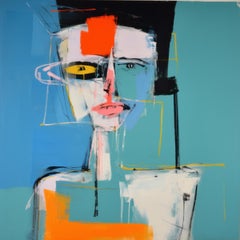
Georges Braque, Seaside, from Varengeville, 1968 (after)
Located in Southampton, NY
This exquisite lithograph after Georges Braque (1882–1963), titled Bord de mer (Seaside), originates from the 1968 folio Varengeville, published by Maeght Editeur, Paris, and printed...
Category

1960s Cubist Prints and Multiples

Materials

Lithograph

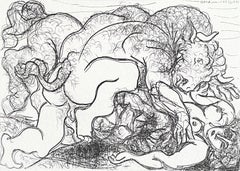
Picasso, Minotaure attaquant une Amazone (after)
Located in Fairfield, CT
Artist: After Pablo Picasso (1881-1973) Title: Minotaure attaquant une Amazone (after Bloch 195) Year: 1992 Medium: Reproduced from the original edition using the grain Autotype half...
Category

1990s Cubist Prints and Multiples

Materials

Lithograph

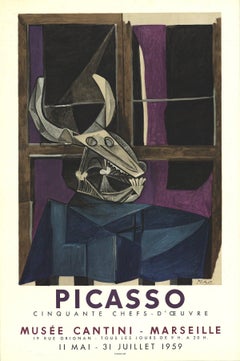
Picasso 'Musee Cantini' 1959- Lithograph Vintage
Located in Brooklyn, NY
The Crâne de Bœuf poster was designed by Pablo Picasso for an exhibition of his work held at the Musée Cantini in Marseille, France, in 1959. The lithography was executed by Henri De...
Category

1950s Cubist Prints and Multiples

Materials

Lithograph

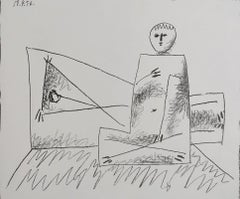
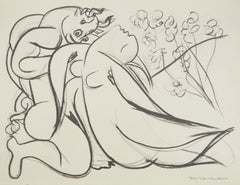
Reclining Man and Crouching Woman
Located in London, GB
PABLO PICASSO 1881-1973 Málaga 1881-1973 Mougins (Spanish) Title: Reclining Man and Crouching Woman Homme couché et femme accroupie, 1956 Technique:...
Category

1950s Cubist Prints and Multiples

Materials

Lithograph

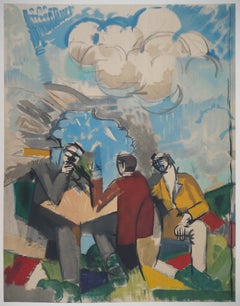
The Card Players - Lithograph, Mourlot
Located in Paris, IDF
Roger de la Fresnaye The Card Players Stone lithograph after a painting Printed in Mourlot workshop On Arches vellum 65 x 50 cm (c. 26 x 20 inch) Ex...
Category

1960s Cubist Prints and Multiples

Materials

Lithograph

THE INTRICACIES OF SELF
Located in Aventura, FL
Lithograph on paper. Hand signed, dated and numbered by the artist. Artwork is in excellent condition. Certificate of authenticity included. Edition of 195. Image size: 27.5 x 16.5 i...
Category

21st Century and Contemporary Cubist Prints and Multiples

Materials

Paper, Lithograph

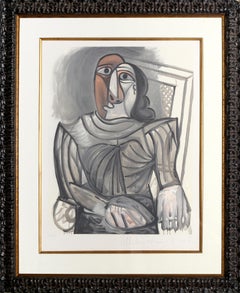
Femme Assise a la Robe Grise, Cubist Lithograph after Pablo Picasso
Located in Long Island City, NY
A lithograph from the Marina Picasso Estate Collection after the Pablo Picasso painting "Femme Assise a la Robe Grise". The original painting was completed in 1943. In the 1970's af...
Category

1980s Cubist Prints and Multiples

Materials

Lithograph

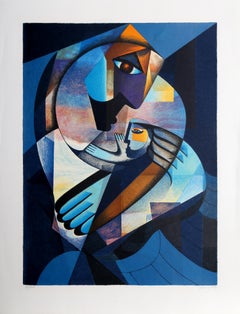
Mother and Child, Cubist Screenprint by Neal Doty
Located in Long Island City, NY
Mother and Child I Neal Doty, American (1941–2016) Date: circa 1979 Screenprint, Signed and numbered in Pencil Edition of 65/300 Image: 32.5 x 24 inches Size: 39 in. x 30 in. (99.06 ...
Category

1970s Cubist Prints and Multiples

Materials

Screen

Fernand Leger, Acrobats and Musicians, from Derriere le Miroir, 1960 (after)
Located in Southampton, NY
This exquisite lithograph after Fernand Leger (1881–1955), titled Acrobates et musiciens (Acrobats and Musicians), originates from the 1960 folio Derriere le Miroir, No. 119, Poetes, peintres, sculpteurs (Poets, Painters, Sculptors), published by Maeght Editeur, Paris, under the direction of Aime Maeght, and printed by Mourlot Freres, Paris. Acrobates et musiciens exemplifies Leger’s dynamic integration of human movement, geometric rhythm, and vibrant color—hallmarks of his post-Cubist visual language. The composition celebrates modern vitality and the harmony of mechanized and organic forms, capturing the artist’s enduring fascination with energy, structure, and the human figure in motion. Executed on velin paper, this lithograph measures 15 x 22 inches (38.1 x 55.9 cm), with centerfold, as issued. Signed in the plate, as issued. The edition reflects the exceptional quality and craftsmanship of the Maeght and Mourlot collaborations, translating Leger’s bold visual vocabulary into a masterful graphic work. Artwork Details: Artist: After Fernand Leger (1881–1955) Title: Acrobates et musiciens (Acrobats and Musicians), from Derriere le Miroir, No. 119, Poetes, peintres, sculpteurs (Poets, Painters, Sculptors), 1960 Medium: Lithograph on velin paper Dimensions: 15 x 22 inches (38.1 x 55.9 cm), with centerfold, as issued Inscription: Signed in the plate, as issued Date: 1960 Publisher: Maeght Editeur, Paris Printer: Mourlot Freres, Paris Catalogue raisonne reference: Leger, Fernand, and Lawrence Saphire. Fernand Leger: The Complete Graphic Work. Blue Moon Press, 1978, illustration 270 Condition: Well preserved, consistent with age and medium Provenance: From the 1960 folio Derriere le Miroir, No. 119, Poetes, peintres, sculpteurs (Poets, Painters, Sculptors), published by Maeght Editeur, Paris About the Publication: Derriere le Miroir (translated as "Behind the Mirror") was an iconic French art periodical published from 1946 to 1982 by Maeght Editeur, one of the most influential art publishers of the 20th century. Founded by Aime Maeght in Paris, the publication was conceived as a visual and literary collaboration between leading modern artists, poets, and critics. Each issue functioned as both an exhibition catalogue and a work of art in itself—featuring original lithographs printed directly from the artists' stones or plates, alongside essays, poems, and critical commentary. Over the course of 36 years, Derriere le Miroir produced more than 250 issues and showcased an extraordinary roster of artists including Henri Matisse, Marc Chagall, Joan Miro, Georges Braque, Alexander Calder, Fernand Leger, Pierre Bonnard, Alberto Giacometti, Eduardo Chillida, Ellsworth Kelly, Francis Bacon, Paul Rebeyrolle, Claude Garache, Antoni Tapies, Bram van Velde, Pierre Alechinsky, Pol Bury, Shusaku Arakawa, and Gerard Titus-Carmel. Printed in the ateliers of Mourlot, Arte, and Imprimerie Moderne du Lion, the periodical set new standards for quality in color lithography, combining fine art printing with elegant typography and poetic text. Beyond its visual brilliance, Derriere le Miroir also became a cultural chronicle of postwar European modernism. Each issue coincided with exhibitions held at Galerie Maeght, providing a collectible and widely accessible record of groundbreaking shows. Its integration of image, text, and philosophy created a dialogue between art and literature that elevated the modern art book to new aesthetic heights. Today, Derriere le Miroir remains one of the most sought-after and historically significant art publications, prized by collectors and scholars alike for its craftsmanship, influence, and its role in defining the visual language of 20th-century modernism. The Maeght Foundation in Saint-Paul-de-Vence continues to honor this legacy through exhibitions and archival preservation of the series, affirming Derriere le Miroir's enduring place in the history of modern art and fine art publishing. About the Artist: Fernand Leger (1881–1955) was a French painter, sculptor, and filmmaker whose bold, mechanized aesthetic made him one of the most influential figures of modern art. A pioneer of Cubism alongside Pablo Picasso and Georges Braque, Leger developed a distinctive style that celebrated modern life through rhythmic forms, tubular figures, and vibrant color contrasts. His compositions combined industrial precision with human warmth, reflecting both the dynamism and optimism of the 20th century. Influenced by and in dialogue with leading artists such as Henri Matisse, Alexander Calder, Marc Chagall, Alberto Giacometti, Salvador Dali, Joan Miro, Wassily Kandinsky, Marcel Duchamp, and Man Ray, Leger bridged the gap between Cubism, abstraction, and the rise of modern design. His work extended into murals, sculpture, and film, uniting fine art with architecture and everyday life. Represented in major museums worldwide—including MoMA, the Guggenheim, the Centre Pompidou, and the Tate—Leger’s art continues to captivate collectors for its clarity, structure, and vitality. The highest price ever paid for a Fernand Leger artwork is approximately $70 million USD, achieved in 2012 at Christie's New York for Contraste de formes (1913). Fernand Leger Acrobates et musiciens, Leger Derriere le Miroir, Leger Maeght Editeur Paris, Leger Mourlot...
Category

1960s Cubist Prints and Multiples

Materials

Lithograph

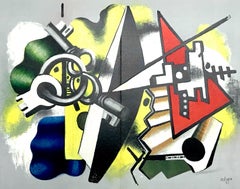
Fernand Leger, Composition with Three Keys, Derriere le miroir, 1955 (after)
Located in Southampton, NY
This exquisite lithograph after Fernand Leger (1881–1955), titled Composition aux trois cles (Composition with Three Keys), from the folio Derriere le miroir, No. 79-81, originates from the 1955 edition published by Maeght Editeur, Paris, and printed by Mourlot Freres, Paris, 1955. This composition exemplifies Leger’s rhythmic balance of color, form, and movement, translating the mechanical vitality of modern life into a harmonious, humanized geometry. Executed as a lithograph on velin paper, this work measures 15 x 22 inches, with centerfold as issued. Signed in the plate and unnumbered as issued. The edition exemplifies the superb craftsmanship of Mourlot Freres, Paris. Artwork Details: Artist: After Fernand Leger (1881–1955) Title: Composition aux trois cles (Composition with Three Keys), from the folio Derriere le miroir, No. 79-81 Medium: Lithograph on velin paper Dimensions: 15 x 22 inches (38.1 x 55.88 cm), with centerfold as issued Inscription: Signed in the plate and unnumbered as issued Date: 1955 Publisher: Maeght Editeur, Paris Printer: Mourlot Freres, Paris Condition: Well preserved, consistent with age and medium Provenance: From the folio Derriere le miroir, No. 79-81, published by Maeght Editeur, Paris; printed by Mourlot Freres, Paris, 1955 About the Publication: Derriere le miroir (Behind the Mirror) was one of the most important art publications of the 20th century, created and published by Maeght Editeur in Paris from 1946 to 1982. Founded by the visionary art dealer and publisher Aime Maeght, the series served as both an exhibition catalogue and a work of art in its own right, uniting original lithographs by leading modern and contemporary artists with critical essays, poetry, and design of the highest quality. Printed by master lithographers such as Mourlot Freres and Arte, Derriere le miroir became synonymous with the artistic vanguard of postwar Europe. Each issue was devoted to a single artist or theme and published to accompany exhibitions at the Galerie Maeght in Paris, featuring works by Pablo Picasso, Henri Matisse, Georges Braque, Joan Miro, Marc Chagall, Alexander Calder, Fernand Leger, and Alberto Giacometti, among others. The publication reflected Maeght's belief that art should be both accessible and elevated—an ideal realized through its luxurious production values, meticulous printing, and collaboration with the greatest creative minds of its time. About the Artist: Fernand Leger (1881–1955) was a visionary French painter, sculptor, designer, and filmmaker whose groundbreaking fusion of modern industry, vivid color, and geometric form transformed the course of 20th-century art. Born in Argentan, Normandy, Leger began as an architectural draftsman before studying at the Academie Julian and the Ecole des Beaux-Arts in Paris, where he absorbed the lessons of Paul Cezanne’s structural rigor and the revolutionary ideas of Cubism. Alongside Pablo Picasso and Georges Braque, he became one of the leading innovators of the avant-garde, yet his work stood apart through its embrace of mechanical rhythm, bold contrasts, and industrial modernity—earning him the title “the painter of the machine age.” His art celebrated the beauty of technology, urban life, and the human form rendered in dynamic, interlocking cylinders and planes, evoking the pulse of the modern world. Immersed in the vibrant Parisian art scene, Leger worked in dialogue with peers and contemporaries such as Alexander Calder, Alberto Giacometti, Salvador Dali, Joan Miro, Wassily Kandinsky, Marcel Duchamp, and Man Ray, all of whom shared his commitment to innovation and the reimagining of artistic expression. Beyond painting, Leger’s creative reach extended into film, design, and monumental public art—his 1924 collaboration on Ballet Mecanique with Dudley Murphy and Man Ray remains a landmark of avant-garde cinema. His later works evolved toward greater clarity and monumentality, celebrating the unity of form, color, and humanity through large-scale murals and mosaics that bridged fine art and architecture. Leger’s synthesis of Cubism, Futurism, and abstraction paved the way for movements such as Pop Art and influenced generations of artists including Roy Lichtenstein, Ellsworth Kelly, Robert Indiana, and Alexander Calder, who admired his fusion of structure, energy, and optimism. Today, his works are prized by major museums and collectors worldwide for their bold visual power and enduring modernity. His highest auction record was achieved by La femme en rouge et vert (1914), which sold for 39,241,000 USD at Sotheby’s, New York, on May 7, 2008. After Fernand Leger Composition aux trois cles 1955, Leger Derriere le miroir No. 79-81, Leger Mourlot...
Category

1950s Cubist Prints and Multiples

Materials

Lithograph

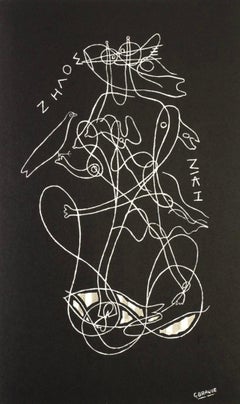
Georges Braque, Zelos, from Derriere le miroir, 1951
Located in Southampton, NY
This exquisite lithograph by Georges Braque (1882–1963), titled Zelos, from the folio Derriere le miroir, No. 36-37-38, originates from the 1951 edition published by Maeght Editeur, ...
Category

1950s Cubist Prints and Multiples

Materials

Lithograph

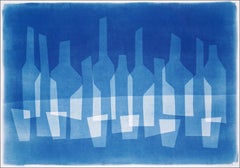
Double Vision Bar Scene, Still Life Wine Bottles and Glass, Blue Tones Monotype
Located in Barcelona, ES
"Double Vision Bar Scene" is an exclusive handprinted unique cyanotype made by layering paper cutouts of bottle silhouettes and wine glasses using uv...
Category

2010s Cubist Prints and Multiples

Materials

Watercolor, Lithograph

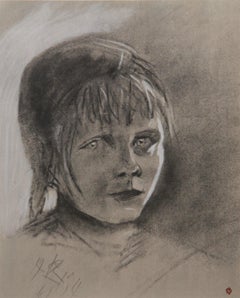
Sonia Delaunay, Portrait of a Young Girl, from Faces of Children, 1968 (after)
Located in Southampton, NY
This exquisite lithograph and pochoir after Sonia Delaunay (1885–1979), titled Portrait de petite fille (Portrait of a Young Girl), originates from the 1968 folio Visages d Enfants. Quinze Dessins de Durer a Dufy Appartenant aux Collections des Musees Nationaux (Faces of Children. Fifteen Drawings from Durer to Dufy from the Collections of the National Museums), published by Editions Artistiques et Documentaires, Paris, and Daniel Jacomet, Editeur, Paris, and rendered and printed by Daniel Jacomet et Cie, Paris, 1968. The composition reflects Delaunay’s modern sensitivity to rhythm, structure, and expressive clarity, translating the original drawing into a refined synthesis of color and form through meticulous printmaking. Executed as a lithograph and pochoir on velin paper, archivally hinged on a velin support sheet as issued, this work measures 18.5 x 14 inches overall, with the image measuring approximately 13.39 x 10.83 inches. Signed in the plate and unnumbered as issued. Rendered and printed by Daniel Jacomet et Cie, Paris. Artwork Details: Artist: After Sonia Delaunay (1885–1979) Title: Portrait de petite fille (Portrait of a Young Girl), from Visages d Enfants. Quinze Dessins de Durer a Dufy Appartenant aux Collections des Musees Nationaux (Faces of Children. Fifteen Drawings from Durer to Dufy from the Collections of the National Museums), 1968 Medium: Lithograph and pochoir on velin paper, archivally hinged on velin support sheet, as issued Dimensions: 18.5 x 14 inches overall; image size 13.39 x 10.83 inches Inscription: Signed in the plate and unnumbered as issued Date: 1968 Publisher: Editions Artistiques et Documentaires, Paris; Daniel Jacomet, Editeur, Paris Printer: Daniel Jacomet et Cie, Paris Condition: Well preserved, consistent with age and medium Provenance: From the 1968 folio Visages d Enfants. Quinze Dessins de Durer a Dufy Appartenant aux Collections des Musees Nationaux, published by Editions Artistiques et Documentaires and Daniel Jacomet, Paris Notes: Excerpted from the folio (translated from French), This album, first of the series of pochoirs similar to masters drawings, published by Daniel Jacomet, publisher, was completed printing on March XXXI, MCMLXVIII. The fifteen drawings have been rendered in similar pochoirs in Les Ateliers Daniel Jacomet. Composition and typographic printing are from the Union Printing. It was drawn in LXX numbered examples and L examples, out of the trade. About the Publication: Visages d Enfants. Quinze Dessins de Durer a Dufy Appartenant aux Collections des Musees Nationaux, issued in 1968, represents a landmark achievement in Parisian printmaking devoted to the faithful translation of historic master drawings into modern pochoir and lithographic form. Conceived and published by Daniel Jacomet in collaboration with Editions Artistiques et Documentaires, the project inaugurated a series dedicated to rendering canonical drawings with exceptional fidelity to line, tone, and original intent. Jacomets atelier was internationally respected for its rigorous technical standards and scholarly approach, bridging museum collections and contemporary print culture through meticulous craftsmanship. By uniting works spanning centuries and artistic traditions, the publication reflects a curatorial vision rooted in preservation, education, and aesthetic continuity. Produced in strictly limited examples, including a small number outside the trade, it exemplifies the highest standards of mid twentieth century Parisian printmaking and remains valued for its role in transmitting the legacy of master draftsmanship to collectors, institutions, and scholars. About the Artist: Sonia Delaunay (1885–1979) was a Ukrainian born French painter, designer, and avant garde visionary whose revolutionary use of color, geometry, and abstraction transformed twentieth century art and design. Born Sarah Stern in Odessa, she moved to Paris, where she became a leading figure of modernism and a pioneer of Orphism, a lyrical offshoot of Cubism founded with her husband Robert Delaunay that fused structure, rhythm, and pure chromatic energy. Deeply influenced by the innovations of Pablo Picasso, Alexander Calder, Alberto Giacometti, Salvador Dali, Joan Miro, Wassily Kandinsky, Marcel Duchamp, and Man Ray, Delaunay absorbed the experimental spirit of the European avant garde while extending abstraction beyond the canvas into fashion, textiles, interiors, and stage design. Her theory of simultaneity celebrated the dynamic interaction of colors, creating visual rhythms that paralleled music and movement, and her designs for the Ballets Russes and Atelier Simultane introduced geometric modernism into everyday life. Like Picasso, she sought to unify art and existence; like Kandinsky, she viewed color as a spiritual force; and like Duchamp and Man Ray, she embraced modern technology and materials as tools for innovation. Her works from the nineteen thirties through the nineteen sixties captured the rhythm of modern life through radiant compositions of interlocking forms and shifting hues. The first living woman honored with a retrospective at the Louvre in nineteen sixty four, Delaunay remains a cornerstone of modernism, with works held in the Museum of Modern Art, the Tate Modern, and the Centre Pompidou. Her highest auction record was achieved by Rythme couleur (1964), which sold for approximately 4.3 million US dollars at Sothebys Paris on November twenty four, two thousand twenty one, confirming her enduring influence and global stature. Sonia Delaunay lithograph...
Category

1960s Cubist Prints and Multiples

Materials

Lithograph, Stencil

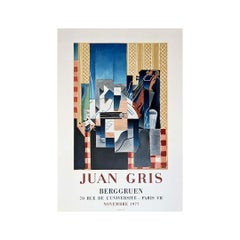
1977 exhibition poster by Juan Gris edited by Mourlot for the Gallery Berggruen
Located in PARIS, FR
Beautiful poster of exhibition of Juan Gris edited by Mourlot in 1977 for the Gallery Berggruen. José Victoriano González, who would later become Juan Gris, was born in Madrid in 1887. He abandoned his previous studies as an engineer to begin (1904) studies at the School of Arts and Manufactures in Madrid, and devoted himself to painting. His first works were inspired by the "Jugendstil" (German Art Nouveau movement), which the Madrid art world perceived as a major art form. Juan Gris was nineteen years old when he moved to Paris in 1906 and soon, after living in a hotel in Montmartre, he took a studio in the Bateau-Lavoir. Pablo Picasso was a close neighbor! The artist will, at first, earn a living by doing important work as an illustrator for famous French magazines (L'assiette au beurre, Charivari, Le cri de Paris, etc.) and Spanish ones. He produced more than 700 drawings for the press, mostly humorous or satirical. As soon as he arrived in France, Juan Gris painted, but he would not devote himself exclusively to painting until 1911. Gris was very impressed by the cubist works...
Category

1970s Cubist Prints and Multiples

Materials

Paper

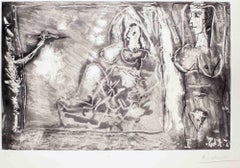
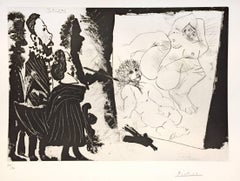
Dans l'Atelier - Etching by Pablo Picasso - 1965
Located in Roma, IT
Complete Title: Dans l'Atelier (Peintre au travail avec une grande toile et un modèle debout). Etching, aquatint  and drypoint on Auvergne wove paper. Hand Signed.  Editions of 32/5...
Category

1960s Cubist Prints and Multiples

Materials

Paper, Etching

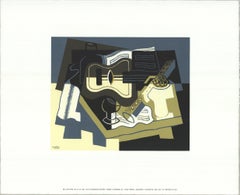
Juan Gris 'Guitar and Clarinet' 1991- Serigraph Vintage
Located in Brooklyn, NY
This high-quality serigraph reproduces Juan Gris’s Guitar and Clarinet, one of the artist’s elegant explorations of musical still-life motifs central to his mature Cubist period. Printed in Italy on 250g fine art paper with deckled edges and published by Silvio Zamorani...
Category

1990s Cubist Prints and Multiples

Materials

Screen

Pablo Picasso, Minotaur, from The Double Flute, 1967 (after)
Located in Southampton, NY
This exquisite lithograph and pochoir after Pablo Picasso (1881–1973), titled Minotaure (Minotaur), from the folio Picasso, La flute double, 16 Dessins, Aquarelles Lavis (The Double ...
Category

1960s Cubist Prints and Multiples

Materials

Lithograph, Stencil

Figure - Lithograph by Henry Ramey - Mid-20th Century
Located in Roma, IT
Figure is a lithograph realized by Henry Ramey in the mid-20th Century. Good condition. Hand-signed. Artist's proof.
Category

Mid-20th Century Cubist Prints and Multiples

Materials

Lithograph

Georges Braque, Seascape with Seagull, from Varengeville, 1968 (after)
Located in Southampton, NY
This exquisite lithograph after Georges Braque (1882–1963), titled Marine a la Mouette (Seascape with Seagull), originates from the 1968 folio Varengeville, published by Maeght Edite...
Category

1960s Cubist Prints and Multiples

Materials

Lithograph

Bird of the Moon - lithograph - 399 copies
Located in Paris, IDF
Georges BRAQUE Bird of the Moon Lithograph (Art-Litho workshop) Printed signature in the plate On Arches vellum 18 x 23" INFORMATION: Limited edition of 399 copies unumbered - Ed...
Category

Late 20th Century Cubist Prints and Multiples

Materials

Lithograph

Patron et sa Suite en Visite à l’Atelier - Etching by P. Picasso - 1968
Located in Roma, IT
Hand signed. Edition 35 of 50. From the Serie “Les 347”, table no. 110. Perfect impression on vélin blanc, very fresh and with sheet in full margins and perfect conditions, numbered ...
Category

1960s Cubist Prints and Multiples

Materials

Drypoint, Aquatint

Picasso Poster Exhibition after Pablo Picasso - 1976
Located in Roma, IT
Picasso Poster is an offset  poster about an exhibition of Pablo Picasso's graphic works at Marino Gallery in Rome Piazza Navona. Limited edition of 1.000. Signed in the plate. Ex...
Category

1970s Cubist Prints and Multiples

Materials

Offset

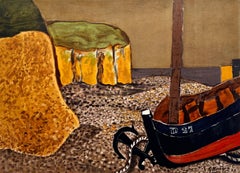
Georges Braque, The Boat D-27, from Varengeville, 1968 (after)
Located in Southampton, NY
This exquisite lithograph after Georges Braque (1882–1963), titled La barque D-27 (The Boat D-27), originates from the 1968 folio Varengeville, published by Maeght Editeur, Paris, an...
Category

1960s Cubist Prints and Multiples

Materials

Lithograph

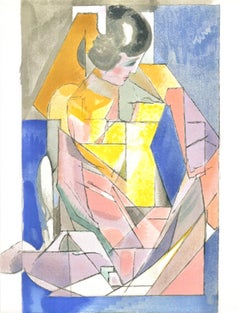
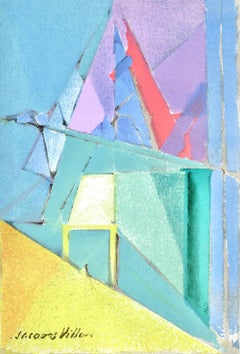
Jacques Villon, Portrait of a Young Girl, 1973 (after)
Located in Southampton, NY
This exquisite lithograph after Jacques Villon (1875–1963), titled Portrait d'une jeune fille (Portrait of a Young Girl), originates from the 1972 edition published by Editions A. C....
Category

1970s Cubist Prints and Multiples

Materials

Lithograph

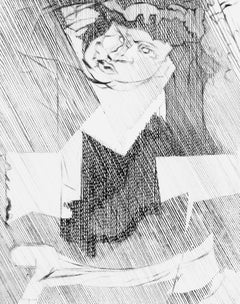
Jacques Villon, Woman’s Head, from XXe Siecle, 1952
Located in Southampton, NY
This exquisite etching by Jacques Villon (1875–1963), titled Tete de Femme (Woman’s Head), from the album XXe Siecle, Nouvelle serie N°3 (double), Juin 1952, originates from the 1952...
Category

1950s Cubist Prints and Multiples

Materials

Etching

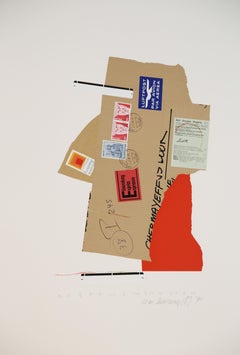
Customs Inspector, Screenprint Collage by Ian Chermayeff
Located in Long Island City, NY
This screenprint and collage was created by Ivan Chermayeff, a noted graphic designer who created the now-famous logos for companies and institutions such as the Smithsonian, Nationa...
Category

1990s Cubist Prints and Multiples

Materials

Screen

347 SERIES (BLOCH 1502)
Located in Aventura, FL
Etching on paper. Hand signed and numbered by the artist. From the 347 series. Bloch 1502. Edition 32/50. Sheet size: 18 x 22 inches. Image size 12.375 x 16.375 inches. Frame si...
Category

1960s Cubist Prints and Multiples

Materials

Paper, Etching

Georges Braque, Seascape, from Varengeville, 1968 (after)
Located in Southampton, NY
This exquisite lithograph after Georges Braque (1882–1963), titled Marine (Seascape), originates from the 1968 folio Varengeville, published by Maeght Editeur, Paris, and printed by ...
Category

1960s Cubist Prints and Multiples

Materials

Lithograph

Georges Braque, Landscape at L’Estaque, from Derriere le Miroir, 1964 (after)
Located in Southampton, NY
This exquisite lithograph after Georges Braque (1882–1963), titled Paysage a l’Estaque (Landscape at L’Estaque), originates from the 1964 folio Derriere le Miroir, Nos. 144–145–146, ...
Category

1960s Cubist Prints and Multiples

Materials

Lithograph

Man and Shadow - Original Lithograph (Morance 1938)
Located in Paris, IDF
Le Corbusier (1887-1965) Man and Shadow, 1938 Original lithograph Signature printed in the plate Dated in the plate On light vellum 21 x 27 cm (c. 8 x 11 inch) Very good condition,...
Category

1930s Cubist Prints and Multiples

Materials

Lithograph

Georges Braque, Ajax, from Derriere le Miroir, 1964 (after)
Located in Southampton, NY
This exquisite lithograph after Georges Braque (1882–1963), titled Ajax, originates from the 1964 folio Derriere le Miroir, Nos. 144–145–146, L’Hommage a Georges Braque (Tribute to G...
Category

1960s Cubist Prints and Multiples

Materials

Lithograph

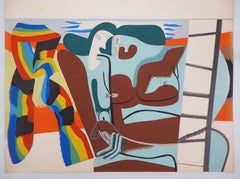
Pride : Two Women with Rainbow Scarf - Lithograph and watercolor stencil
Located in Paris, IDF
Le Corbusier (1887-1965) Pride : Two Women with Rainbow Scarf , 1938 Lithograph and watercolor stencil On light vellum 21 x 27 cm (c. 8 x 11 inch) Very good condition
Category

1930s Cubist Prints and Multiples

Materials

Lithograph

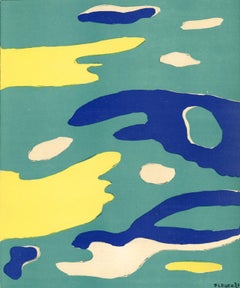
Fernand Leger, Water, from Verve, Revue Artistique, 1937
Located in Southampton, NY
This exquisite lithograph by Fernand Leger (1881–1955), titled L’Eau (Water), from Verve, Revue Artistique et Litteraire, Vol. I, No. 1, originates from the 1937 issue published by Editions de la revue Verve, Paris, under the direction of Teriade, Editeur, Paris, and printed by Mourlot Freres, Paris, 1937. This vibrant composition embodies Leger’s fascination with the elemental forces of nature reinterpreted through the lens of modernity. L’Eau reflects his ongoing exploration of the harmony between mechanical precision and organic movement, transforming the natural motif of flowing water into an abstract symphony of curves, color, and rhythm. Through its interplay of form and line, the work reveals Leger’s mastery of balance and visual dynamism—an artistic celebration of motion and modern life. Executed as a lithograph on velin du Marais paper, this work measures 14 x 10.5 inches (35.56 x 26.67 cm). Signed in the plate and unnumbered as issued. The edition reflects the superior craftsmanship of the Mourlot Freres atelier, celebrated for its collaborations with the leading modern artists of the 20th century. Artwork Details: Artist: Fernand Leger (1881–1955) Title: L’Eau (Water), from Verve, Revue Artistique et Litteraire, Vol. I, No. 1, 1937 Medium: Lithograph on velin du Marais paper Dimensions: 14 x 10.5 inches (35.56 x 26.67 cm) Inscription: Signed in the plate and unnumbered as issued Date: 1937 Publisher: Editions de la revue Verve, Paris, under the direction of Teriade, Editeur, Paris Printer: Mourlot Freres, Paris Condition: Well preserved, consistent with age and medium Provenance: From Verve, Revue Artistique et Litteraire, Vol. I, No. 1, published by Editions de la revue Verve, Paris, 1937 About the Publication: Verve, Revue Artistique et Litteraire was one of the most influential art periodicals of the 20th century, founded in Paris in 1937 by the visionary Greek-born publisher Teriade (Stratis Eleftheriades). Designed as a meeting point of art, poetry, and philosophy, Verve united the era’s greatest modern artists—including Henri Matisse, Pablo Picasso, Marc Chagall, Georges Braque, Joan Miro, and Fernand Leger—with leading intellectuals such as Paul Eluard and Albert Camus. Printed by the master lithographers Mourlot Freres, each issue was a masterpiece of craftsmanship, presenting original lithographs alongside literary works in a richly designed format. The inaugural issue, Vol. I, No. 1, published in 1937, marked a defining moment in the history of modern art publishing—introducing the vision of Verve as a beacon of artistic collaboration and aesthetic excellence that would shape the visual culture of the 20th century. About the Artist: Fernand Leger (1881–1955) was a visionary French painter, sculptor, designer, and filmmaker whose groundbreaking fusion of modern industry, vivid color, and geometric form transformed the course of 20th-century art. Born in Argentan, Normandy, Leger began as an architectural draftsman before studying at the Academie Julian and the Ecole des Beaux-Arts in Paris, where he absorbed the lessons of Paul Cezanne’s structural rigor and the revolutionary ideas of Cubism. Alongside Pablo Picasso and Georges Braque, he became one of the leading innovators of the avant-garde, yet his work stood apart through its embrace of mechanical rhythm, bold contrasts, and industrial modernity—earning him the title “the painter of the machine age.” His art celebrated the beauty of technology, urban life, and the human form rendered in dynamic, interlocking cylinders and planes, evoking the pulse of the modern world. Immersed in the vibrant Parisian art scene, Leger worked in dialogue with peers and contemporaries such as Alexander Calder, Alberto Giacometti, Salvador Dali, Joan Miro, Wassily Kandinsky, Marcel Duchamp, and Man Ray, all of whom shared his commitment to innovation and the reimagining of artistic expression. Beyond painting, Leger’s creative reach extended into film, design, and monumental public art—his 1924 collaboration on Ballet Mecanique with Dudley Murphy and Man Ray remains a landmark of avant-garde cinema. His later works evolved toward greater clarity and monumentality, celebrating the unity of form, color, and humanity through large-scale murals and mosaics that bridged fine art and architecture. Leger’s synthesis of Cubism, Futurism, and abstraction paved the way for movements such as Pop Art and influenced generations of artists including Roy Lichtenstein, Ellsworth Kelly, Robert Indiana, and Alexander Calder, who admired his fusion of structure, energy, and optimism. Today, his works are prized by major museums and collectors worldwide for their bold visual power and enduring modernity. His highest auction record was achieved by La femme en rouge et vert (1914), which sold for $39,241,000 at Sotheby’s, New York, on May 7, 2008. Fernand Leger L’Eau, Leger Verve, Leger Mourlot...
Category

1930s Cubist Prints and Multiples

Materials

Lithograph

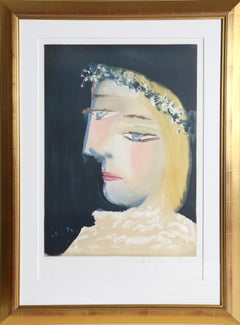
Femme a la Robe, Blanche Couronee de Fleurs - Lithograph after Pablo Picasso
Located in Long Island City, NY
Wearing a crown of white flowers, the woman in the white dress has clear blue eyes and pink lips. A classic example of Pablo Picasso's work, the woman's face is disjointed and fragme...
Category

1980s Cubist Prints and Multiples

Materials

Lithograph

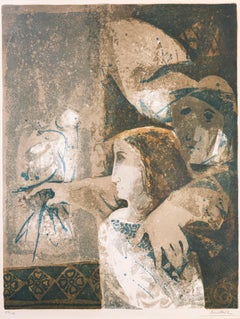
"Gray with Dove" 54/100 Cubist Mother Child Bird Blue Earth Tones Peaceful
Located in Austin, TX
Page size: 27 x 20 in. Frame size: 32 x 25 in. Signed in pencil, bottom right: "ALVAR" Numbered in pencil, bottom left "54/100" A dreamy, abstract litograph in misty blues, grays, w...
Category

Mid-20th Century Cubist Prints and Multiples

Materials

Archival Paper, Lithograph

Jacques Villon, Intimacy, from Prints from the Mourlot Press, 1964 (after)
Located in Southampton, NY
This exquisite lithograph after Jacques Villon (1875–1963), titled Intimite (Intimacy), from the album Prints from the Mourlot Press, exhibition sponsored by the French Embassy, circ...
Category

1960s Cubist Prints and Multiples

Materials

Lithograph

In Between the Shadows #6, earthy colours, Framed Medium Large Collage Print
Located in London, GB
In Between the Shadows 6 Giclee Print on Hahnemuhle Pearl Fine Art Paper, Mounted 65 x 70cm, Edition of 2/5 + 2 Artist’s Proofs, Custom Framed, Mounted on Aluminium and finished with...
Category

2010s Cubist Prints and Multiples

Materials

Photographic Paper, Black and White, Color, Archival Pigment

Nature Morte au Pot de Grès - Lithograph by Pablo Picasso - 1947
Located in Roma, IT
Hand signed in red pencil and numbered. Dated in plate. Edition 14/50. On Arches Wove Paper. Excellent condition. Reference: Bloch n.443; Mourlot 86.
Category

1940s Cubist Prints and Multiples

Materials

Paper, Lithograph

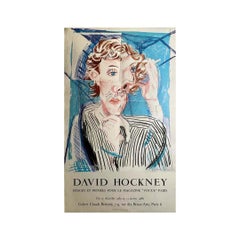
1986 original poster of David Hockney, Images and thoughts for Vogue magazine
Located in PARIS, FR
Very nice original poster of David Hockney, Images and thoughts for Vogue magazine at the Claude Bernard gallery. David Hockney was born in 1937 in Brad...
Category

1980s Cubist Prints and Multiples

Materials

Paper, Lithograph

Cubist prints and multiples for sale on 1stDibs.

Find a wide variety of authentic Cubist prints and multiples available for sale on 1stDibs. Works in this style were very popular during the 21st Century and Contemporary, but contemporary artists have continued to produce works inspired by this movement. If you’re looking to add prints and multiples created in this style to introduce contrast in an otherwise neutral space in your home, the works available on 1stDibs include elements of blue, orange, yellow, green and other colors. Many Pop art paintings were created by popular artists on 1stDibs, including Pablo Picasso, (after) Pablo Picasso, Jean-Emile Laboureur, and (after) Georges Braque. Frequently made by artists working with Lithograph, and Etching and other materials, all of these pieces for sale are unique and have attracted attention over the years. Not every interior allows for large Cubist prints and multiples, so small editions measuring 2.13 inches across are also available. Prices for prints and multiples made by famous or emerging artists can differ depending on medium, time period and other attributes. On 1stDibs, the price for these items starts at $88 and tops out at $265,000, while the average work sells for $2,443.

Still Thinking About These?

All Recently Viewed