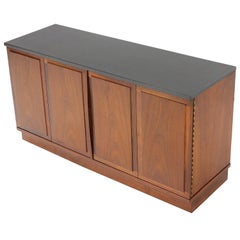
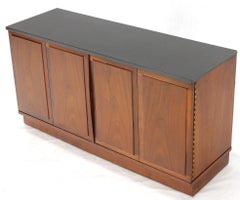
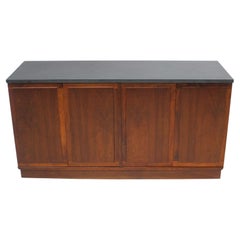
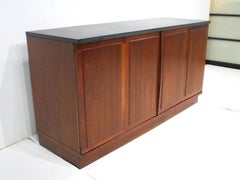
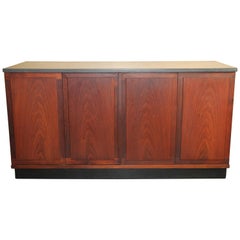
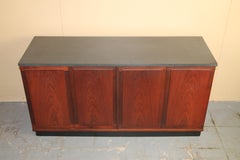
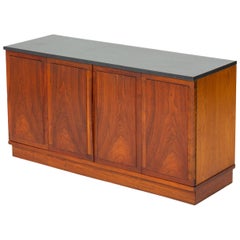
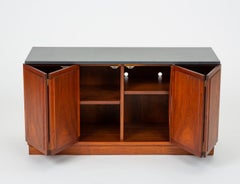
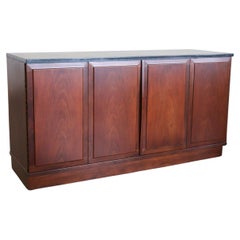
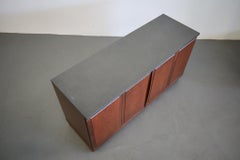
Walnut Credenza Slate Top

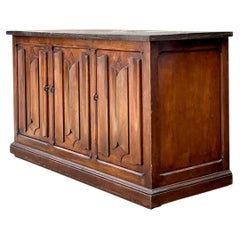
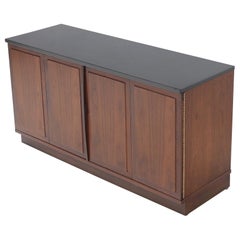
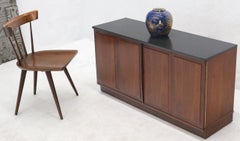
Jack Cartwright for Founders Mid Century Walnut and Slate Top Credenza

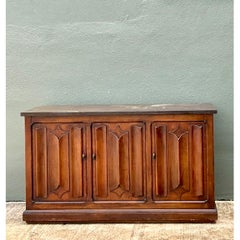
Jack Cartwright for Founders Mid Century Walnut and Slate Top Credenza

By Jack Cartwright, Founders Furniture Company

Located in Franklin Park, IL

Jack Cartwright for Founders Mid Century Walnut and Slate Top Credenza This credenza measures: 48 wide x 16 deep x 25.25 inches high Good Vintage Condition - Stain on Top Surface i...

Category

Mid-20th Century American Mid-Century Modern Credenzas

Materials

Slate

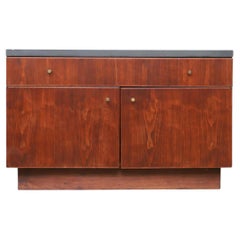
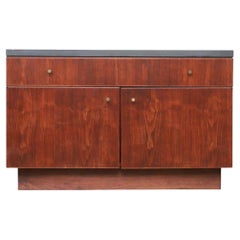
Walnut Base Petit Credenza with Slate Top TV Stand Cabinet Console Table

Walnut Base Petit Credenza with Slate Top TV Stand Cabinet Console Table

By Milo Baughman, Drexel

Located in Rockaway, NJ

Small hall entry space cabinet credenza, TV stand alternative with slate top. Mid-Century Modern circa 1970s Milo Baughman style piece.

Category

20th Century American Mid-Century Modern Credenzas

Materials

Slate

Mid Century American Studio Craft Thick Slate Top Black Walnut cabinet

Mid Century American Studio Craft Thick Slate Top Black Walnut cabinet

By Phillip Lloyd Powell

Located in Brooklyn, NY

Mid century American Studio craft thick slate top black walnut credenza cabinet. beautiful hand crafted solid black walnut single drawer cabinet.

Category

Vintage 1960s American Mid-Century Modern Credenzas

Materials

Slate

Mid-Century Modern Slate Top Petit Oiled Walnut Credenza Cabinet

Mid-Century Modern Slate Top Petit Oiled Walnut Credenza Cabinet

By Milo Baughman

Located in Rockaway, NJ

Mid-Century Modern double accordion doors walnut credenza storage cabinet with slate top. Dramatic vintage oiled walnut wood grain.

Category

20th Century American Mid-Century Modern Commodes and Chests of Drawers

Materials

Slate

Recent Sales

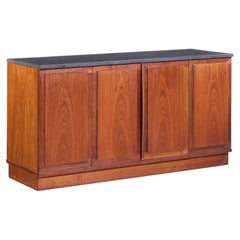
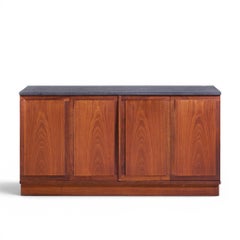
Mid Century Walnut Slate Topped Credenza in the style of Danish Modern

Mid Century Walnut Slate Topped Credenza in the style of Danish Modern

By Otmar

Located in Cincinnati, OH

Having a gray slate stone top gives the piece a rich , clean added touch of style .

Category

Mid-20th Century American Mid-Century Modern Credenzas

Materials

Slate

Slate-Top Walnut Sideboard by Jack Cartwright for Founders

Slate-Top Walnut Sideboard by Jack Cartwright for Founders

By Jack Cartwright, Founders Furniture Company

Located in Los Angeles, CA

A walnut case piece from North Carolina-based Founders Furniture designed in the 1950s by Jack Cartwright. This small sideboard, known as the Half Cabinet, features beautifully figur...

Category

Mid-20th Century American Mid-Century Modern Credenzas

Materials

Slate

Walnut & Slate Petite Credenza by Jack Cartwright for Founders

Walnut & Slate Petite Credenza by Jack Cartwright for Founders

By Jack Cartwright, Founders Furniture Company

Located in Long Beach, CA

Well constructed walnut credenza with slate top in a unique size for those smaller spaces that are hard to fill.

Category

Vintage 1960s American Mid-Century Modern Credenzas

Materials

Slate

Get Updated with New Arrivals
Save "Walnut Credenza Slate Top", and we’ll notify you when there are new listings in this category.

A Close Look at Mid-century-modern Furniture

Organically shaped, clean-lined and elegantly simple are three terms that well describe vintage mid-century modern furniture. The style, which emerged primarily in the years following World War II, is characterized by pieces that were conceived and made in an energetic, optimistic spirit by creators who believed that good design was an essential part of good living.

ORIGINS OF MID-CENTURY MODERN FURNITURE DESIGN

CHARACTERISTICS OF MID-CENTURY MODERN FURNITURE DESIGN

MID-CENTURY MODERN FURNITURE DESIGNERS TO KNOW

ICONIC MID-CENTURY MODERN FURNITURE DESIGNS

VINTAGE MID-CENTURY MODERN FURNITURE ON 1STDIBS

The mid-century modern era saw leagues of postwar American architects and designers animated by new ideas and new technology. The lean, functionalist International-style architecture of Le Corbusier and Bauhaus eminences Ludwig Mies van der Rohe and Walter Gropius had been promoted in the United States during the 1930s by Philip Johnson and others. New building techniques, such as “post-and-beam” construction, allowed the International-style schemes to be realized on a small scale in open-plan houses with long walls of glass.

Materials developed for wartime use became available for domestic goods and were incorporated into mid-century modern furniture designs. Charles and Ray Eames and Eero Saarinen, who had experimented extensively with molded plywood, eagerly embraced fiberglass for pieces such as the La Chaise and the Womb chair, respectively. 

Architect, writer and designer George Nelson created with his team shades for the Bubble lamp using a new translucent polymer skin and, as design director at Herman Miller, recruited the Eameses, Alexander Girard and others for projects at the legendary Michigan furniture manufacturer

Harry Bertoia and Isamu Noguchi devised chairs and tables built of wire mesh and wire struts. Materials were repurposed too: The Danish-born designer Jens Risom created a line of chairs using surplus parachute straps for webbed seats and backrests.

The Risom lounge chair was among the first pieces of furniture commissioned and produced by celebrated manufacturer Knoll, a chief influencer in the rise of modern design in the United States, thanks to the work of Florence Knoll, the pioneering architect and designer who made the firm a leader in its field. The seating that Knoll created for office spaces — as well as pieces designed by Florence initially for commercial clients — soon became desirable for the home.

As the demand for casual, uncluttered furnishings grew, more mid-century furniture designers caught the spirit.

Classically oriented creators such as Edward Wormley, house designer for Dunbar Inc., offered such pieces as the sinuous Listen to Me chaise; the British expatriate T.H. Robsjohn-Gibbings switched gears, creating items such as the tiered, biomorphic Mesa table. There were Young Turks such as Paul McCobb, who designed holistic groups of sleek, blond wood furniture, and Milo Baughman, who espoused a West Coast aesthetic in minimalist teak dining tables and lushly upholstered chairs and sofas with angular steel frames.

Generations turn over, and mid-century modern remains arguably the most popular style going. As the collection of vintage mid-century modern chairs, dressers, coffee tables and other furniture for the living room, dining room, bedroom and elsewhere on 1stDibs demonstrates, this period saw one of the most delightful and dramatic flowerings of creativity in design history.

Finding the Right Credenzas for You

Antique and vintage credenzas can add an understated touch of grace to your home. These long and sophisticated cabinet-style pieces of furniture can serve a variety of purposes, and they look great too.

In Italy, the credenza was originally a small side table used in religious services. Appropriately, credere in Italian means “to believe.” Credenzas were a place to not only set the food ready for meals, they were also a place to test and taste prepared food for poison before a dish was served to a member of the ruling class. Later, credenza was used to describe a type of versatile narrow side table, typically used for serving food in the home. In form, a credenza has much in common with a sideboard — in fact, the terms credenza and sideboard are used almost interchangeably today.

Credenzas usually have short legs or no legs at all, and can feature drawers and cabinets. And all kinds of iterations of the credenza have seen the light of day over the years, from ornately carved walnut credenzas originating in 16th-century Tuscany to the wealth of Art Deco credenzas — with their polished surfaces and geometric patterns — to the array of innovative modernist interpretations that American furniture maker Milo Baughman created for Directional and Thayer Coggin.

The credenza’s blend of style and functionality led to its widespread use in the 20th century. Mid-century modern credenzas are particularly popular — take a look at Danish furniture designer Arne Vodder’s classic Model 29, for instance, with its reversible sliding doors and elegant drawer pulls. Hans Wegner, another Danish modernist, produced strikingly minimalist credenzas in the 1950s and ’60s, as did influential American designer Florence Knoll. Designers continue to explore new and exciting ways to update this long-loved furnishing.

Owing to its versatility and familiar low-profile form, the credenza remains popular in contemporary homes. Unlike many larger case pieces, credenzas can be placed under windows and in irregularly shaped rooms, such as foyers and entryways. This renders it a useful storage solution. In living rooms, for example, a credenza can be a sleek media console topped with plants and the rare art monographs you’ve been planning to show off. In homes with open floor plans, a credenza can help define multiple living spaces, making it ideal for loft apartments.

Browse a variety of antique and vintage credenzas for sale on 1stDibs to find the perfect fit for your home today.