1910s Art
to
269
1,083
355
394
190
169
Overall Width
to
Overall Height
to
7,539
21,275
158,968
232,548
1,968
2,243
4,929
6,411
5,814
13,295
19,739
25,675
18,297
13,577
5,382
410
312
138
137
47
20
19
12
6
1
1,225
883
32
1,425
690
592
408
385
351
215
151
144
137
132
121
114
100
96
91
76
76
59
57
864
627
485
394
385
95
51
34
23
22
849
362
1,169
949
Period: 1910s
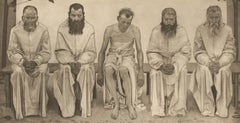
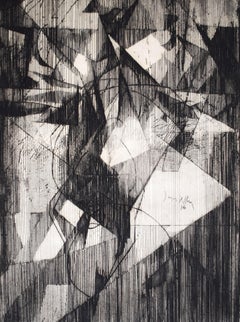
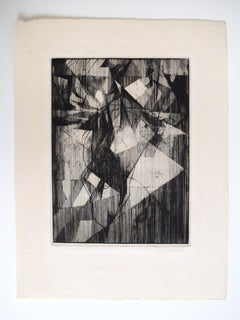
Selbstmörder - Original Etching and Drypoint by Magnus Zeller - 1919
By Magnus Zeller
Located in Roma, IT
Selbstmörder is an original drypoint, realized by Magnus Zeller in 1919, signed and inscribed,
Included a frame.
In very good conditions.
The artwork is representing a desperate m...
Category
Expressionist 1910s Art
Materials
Drypoint, Etching
Oriental Head Dress (Persia), British Museum Roman antiquity photogravure
Located in Melbourne, Victoria
'Oriental Head Dress (Persia)'
Photogravure after Donald Macbeth (1865-1943).
Donald Macbeth was a commercial photographer who seems to have held a quasi-official position at the B...
Category
Other Art Style 1910s Art
Materials
Photogravure
Westmacott Boy, British Museum Roman antiquity Classical sculpture photogravure
Located in Melbourne, Victoria
'Westmacott Boy'
Photogravure from a collection of photogravures depicting Greek and Roman marbles and bronzes in the British museum. Plate number above top right corner of the imag...
Category
Other Art Style 1910s Art
Materials
Photogravure
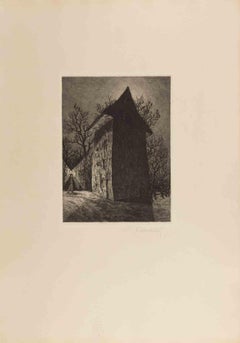
Under the Snow - Original Etching by Anselmo Bucci - 1913
Located in Roma, IT
Image dimensions: 11,5x17,8 cm.
Under the Snow is an original artwork realized by Anselmo Bucci in 1913.
The state of preservation is very good, except for some small stains on the...
Category
1910s Art
Materials
Drypoint, Etching
The Discussion - Original China Ink by Carlo Rivalta - 1914
Located in Roma, IT
Image dimensions: 16,5x8,5 cm.
The Discussion is an original artwork realized by Rivalta, in 1914.
The state of preservation is good, except for some small holes on the back. Hand-...
Category
1910s Art
Materials
Ink
Woman Figure - Woodcut Print by A. Marquet - 1910 ca.
Located in Roma, IT
Signed on plate. Numbered. Edition of 60 prints in Roman Numerals. Very good conditions.
Image Dimensions : 21 x 12.5 cm
Category
Post-Impressionist 1910s Art
Materials
Woodcut
Sketches of a Nude - Original Pencil and Pastel Drawing by J. Dreyfus-Stern
Located in Roma, IT
Sketch for a Nude is an original artwork realized by Jean Dreyfus-Stern in the 1920s.
Pencil and red pencil on paper.
Hand-signed in pencil by the artist on the lower right margi...
Category
1910s Art
Materials
Pastel, Pencil
Vaso di Anemoni (Red Anemones) - 1910s - Arturo Noci - Oil on Canvas
By Arturo Noci
Located in Roma, IT
Hand signed and dated lower right "Arturo Noci 1912". In excellent conditions.
Includes wooden frame: 63x78 cm.
Category
Modern 1910s Art
Materials
Oil, Canvas
Group of Men - Original Lithograph by Anselmo Bucci - 1918
Located in Roma, IT
Group of Men is an original lithograph on cream-colored paper, signed by the Italian artist, painter, and printmaker Anselmo Bucci, Hand-signed and dated on the lower margin of artwo...
Category
Futurist 1910s Art
Materials
Lithograph
Extenués - Etching by Anselmo Bucci - 1917
Located in Roma, IT
Image dimensions: 6 x 8 cm.
Hand signed. Edition of 100 prints on Hollande paper. From the collection: “Croquis du Front Italien” , published in Paris by D'Alignan editions. Anselmo...
Category
Futurist 1910s Art
Materials
Drypoint, Etching
La Chaîne - Etching by Anselmo Bucci - 1917
Located in Roma, IT
Image dimensions: 9.5 x 13.5 cm.
Hand signed. Edition of 100 prints on Hollande paper. From the collection: “Croquis du Front Italien” , published in Paris by D'Alignan editions. An...
Category
Futurist 1910s Art
Materials
Drypoint, Etching
Alpino - Etching by Anselmo Bucci - 1917
Located in Roma, IT
Image dimensions: 10 x 9.5 cm.
Hand signed. Edition of 100 prints on Hollande paper. From the collection: “Croquis du Front Italien” , published in Paris by D'Alignan editions. Anse...
Category
Futurist 1910s Art
Materials
Drypoint, Etching
Le Releve - Original Etching by Anselmo Bucci - 1915
Located in Roma, IT
Image dimensions: 12.5 x 8.5 cm.
Hand signed. Edition of 100 prints on Hollande paper. From the collection: “Croquis du Front Italien”, published in Paris by D'Alignan editions. Ans...
Category
Futurist 1910s Art
Materials
Drypoint, Etching
Le Poisonnier - Etching by Anselmo Bucci - 1917
Located in Roma, IT
Image dimensions: 11.5 x 14 cm.
Hand signed. Edition of 100 prints on Hollande paper. From the collection: “Croquis du Front Italien” , published in Paris by D'Alignan editions. Ans...
Category
Futurist 1910s Art
Materials
Drypoint, Etching
On Tire - Original Etching by Anselmo Bucci - 1917
Located in Roma, IT
Image dimensions: 8.5 x 12 cm.
Hand signed. Edition of 100 prints on Hollande paper. From the collection: Croquis du Front Italien, published in Paris by D'Alignan editions. Anselmo...
Category
Futurist 1910s Art
Materials
Drypoint, Etching
Fusilier - Etching by Anselmo Bucci - 1917
Located in Roma, IT
Image dimensions: 6 x 5 cm.
Hand signed. Edition of 100 prints on Hollande paper. From the collection: “Croquis du Front Italien” , published in Paris by D'Alignan editions. Anselm...
Category
Futurist 1910s Art
Materials
Drypoint, Etching
Oli Sasso - Original Advertising Lithograph by Plinio Nomellini - 1914 ca.
Located in Roma, IT
Oli Sasso is a colored lithographed original manifesto on cardboard, realized around 1914 by the Italian artist Plinio Nomellini.
This modern artwork is signed on plate on higher left margin and has the inscriptions printed on lower margin in the image "Chiedere Catalogo e Campioni ai Sigg. Sasso Oneglia e Figli", under the image: "P. Nomellini/ Off. G. Ricordi and C. Milano / 140 x 200". From the Ricordi Portfolio...
Category
1910s Art
Materials
Lithograph
Une Mère et Deux Enfants
Located in New York, NY
A very good, dark and evenly-printed impression of this scarce lithograph on cream laid paper. From the edition of approximately 50.
Category
Impressionist 1910s Art
Materials
Laid Paper, Lithograph
"Coin de fonderie" original etching
Located in Henderson, NV
Medium: original etching. Printed in 1913 and published in Paris by the Revue de l'art ancien et moderne. Plate size: 4 3/8 x 5 5/8 inches (112 x 143 mm). A rich, dark impression on ...
Category
Expressionist 1910s Art
Materials
Etching
"Night Stroll" Amy Londoner, Ashcan School, Figurative Nocturne
By Amy Londoner
Located in New York, NY
Amy Londoner
Beach at Atlantic City, circa 1922
Signed lower right
Pastel on paper
Sight 23 x 18 inches
Amy Londoner (April 12, 1875 – 1951) was an American painter who exhibited at the 1913 Armory Show. One of the first students of the Henri School of Art in 1909. Prior to the Armory Show of 1913, Amy Londoner and her classmates studied with "Ashcan" painter Robert Henri at the Henri School of Art in New York, N.Y. One notable oil painting, 'The Vase', was painted by both Henri and Londoner.
Londoner was born in Lexington, Missouri on April 12, 1875. Her parents were Moses and Rebecca Londoner, who moved to Leadville, Colorado, by 1880. In 1899, Amy took responsibility for her father who had come to Los Angeles from Leadville and had mental issues. By 1900, Amy was living with her parents and sister, Blanche, in the vicinity of Leadville, Denver, Colorado. While little was written about her early life, Denver City directories indicated that nineteenth-century members of the family were merchants, with family ties to New York, N.Y. The family had a male servant. Londoner traveled with her mother to England in 1907 then shortly later, both returned to New York in 1909. Londoner was 34 years old at the time, and, according to standards of the day, should have married and raised a family long before. Instead, she enrolled as one of the first students at the Henri School of Art in 1909.
At the Henri School, Londoner established friendships with Carl Sprinchorn (1887-1971), a young Swedish immigrant, and Edith Reynolds (1883-1964), daughter of wealthy industrialist family from Wilkes-Barre, PA. Londoner's correspondence, which often included references to Blanche, listed the sisters' primary address as the Hotel Endicott at 81st Street and Columbus Avenue, NYC. Other correspondence also reached Londoner in the city via Mrs. Theodore Bernstein at 252 West 74th Street; 102 West 73rd Street; and the Independent School of Art at 1947 Broadway. In 1911, Londoner vacationed at the Hotel Trexler in Atlantic City, NJ. As indicated by an undated photograph, Londoner also spent time with Edith Reynolds and Robert Henri at 'The Pines', the Reynolds family estate in Bear Creek, PA.
Through her connections with the Henri School, Londoner entered progressive social and professional circles. Henri's admonition, phrased in the vocabulary of his historical time period, that one must become a "man" first and an artist second, attracted both male and female students to classes where development of unique personal styles, tailored to convey individual insights and experiences, was prized above the mastery of standardized, technical skill. Far from being dilettantes, women students at the Henri School were daring individuals willing to challenge tradition. As noted by former student Helen Appleton Read, "it was a mark of defiance,to join the radical Henri group."
As Henri offered educational alternatives for women artists, he initiated exhibition opportunities for them as well. Troubled by the exclusion of work by younger artists from annual exhibitions at the National Academy of Design, Henri was instrumental in organizing the no-jury, no-prize Exhibition of Independent Artists in 1910. About half of the 103 artists included in the exhibition were or had been Henri students, while twenty of the twenty-six women exhibiting had studied with Henri. Among the exhibition's 631 pieces, nine were by Amy Londoner, including the notorious 'Lady with a Headache'. Similarly, fourteen of Henri's women students exhibited in the groundbreaking Armory Show of 1913, forming about eight percent of the American exhibitors and one-third of American women exhibitors. Of the nine documented works submitted by Londoner, five were rejected, while four pastels of Atlantic City beach scenes, including 'The Beach Umbrellas' now in the Remington Collection, were displayed.
Following Henri's example, Londoner served as an art instructor for younger students at the Modern School, whose only requirement was to genuinely draw what they pleased. The work of dancer Isadora Duncan, another artist devoted to the ideals of a liberal education, was also lauded by the Modern School. Henri, who long admired Duncan and invited members of her troupe to model for his classes, wrote an appreciation of her for the Modern School journal in 1915. She was also the subject of Londoner's pastel Isadora Duncan and the Children: Praise Ye the Lord with Dance. In 1914, Londoner traveled to France to spend summer abroad, living at 99 rue Notre Dames des Champs, Paris, France. As the tenets of European modernism spread throughout the United States, Londoner showed regularly at venues which a new generation of artists considered increasingly passe, including the annual Society of Independent Artists' exhibitions between 1918 and 1934, and the Salons of America exhibition in 1922. Londoner also exhibited at the Morton Gallery, Opportunity Gallery, Leonard Clayton Gallery and Brownell-Lambertson Galleries in NYC. Her painting of a 'Blond Girl' was one of two works included in the College Art Associations Traveling Exhibition of 1929, which toured colleges across the country to broad acclaim.
Londoner later in life suffered from illnesses then suffered a stroke which resulted in medical bills significantly mounting over the years that her old friends from the Henri School, including Carl Sprinchorn, Florence Dreyfous, Florence Barley, and Josephine Nivison Hopper, scrambled to raise funds and find suitable long-term care facilities for Londoner. Londoner later joined Reynolds in Bear Creek, PA. Always known for her keen wit, Londoner retained her humor and concern for her works even during her illness, noting that "if anything happens to the Endicott, I guess they will just throw them out." Sprinchorn and Reynolds, however, did not allow this to happen. In 1960, Londoner's paintings 'Amsterdam Avenue at 74th Street' and 'The Builders' were loaned by Reynolds to a show commemorating the Fiftieth Anniversary of the Exhibition of Independent Artists in 1910, presented at the Delaware Art Center, Wilmington, DE. In the late 80's, Francis William Remington, 'Bill Remington', of Bear Creek Village PA, along with his neighbor and artist Frances Anstett Brennan, both had profound admiration for Amy Londoner's art work and accomplishments as a woman who played a significant role in the Ashcan movement. Remington acquired a significant number of Londoner's artwork along with Frances Anstett Brenan that later was part of an exhibition of Londoner's artwork in April 15 of 2007, at the Hope Horn...
Category
Ashcan School 1910s Art
Materials
Paper, Pastel
"L'enfant a l'arbalete" original lithograph
Located in Henderson, NV
Medium: original lithograph. Printed in 1910 in sanguine ink and published in Paris for Gazette des Beaux-Arts. Image size: 5 3/4 x 4 3/4 inches (146 x 122 mm). Not signed.
Category
1910s Art
Materials
Lithograph
(after) Edouard Manet - "L'enfant aux cerises"
Located in Henderson, NV
Medium: engraving (after the painting). Engraved by French artist Henri Bérengier (1881-1943) after the Manet painting. Printed in 1910 on watermarked BFK Rives paper and published i...
Category
1910s Art
Materials
Engraving
Studies for the Female Figure - Pencil Drawing by D. Ginsbourg - 1918
Located in Roma, IT
Studies for the Female Figure is an original artwork realized by the french artist Ginsbourg in 1918.
Original red pencil on paper.
Hand-signed and dated in pencil on the lower ri...
Category
1910s Art
Materials
Pencil
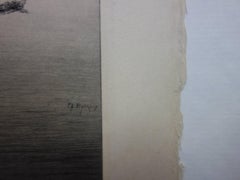
Mein Weg mit dem Weib # 12 - Original Etching by W.R. Rehn
Located in Roma, IT
Drypoint and aquatint (brown ink) on cream paper.
Signed "Rehn" in pencil on the lower right margin. Titled and numbered in pencil on the lower left margin. Edition of 25 prints. Fr...
Category
Symbolist 1910s Art
Materials
Drypoint, Aquatint
Glimpse of the Sea - Scottish 1915 art Impressionist landscape oil painting
By Sir Charles James Lawton Wingate
Located in Hagley, England
A superb landscape oil painting on canvas by Sir James Lawton Wingate, President of The Royal Scottish Academy. This painting shows a windswept Scottish landscape and a "glimpse of t...
Category
Impressionist 1910s Art
Materials
Oil
Desert - Original Woodcut by Marcel Gaillard - 1918
Located in Roma, IT
Desert is a beautiful black and white xylograph on ivory colored paper, by the French landscapist Marcel Gaillard (1886 -1947).
This original print, representing an oriental buildin...
Category
Modern 1910s Art
Materials
Woodcut
Egon Tschirch's original poster "Englands Absicht: Geschlossen Wegen Mangel"
Located in PARIS, FR
Egon Tschirch's original poster entitled "Englands Absicht: Geschlossen Wegen Mangel an Arbeit" is a work that reveals the artist's talent for combining visual aesthetics with politi...
Category
1910s Art
Materials
Linen, Paper, Lithograph
Dix Neuf Poèmes Élastiques
Located in Roma, IT
One of 40 copies on Hollande Van Gelder in 8° format including a second portrait of the author out of text. Rigid binding lightly wore on angles. Internal papers in perfect conditions.
Edition: Paris, Au Sans Pareil
Circulation: 50 copies of which 10 on Japon ancient and 40 on Hollande Van Gelder, plus 1050 on velin d' alfa
Format: In-4°
Pages: 52
Artist: Amedeo Modigliani, Blaise Cendrars
Category
Post-Impressionist 1910s Art
Materials
Paper
"Jeune femme a la balustrade" original lithograph
Located in Henderson, NV
Medium: original lithograph. Printed in 1914 on chine-colle paper by E. Duchatel and published in Paris by Gazette des Beaux-Arts. The catalogue reference is Sanchez and Seydoux 1914...
Category
1910s Art
Materials
Lithograph
original lithograph
Located in Henderson, NV
Medium: original lithograph. This impression on wove paper was printed in 1919 for Das Kestnerbuch, an important collection of original prints published during the height of the Germ...
Category
Expressionist 1910s Art
Materials
Lithograph
Circle of Life
By Rudolf Bauer
Located in Fairlawn, OH
Circle of Life
Lithograph on tan paper, c. 1910's
Signed in pencil lower right; signed in the plate lower right
(see photo)
Annotated "No. 50" in pencil lower left (see photo)
...
Category
Expressionist 1910s Art
Materials
Lithograph
"Der Kritiker" original lithograph
Located in Henderson, NV
Medium: original lithograph. This is one of the scenes of the Berlin art world executed by Rudolf Grossmann. Printed in 1919 at the Wolf & Sohn atelier for the Ganymed portfolio (vol...
Category
Expressionist 1910s Art
Materials
Lithograph
"Der Kunstfreund" original lithograph
Located in Henderson, NV
Medium: original lithograph. This is one of the scenes of the Berlin art world executed by Rudolf Grossmann. Printed in 1919 at the Wolf & Sohn atelier for the Ganymed portfolio (vol...
Category
Expressionist 1910s Art
Materials
Lithograph
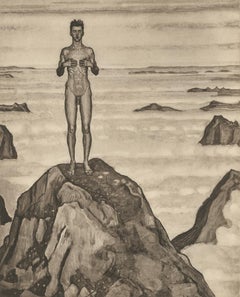
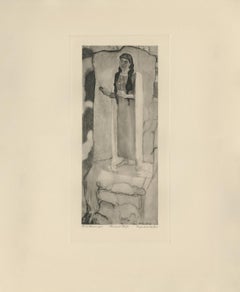
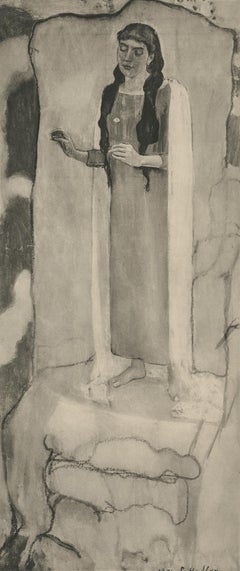
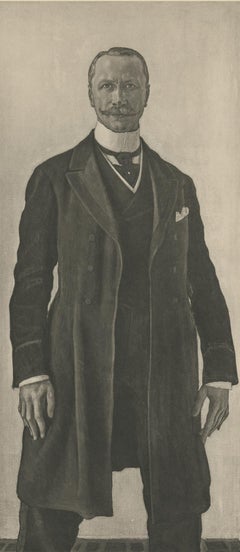
"The World Weary" Copper Plate Heliogravure
Located in Palm Beach, FL
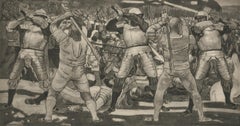
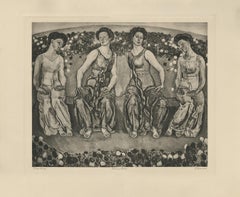
2018 marks the centenary anniversary of Ferdinand Hodler’s death. In that 100 years time, the art world’s esteem of this important artist has proved fickle. It has shifted from extolling his artistic merits during his lifetime to showing something of a feigned disdain- more reflective of the world political order than a true change of heart for Hodler’s work. After years of Hodler being all but a footnote in the annals of art history and generally ignored, finally, the pendulum has righted itself once again. Recent retrospective exhibitions in Europe and the United States have indicated not only a joyful rediscovery of Hodler’s art but a firm conviction that his work and world view hold particular relevance today. DAS WERK FERDINAND HODLERS is not only a collection of printed work reflecting the best of all of his painted work created up to 1914 just before the outbreak of World War I, the portfolio itself is an encapsulation of Hodler’s ethos, Parallelisme.
Hodler developed his philosophy of Parallelisme as a unifying approach to art which strips away detail in search of harmony. By means of abstraction, symmetry and repetition, Hodler sought ways to depict Nature’s essence and her fundamental, universal order. He believed these universal laws governing the natural, observable world extend to the spiritual realm. Symbolist in nature with Romantic undertones, his works are equally portraits of these universal concepts and feelings governing all life as they are a visual portrait in the formal sense. Whether his subject is a solitary tree, a moment in battle, mortal fear, despair, the awe inspired by a vast mountain range, a tender moment or even the collective conviction in a belief, Hodler unveils this guiding principle of Parallelisme.
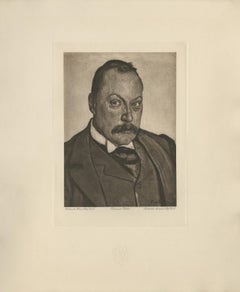
Several aspects of Hodler’s portfolio reinforce his tenets of Parallelisme. The Table of Contents clearly preferences a harmonious design over detail. The two columns, consisting of twenty lines each, list the images by order of appearance using their German titles. The abbreviated titles are somewhat cryptic in that they obscure the identities of the sitters. Like the image Hodler presents, they are distillations of the sitter without any extraneous details. This shortening was also done in an effort to maintain a harmonious symmetry of the Table of Contents, themselves, and keep titles to a one-line limit. The twenty-fourth title: “Bildnis des Schweizerischen Gesandten C.” was so long, even with abbreviation, that it required two lines; so, for the sake of maintaining symmetry, the fortieth title: “Bauernmadchen” was omitted from the list. This explains why the images are not numbered. Hodler’s reasoning is not purely esoteric. Symmetry and pattern reach beyond mere formal design principles. Finding sameness and imposing it over disorder goes to the root of Hodler’s identity and his art. A Swiss native, Hodler was bi-lingual and spoke German and French. Each printed image, even number forty, have titles in both of Hodler’s languages. Certainly, there was a market for Hodler’s work among francophones and this inclusion may have been a polite gesture to that end; however, this is the only place in the portfolio which includes French. With German titles at the lower left of each image, Hodler’s name at bottom center and corresponding French titles at the lower right of each image, there is a harmony and symmetry woven into all aspects of the portfolio. This holds true for the page design, as it applies to each printed image and as it describes the Swiss artist himself. Seen in this light, Hodler’s portfolio of printed work is the epitome of Hodler’s Parallelisme. DAS WERK FERDINAND HODLERS is also one of the most significant documents to best tell the story of how Hodler, from Switzerland, became caught between political cross-hairs and how the changing tides of nations directly impacted the artist during his lifetime as well as the accessibility of his art for generations to come.
The Munich-based publisher of the portfolio, R. Piper & Co., Verlag, plays a crucial role in this story. Publishing on a wide range of subjects from philosophy and world religion to music, literature and the visual arts; the publisher’s breadth of inquiry within any one genre was equal in scope. Their marketing strategy to publish multiple works on Hodler offers great insight as to what a hot commodity Hodler was at that time. R.Piper & Co.’s Almanach, which they published in 1914 in commemoration of their first ten years in business, clearly illustrates the rapid succession- strategically calculated for achieving the deepest and broadest impact - in which they released three works on Hodler to hit the market by the close of 1914. DAS WERK FERDINAND HODLERS was their premier publication. It preceded C.A. Loosli’s Die Zeichnungen Ferdinand Hodlers, a print portfolio after 50 drawings by Hodler which was released in Autumn of 1914 at the mid-level price-point of 75-150 Marks; and a third less expensive collection of prints after original works by Hodler, which had not been included in either of the first two portfolios, was released at the end of that year entitled Ferdinand Hodler by Dr. Ewald Bender.
The title and timing of DAS WERK FERDINAND HODLERS' debut leaves little doubt as to the connection it has with another avant-garde portfolio of art prints, Das Werk Gustav Klimts, released in 5 installments from 1908 -1914 by Galerie Miethke in Vienna. Hodler, himself, was involved in Klimt’s ground-breaking project. As the owner of Klimt’s 1901 painting, “Judith with the Head of Holifernes” which appears as the ninth collotype print in the second installment of Das Werk Gustav Klimts, Hodler was obliged to grant access of the painting to the art printers in Vienna for them to create the collotype sometime before 1908. Hodler had been previously invited in 1904 to take part in what would be the last exhibition of the Vienna Secession before Klimt and others associated with Galerie Miethke broke away. In an interview that same year, Hodler indicated that he respected and was impressed by Klimt. Hodler’s esteem for Klimt went beyond the art itself; he emulated Klimt’s method aimed at increasing his market reach and appeal to a wider audience by creating a print portfolio of his painted work. By 1914, Hodler and his publisher had the benefit of hindsight to learn from Klimt’s Das Werk publication.
Responding to the sluggish sales of Klimt’s expensive endeavor, Hodler’s publisher devised the same diversified 1-2-3 strategy for selling Hodler’s Das Werk portfolio as they did with regards to all three works on Hodler they published that year. For their premium tier of DAS WERKS FERDINAND HODLERS, R. Piper & Co. issued an exclusive Museum quality edition of 15 examples on which Hodler signed each page. At a cost of 600 Marks, this was generally on par with Klimt’s asking price of 600 Kronen for his Das Werk portfolio. A middle-tiered Preferred edition of 30, costing somewhat less and with Hodler’s signature only on the Title Page, was also available. The General edition, targeting the largest audience with its much more affordable price of 150 Marks, is distinguishable by its smaller size.
Rather than use the subscription format Miethke had chosen for Klimt’s portfolios which proved to have had its challenges, R. Piper & Co. employed a different strategy. In addition to instantly gratifying the buyer with all 40 of the prints comprising DAS WERK FERDINAND HODLERS and the choice among three price points, they advertised in German journals a fourth possibility of ordering single prints from them directly. These printed images are easily discernible from the three complete folio editions. The paper size of the single purchased images is of the larger format like the Museum and Preferred editions, measuring 65 h x 50 w cm; however, the paper itself is the same copper print paper used in the General edition and then mounted on poster board. The publishing house positioned itself to be a direct retailer of Hodler’s art. They astutely recognized the potential for profitability and the importance, therefore, of having proprietary control over his graphic works.
R. Piper & Co. owned the exclusive printing rights to Hodler’s best work found in their three publications dating from 1914. That same year, a competing publication out of Weimar entitled Ferdinand Hodler: Ein Deutungsversuch von Hans...
Category
Symbolist 1910s Art
Materials
Paper
Isadora Duncan
Located in Fairlawn, OH
Isadora Duncan
Graphite with grey wash on paper mounted to cardstock
Signed and dated in pencil lower right (see photo)
Provenance: Charlotte Bergman, f...
Category
American Modern 1910s Art
Materials
Graphite
Sons de Cloches, Surrealist Etching by Frantisek Kupka
Located in Long Island City, NY
Frantisek Kupka, Czech (1871 - 1957) - Sons de Cloches. Year: 1912, Medium: Etching on Richard de Bas, stamp signed and signed in the plate, Image Size: 11 x 8.75 inches, Size: 20 x ...
Category
Surrealist 1910s Art
Materials
Etching
Standing Female Nude
Located in Fairlawn, OH
Standing Female Nude
Oil on canvas, c. 1910
Signed lower left corner (see photo)
Condition: Excellent
Housed in a 22K Gold Leaf Frame
Canvas size: 24 x 18 1/8 inche...
Category
Ashcan School 1910s Art
Materials
Oil
Answering the Door Early 20th Century w/c Fauvism Social Realism American Scene
By Stuart Davis
Located in New York, NY
Answering the Door Early 20th Century w/c Fauvism Social Realism American Scene
Note: We have three similar in style works from 1911 available now on 1stDibs. All are framed identi...
Category
American Realist 1910s Art
Materials
Paper, Watercolor
Reclining Young Man Liegender junger Mann - Drawing German Expressionism
Located in London, GB
This pencil drawing by the German artist Ernst Ludwig Kirchner is stamped at the lower left corner, verso with the artist's estate stamp (Lugt 1570b) and inscribed in black ink “B Dr...
Category
Expressionist 1910s Art
Materials
Paper, Pencil
Circa 1910 Original poster - 6th International Aeronautical Exhibition - London
Located in PARIS, FR
Original poster of aeronautics. It is an event that took place in the United Kingdom in 1920, it is the 6th International Aeronautical Exhibition.
Aviation - United Kingdom
We are ...
Category
1910s Art
Materials
Linen, Paper, Lithograph
"Exuberant Woman" Copper Plate Heliogravure
Located in Palm Beach, FL
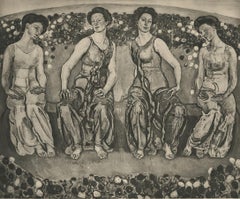
2018 marks the centenary anniversary of Ferdinand Hodler’s death. In that 100 years time, the art world’s esteem of this important artist has proved fickle. It has shifted from extolling his artistic merits during his lifetime to showing something of a feigned disdain- more reflective of the world political order than a true change of heart for Hodler’s work. After years of Hodler being all but a footnote in the annals of art history and generally ignored, finally, the pendulum has righted itself once again. Recent retrospective exhibitions in Europe and the United States have indicated not only a joyful rediscovery of Hodler’s art but a firm conviction that his work and world view hold particular relevance today. DAS WERK FERDINAND HODLERS is not only a collection of printed work reflecting the best of all of his painted work created up to 1914 just before the outbreak of World War I, the portfolio itself is an encapsulation of Hodler’s ethos, Parallelisme.
Hodler developed his philosophy of Parallelisme as a unifying approach to art which strips away detail in search of harmony. By means of abstraction, symmetry and repetition, Hodler sought ways to depict Nature’s essence and her fundamental, universal order. He believed these universal laws governing the natural, observable world extend to the spiritual realm. Symbolist in nature with Romantic undertones, his works are equally portraits of these universal concepts and feelings governing all life as they are a visual portrait in the formal sense. Whether his subject is a solitary tree, a moment in battle, mortal fear, despair, the awe inspired by a vast mountain range, a tender moment or even the collective conviction in a belief, Hodler unveils this guiding principle of Parallelisme.
Several aspects of Hodler’s portfolio reinforce his tenets of Parallelisme. The Table of Contents clearly preferences a harmonious design over detail. The two columns, consisting of twenty lines each, list the images by order of appearance using their German titles. The abbreviated titles are somewhat cryptic in that they obscure the identities of the sitters. Like the image Hodler presents, they are distillations of the sitter without any extraneous details. This shortening was also done in an effort to maintain a harmonious symmetry of the Table of Contents, themselves, and keep titles to a one-line limit. The twenty-fourth title: “Bildnis des Schweizerischen Gesandten C.” was so long, even with abbreviation, that it required two lines; so, for the sake of maintaining symmetry, the fortieth title: “Bauernmadchen” was omitted from the list. This explains why the images are not numbered. Hodler’s reasoning is not purely esoteric. Symmetry and pattern reach beyond mere formal design principles. Finding sameness and imposing it over disorder goes to the root of Hodler’s identity and his art. A Swiss native, Hodler was bi-lingual and spoke German and French. Each printed image, even number forty, have titles in both of Hodler’s languages. Certainly, there was a market for Hodler’s work among francophones and this inclusion may have been a polite gesture to that end; however, this is the only place in the portfolio which includes French. With German titles at the lower left of each image, Hodler’s name at bottom center and corresponding French titles at the lower right of each image, there is a harmony and symmetry woven into all aspects of the portfolio. This holds true for the page design, as it applies to each printed image and as it describes the Swiss artist himself. Seen in this light, Hodler’s portfolio of printed work is the epitome of Hodler’s Parallelisme. DAS WERK FERDINAND HODLERS is also one of the most significant documents to best tell the story of how Hodler, from Switzerland, became caught between political cross-hairs and how the changing tides of nations directly impacted the artist during his lifetime as well as the accessibility of his art for generations to come.
The Munich-based publisher of the portfolio, R. Piper & Co., Verlag, plays a crucial role in this story. Publishing on a wide range of subjects from philosophy and world religion to music, literature and the visual arts; the publisher’s breadth of inquiry within any one genre was equal in scope. Their marketing strategy to publish multiple works on Hodler offers great insight as to what a hot commodity Hodler was at that time. R.Piper & Co.’s Almanach, which they published in 1914 in commemoration of their first ten years in business, clearly illustrates the rapid succession- strategically calculated for achieving the deepest and broadest impact - in which they released three works on Hodler to hit the market by the close of 1914. DAS WERK FERDINAND HODLERS was their premier publication. It preceded C.A. Loosli’s Die Zeichnungen Ferdinand Hodlers, a print portfolio after 50 drawings by Hodler which was released in Autumn of 1914 at the mid-level price-point of 75-150 Marks; and a third less expensive collection of prints after original works by Hodler, which had not been included in either of the first two portfolios, was released at the end of that year entitled Ferdinand Hodler by Dr. Ewald Bender.
The title and timing of DAS WERK FERDINAND HODLERS' debut leaves little doubt as to the connection it has with another avant-garde portfolio of art prints, Das Werk Gustav Klimts, released in 5 installments from 1908 -1914 by Galerie Miethke in Vienna. Hodler, himself, was involved in Klimt’s ground-breaking project. As the owner of Klimt’s 1901 painting, “Judith with the Head of Holifernes” which appears as the ninth collotype print in the second installment of Das Werk Gustav Klimts, Hodler was obliged to grant access of the painting to the art printers in Vienna for them to create the collotype sometime before 1908. Hodler had been previously invited in 1904 to take part in what would be the last exhibition of the Vienna Secession before Klimt and others associated with Galerie Miethke broke away. In an interview that same year, Hodler indicated that he respected and was impressed by Klimt. Hodler’s esteem for Klimt went beyond the art itself; he emulated Klimt’s method aimed at increasing his market reach and appeal to a wider audience by creating a print portfolio of his painted work. By 1914, Hodler and his publisher had the benefit of hindsight to learn from Klimt’s Das Werk publication.
Responding to the sluggish sales of Klimt’s expensive endeavor, Hodler’s publisher devised the same diversified 1-2-3 strategy for selling Hodler’s Das Werk portfolio as they did with regards to all three works on Hodler they published that year. For their premium tier of DAS WERKS FERDINAND HODLERS, R. Piper & Co. issued an exclusive Museum quality edition of 15 examples on which Hodler signed each page. At a cost of 600 Marks, this was generally on par with Klimt’s asking price of 600 Kronen for his Das Werk portfolio. A middle-tiered Preferred edition of 30, costing somewhat less and with Hodler’s signature only on the Title Page, was also available. The General edition, targeting the largest audience with its much more affordable price of 150 Marks, is distinguishable by its smaller size.
Rather than use the subscription format Miethke had chosen for Klimt’s portfolios which proved to have had its challenges, R. Piper & Co. employed a different strategy. In addition to instantly gratifying the buyer with all 40 of the prints comprising DAS WERK FERDINAND HODLERS and the choice among three price points, they advertised in German journals a fourth possibility of ordering single prints from them directly. These printed images are easily discernible from the three complete folio editions. The paper size of the single purchased images is of the larger format like the Museum and Preferred editions, measuring 65 h x 50 w cm; however, the paper itself is the same copper print paper used in the General edition and then mounted on poster board. The publishing house positioned itself to be a direct retailer of Hodler’s art. They astutely recognized the potential for profitability and the importance, therefore, of having proprietary control over his graphic works.
R. Piper & Co. owned the exclusive printing rights to Hodler’s best work found in their three publications dating from 1914. That same year, a competing publication out of Weimar entitled Ferdinand Hodler: Ein Deutungsversuch von Hans...
Category
Symbolist 1910s Art
Materials
Paper
Crows in Field, Impressionist Woodcut by Raoul Dufy
By Raoul Dufy
Located in Long Island City, NY
Raoul Dufy, French (1877 - 1953) - Crows in Field, Year: 1912, Medium: Woodcut on laid paper, signed in pencil, Image Size: 1.5 x 3.5 inches, Size: 7.25 x 5.5 in. (18.42 x 13.97 cm...
Category
Impressionist 1910s Art
Materials
Woodcut
A Street in China [After Baron Adolph de Meyer]
By Baron Adolf de Meyer
Located in New York, NY
Photogravure #12 (from "Camera Work" #XL)
11 x 7.5 inches, sheet
9.5 x 6 inches, plate
This artwork is offered by ClampArt, located in New York City.
Category
Other Art Style 1910s Art
Materials
Photogravure
The Boat Race at Hammersmith, 1912, original vintage albumen print
Located in London, GB
Messrs Stearn
The 69th Boat Race at Hammersmith, 1912
Albumen print
16 x 21 cm
This photograph depicts Oxford and Cambridge neck and neck at Hammersmith in the 1912 Oxford-Cambridg...
Category
Photorealist 1910s Art
Materials
Silver Gelatin
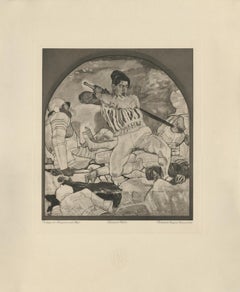
Les Drapeaux ( The Flags )
Located in Paonia, CO
Henri DeGroux (1866-1930) was a Belgian Symbolist painter, sculptor and lithographer. He was known for his allegorical, religious and historical subject matter. He became an inspired...
Category
Symbolist 1910s Art
Materials
Lithograph
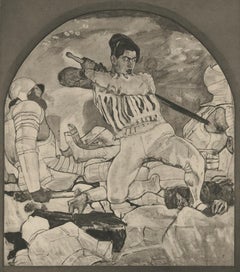
Prisonnier Au Repos (Prisoner At Rest) by Henri DeGroux
Located in Paonia, CO
Henri DeGroux (1866-1930) was a Belgian Symbolist painter, sculptor and lithographer. He was known for his allegorical, religious and historical subject matter. He became an inspired...
Category
Symbolist 1910s Art
Materials
Lithograph
Original Antique American Landscape Fishing Delaware River Oil Painting Framed
Located in Buffalo, NY
A lovely scene adeptly painted by listed American artist and illustrator Jan Nosek (1876 - 1966) who was active in the late 19th and early 20th Century. This scene created in the ea...
Category
American Modern 1910s Art
Materials
Oil, Board
St John's College, Cambridge Kitchen Bridge watercolour by Christopher Wren
Located in London, GB
To see our other views of Oxford and Cambridge, scroll down to "More from this Seller" and below it click on "See all from this Seller" - or send us a message if you cannot find the view you want.
The Wren Bridge, St John's College, Cambridge
Engraving
35 x 24 cm
Signed as a cypher lower right.
A 1911 watercolour of St John's College's Wren Bridge, also known as the Kitchen Bridge. There had been a wooden bridge in this location since the early days of the medieval Hospital of St John the Evangelist. Christopher Wren...
Category
Realist 1910s Art
Materials
Watercolor
Charcoal Portrait of a Lady Profile - Partner of Violet Oakley - Gay Interest
Located in Miami, FL
Academic study in profile of a high bow sitter on gray paper with white highlights.
Signed lower right and dated faintly 1916
Edith Emerson (July 27, 1888 – November 21, 1981) was a...
Category
Academic 1910s Art
Materials
Paper, Charcoal
Russian Ballet.
By David Bomberg
Located in New York, NY
BOMBERG, David. Russian Ballet. With 6 original color lithographs by David Bomberg. London; Hendersons. [The Bomb Shop] 1919. 8 3/8 x 10 1⁄2 Inches, 8 ...
Category
Abstract 1910s Art
Materials
Lithograph
Les Puiseuses d'Eau - Barbizon Figurative Landscape Pastel by Leon Lhermitte
Located in Marlow, Buckinghamshire
Signed figures in landscape pastel on canvas circa 1910 by French Barbizon painter Leon Augustin Lhermitte. The piece depicts a rural landscape with two women in traditional Breton c...
Category
Barbizon School 1910s Art
Materials
Canvas, Pastel
Two Women in Boat, Signed Impressionist Lithograph by Louis Marie Joseph Ridel
Located in Long Island City, NY
Louis Ridel, born February 12, 1866 in Vannes and died November 10, 1937 in Paris, is a painter, sculptor, medalist, French decorator. Louis Ridel studied at the Académie Julian then under the direction of Gustave Moreau at the Ecole des Beaux-Arts in Paris in 1889 (with Matisse, Camoin, Marquet and Rouault). He exhibited at the Salon des Artistes Français between 1893 and 1935, at the Salon des Tuileries between 1927 and 1934, the Universal Exhibition of Ghent in 1913 and the famous Georges Petit Gallery (1909-1910). The works of the artist are present in the museums of Nantes, Strasbourg, Pont-Aven but also Tokyo, Buenos Aires and Rio de Janeiro. This symbolist painter, friend of Aman-Jean, Maxence and Albert Besnard, represented essentially women of the bourgeoisie, ethereal and diaphanous or landscapes of his native region, Brittany. In 1896, he received an honorable mention from the Salon des artistes français, then a third class medal in 1898 and second class in 1900. In 1901, he was out of competition. In 1909, he was named Knight of the Legion of Honor. He receives official orders for the Senate, the Ministry of Public Works or the mayor of the 12th arrondissement of Paris.
Two Women in Boat...
Category
Post-Impressionist 1910s Art
Materials
Lithograph
Au Petit Dunkerque, Modern Etching by Ernest Laborde
Located in Long Island City, NY
Ernest Laborde, French (1870 - 1935) - Au Petit Dunkerque, Year: 1913, Medium: Etching, signed and dated in the plate, Image Size: 9 x 5.5 inches, Size: 11 x 7.5 in. (27.94 x 19.05...
Category
Modern 1910s Art
Materials
Etching
20th century etching figurative urban scene sketch black and white signed
Located in Milwaukee, WI
"Les Matelassiers (The Mattress Makers)" is an original etching by Auguste Brouet. It depicts people creating a mattress outside. The artist signed the...
Category
Modern 1910s Art
Materials
Etching
Fourth Darmstadt exhibition, Expressionist dragon poster, Bernhard Hoetger, 1914
By Bernhard Hoetger
Located in Chicago, IL
Bernhard Hoetger’s 1914 Expressionist poster for the Darmstadt Artists' Colony’s (Darmstädter Künstlerkolonie) fourth and final exhibition depicts the legend of Saint George slaying ...
Category
Expressionist 1910s Art
Materials
Offset
Sunbathing
Located in Fairlawn, OH
Sunbathing
Etching and color aquatint on watermarked Umbria Italy paper, c. 1915
Signed by the artist in pencil lower right (see photo)
Annotated: "No. 6" in pencil lower left (see photo)
An early color print by the artist
Condition: Excellent
Plate size: 11-3/4 x 15-7-8" (30 x 40.3 cm.)
Frame size: 21 x 26 1/8 x 1 inches
Provenance: Estate of the artist
By decent
Louis Oscar Griffith
(1875-1956)
Born in Greencastle, Indiana, Griffith grew up in Dallas, Texas where Texas artist and teacher Charles Franklin Reaugh recognized young “Griff’s” artistic talent. At age 18, Griffith moved to St. Louis where he attended the St. Louis School of Fine Arts.
In 1895, he moved to Chicago where he worked making color prints for the firm Barnes and Crosby. He attended the Art Institute of Chicago and during a brief stay in New York, the National Academy of Design. A successful commercial artist with a studio in the Chicago Loop...
Category
American Impressionist 1910s Art
Materials
Etching
Original Leonetto Cappiello Poster 1912 - Pate Eclair Stove Polish
Located in Boca Raton, FL
This vintage poster advertises the Éclair brand of stove polish paste, a product in high demand during a time when almost all stoves were made out of cast iron. The winged wheel is a...
Category
1910s Art
Materials
Lithograph
Original 'Blot it Out The Hun - his Mark' vintage 1918 WW1 postter
Located in Spokane, WA
Original The Hun ~ his Mark, Blot it Out with Liberty Bonds vintage American World War One poster. Archivail linen backed in mint condition, ready to frame. The images shown are...
Category
American Modern 1910s Art
Materials
Lithograph
John Sloan Etching, 1916, "McSorley's Back Room"
By John Sloan
Located in Phoenix, AZ
John Sloan (1871-1951) etching created 1916.
Edition: 100
Titled: “McSorley’s Back Room”
Plate size: 5 1/4" H x 7 " W
Sheet size: 7 1/2" H x 10 3/8" W
In excellent condition, unframe...
Category
1910s Art
Materials
Paper
Village Auction - British Slade School Art Deco figural landscape oil painting
Located in Hagley, England
This superb, large and vibrant Modern British figurative landscape oil painting is by noted Slade School artist Franklin White. Painted circa 1920 it was exhibited at the New England...
Category
Realist 1910s Art
Materials
Oil
$19,641 Sale Price
20% Off