The story of celebrated family-owned manufacturer Audemars Piguet and its universally acclaimed, widely coveted luxury watches begins deep in the Jura Mountains in western Switzerland.
The Vallée de Joux has been a haven of watchmaking since the late 18th century, when the residents of farming communities began creating timepieces during the winter months.
Jules Louis Audemars (1851–1918) and Edward Auguste Piguet (1853–1919), both natives of the region, were already deeply entrenched in the world of watchmaking when they joined forces to form a new house of horology near the end of the 19th century, an alliance that would be the start of a multigenerational family company. With complementary specialties within the field, Audemars and Piguet made the perfect pair in 1875: Audemars, the more technically minded of the two, oversaw production, while Piguet specialized in quality control and led the business and marketing parts of the outfit.
Audemars Piguet’s first major milestone came in 1892, when it created the world’s first minute-repeating movement for a wristwatch. (It was sold to Omega, whose origins date to 1848.) That was soon followed in 1899 with the Universelle pocket watch, a masterpiece of horology that boasted a perpetual calendar, minute repeater, alarm and chronograph with jumping seconds. It is still said to be the most complicated timepiece that Audemars Piguet has ever designed.
Between 1918 and 1919, both founders of Audemars Piguet had died and were replaced by their respective sons, incidentally both named Paul. Under the leadership of Paul Louis Audemars and Paul Edward Piguet, the watchmaker continued to innovate. It retained an ever-evolving technical focus and found new praise for its efforts, producing the world’s thinnest pocket-watch caliber in 1925, the first skeletonized pocket watch in 1934 and the world’s thinnest wristwatch in 1946.
When the quartz crisis of the 1970s left many watchmakers in the lurch, Audemars and Piguet found a creative solution, tapping the Geneva-born Gérald Genta to conceive the first-ever luxury watch in stainless steel. Launched at what would become the Baselworld watch and jewelry fair in 1972, the Royal Oak, with its octagonal face and integrated bracelet, would come to define the look of Audemars Piguet and revolutionize the luxury wristwatch industry, setting a standard that continues to this day.
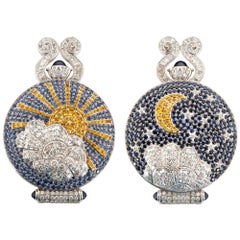
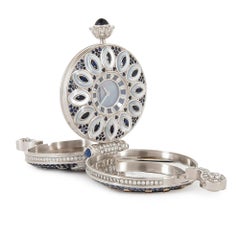
Find a collection of vintage Audemars Piguet wristwatches and pocket watches on 1stDibs.
A sophisticated clock design, whether it’s a desk clock, mantel clock or large wall clock for your living room, is a decorative object to be admired in your home as much as it is a necessary functional element. This is part of the reason clocks make such superb collectibles. Given the versatility of these treasured fixtures — they’ve long been made in a range of shapes, sizes and styles — a clock can prove integral to your own particular interior decor.
Antique and vintage clocks can whisk us back to the 18th and 19th centuries. When most people think of antique clocks, they imagine an Art Deco Bakelite tabletop clock or wall clock, named for the revolutionary synthetic plastic, Bakelite, of which they’re made, or a stately antique grandfather clock. But the art of clock-making goes way back, transcending continents and encompassing an entire range of design styles and technologies. In short, there are many kinds of clocks depending on your needs.
A variety of wall clocks can be found on 1stDibs. A large antique hand-carved walnut wall clock is best suited to a big room and a flat background given what will likely be outwardly sculptural features, while Georgian grandfather clocks, or longcase clocks, will help welcome rainswept guests into your entryway or foyer. An interactive cuckoo clock, large or small, is guaranteed to bring outsize personality to your living room or dining room. For conversation pieces of a similar breed, mid-century modern enthusiasts go for the curious Ball clock, the first of more than 150 clock models conceived in the studio of legendary architect and designer George Nelson.
Minimalist contemporary clocks and books pair nicely on a shelf, but an eye-catching vintage mantel clock can add balance to your home library while drawing attention to your art and design books and other decorative objects. Ormolu clocks dating from the Louis XVI period, designed in the neoclassical style, are often profusely ornate, featuring architectural flourishes and rich naturalistic details. Rococo-style mantel clocks of Meissen porcelain or porcelain originating from manufacturers in cities such as Limoges, France, during the 18th and 19th centuries, exude an air of imperial elegance on your shelves or side tables and can help give your desk a 19th-century upgrade.
On 1stDibs, find a range of extraordinary antique and vintage clocks today.