1940s Art

to
1,186
2,900
1,161
1,040
413
263
Overall Width
to
Overall Height
to
7,453
21,380
163,661
232,380
2,021
2,274
4,928
6,488
5,801
15,004
20,714
25,763
18,677
14,129
5,306
2,127
429
324
227
154
113
84
77
46
20
9
2
2
3,332
2,212
155
2,975
1,427
1,153
912
862
549
400
358
356
355
269
266
264
250
211
193
165
158
146
144
2,043
1,444
1,304
1,044
722
111
110
108
57
44
1,617
897
3,778
1,859
Period: 1940s
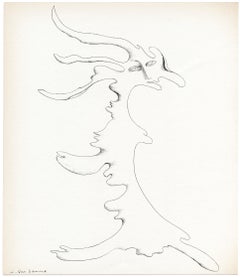
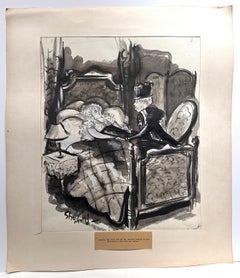
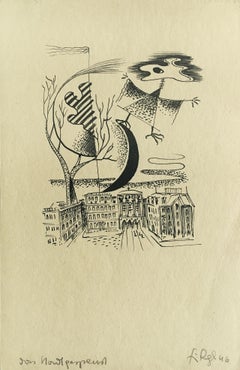
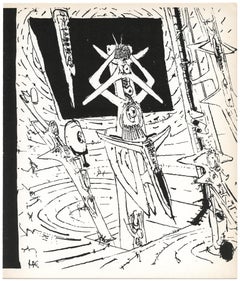
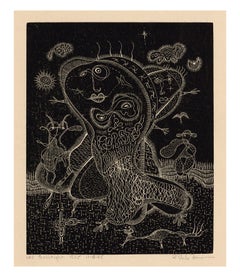
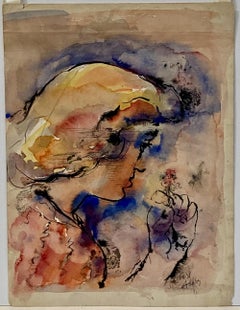
Nachtgespenst / Night ghost

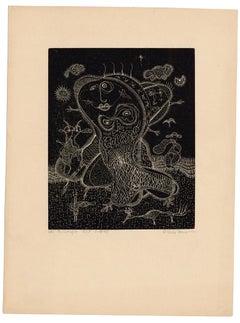
Nachtgespenst / Night ghost

Located in Wien, 9

Franz Rogler (1921 -1994) studied wood and stone sculpture with Wilhelm Gösser at the Graz School of Applied Arts and attended the master class for painting with Rudolf Szyszkowitz. During his studies he was drafted for military service and, together with fellow artist Hans Fronius, was deployed as a war painter in Austria, Germany, Italy, the former Yugoslavia, Greece and Russia. During this time he completed studies at the Academy in Zagreb and organised exhibitions in Austria. In 1944 he deserted and managed to escape to Switzerland, where he settled in Basel after his internment and came into contact with the Swiss Surrealists of "Group 33" and with the artists Hans Arp, Max Ernst and Meret Oppenheim through his friend Regula Weilenmann. After the end of the war, he studied at the Basel Art School with Walter Bodmer and Heinrich Müller, which introduced him to Constructivist art. In 1947 Rogler returned to Graz and became a member of the Graz Secession. From 1948 to 1950 he studied at the Vienna Academy with Albert Paris Gütersloh, before returning to Graz as a freelance artist in 1950. In 1953 he received the Art Prize of the City of Graz and his works were published in the first issue of the "Surrealist Publications" edited by Edgar Jené and Paul Celan...

Category

Surrealist 1940s Art

Materials

Paper, Charcoal

'Racehorses Turning For Home' circa 1940s Oil on Canvas

'Racehorses Turning For Home' circa 1940s Oil on Canvas

Located in Bristol, CT

Classic o/c 'pastel colours' horse-racing c1930s scene depicting four jockeys turning for home! Art Sz: 11 1/4"H x 8 1/2"W Frame Sz: 16"H x 12"W

Category

1940s Art

Materials

Pastel, Oil

Pierre Bonnard, Untitled, from Correspondances, 1944

Pierre Bonnard, Untitled, from Correspondances, 1944

By Pierre Bonnard

Located in Southampton, NY

This exquisite lithograph by Pierre Bonnard (1867–1947), titled Sans titre (Untitled), from the album Pierre Bonnard, Correspondances, originates from the 1944 edition published by E...

Category

Post-Impressionist 1940s Art

Materials

Lithograph

Original George Petty Pinup 'woman sitting with sunhat and phone

Original George Petty Pinup 'woman sitting with sunhat and phone

Located in Spokane, WA

Original George Petty pinup, woman sitting with big sunhat and telephone. Archivally linen backed vintage pinup in very fine condition, ready to frame. (Note: this lithograph is NOT removed from a pinup calendar!) Introducing the original George Petty pinup, a captivating piece of art that showcases the iconic style and exquisite talent of George Petty himself. This artwork features a stunning woman adorned with a large red outlined sun hat, donning a classic one-piece bathing suit and high heels. The addition of a telephone in her right hand adds an intriguing element, making this pinup a unique and visually striking piece. The attention to detail and expert craftsmanship are evident in every brushstroke, bringing the woman to life and capturing the essence of Petty's artistic mastery. As an original George Petty pinup, this artwork holds historical and artistic value, making it a collectible and valuable addition to any art enthusiast's repertoire. About Petty: George Petty was an American pin-up artist from the 1920s to the 1970s. His pin-up art appeared primarily in Esquire and True magazine, but was also in calendars marketed by Esquire, True and Ridgid Tool Company. Petty's Esquire gatefolds originated and popularized the magazine device of centerfold spreads. Reproductions of his work were widely rendered by military artists as nose art decorating warplanes during the Second World War, including the Memphis Belle...

Category

American Realist 1940s Art
Materials

Lithograph

Fantasy
Fantasy

Fantasy

By Bela Kadar

Located in London, GB

BELA KADAR 1877-1956 Budapest 1877-1956 (Hungarian) Title: Fantasy, circa 1940 Technique: Original Hand Signed Gouache on paper size: 46.2 x 29.4 cm / 18.2 x 11.6 in Additional Information: This work is a guache painting by the famous Hungarian artist Bela Kadar. It is hand signed in pencil "Kadar Bela" in the lower right corner of the paper. Exhibitions: New York, Shepherd & Derom Galleries, Hungarian Modernism, 29 April-2 July 2010, no.12. Tel Aviv, Galerie le Minotaure...

Category

Cubist 1940s Art

Materials

Gouache

"Untitled"
"Untitled"

"Untitled"

By Nahum Tschacbasov

Located in Southampton, NY

Original etching on archival paper. Signed and dated lower right, 1947. Artist proof. Condition: Good. Provenance: Estate of the artist. Image size 6.75 by 5 inches. Sheet size 15...

Category

Surrealist 1940s Art
Materials

Archival Paper, Etching

St. Peter's Basilica, Rome

St. Peter's Basilica, Rome

Located in Genève, GE

Work on wood Green wooden frame and gold borders 70 x 81 x 2.6 cm

Category

Italian School 1940s Art

Materials

Oil

Untitled (original framed watercolor on paper)

Untitled (original framed watercolor on paper)

By Rolph Scarlett

Located in Aventura, FL

Original watercolor on paper. Initialed lower right by Rolph Scarlett. Artwork size 7.75 x 8.75 inches. Frame size 17.5 x 21.5 inches. Artwork is in excellent condition. Certifi...

Category

Abstract 1940s Art

Materials

Paper, Watercolor

Pablo Picasso, Untitled, from Carmen, 1949

Pablo Picasso, Untitled, from Carmen, 1949

By Pablo Picasso

Located in Southampton, NY

This exquisite engraving by Pablo Picasso (1881–1973), titled Sans titre (Untitled), from the folio Picasso, Carmen (Picasso, Carmen), originates from the 1949 edition published by L...

Category

Cubist 1940s Art

Materials

Engraving

Woman and Child
Woman and Child

Woman and Child

By John Edward Costigan

Located in Sheffield, MA

John Edward Costigan, N.A. American, 1888-1972 Woman and Child Oil on canvas Signed ‘J.E. Costigan N.A.’ lower left 24 by 30 in. W/frame 32 by 38 in. John Costigan was born of Irish-American parents in Providence, Rhode Island, February 29, 1888. He was a cousin of the noted American showman, George M. Cohan, whose parents brought the young Costigan to New York City and was instrumental in starting him on a career in the visual arts. They were less successful in encouraging him to pursue formal studies at the Art Students League (where, however, he later taught) than in exposing him to the commercial art world through the job they had gotten him with the New York lithographing firm that made their theatrical posters. At the H. C. Miner Lithographing Company, Costigan worked his way up from his entry job as a pressroom helper, through various apprenticeships, to the position of sketch artist. In the latter capacity he was an uncredited designer of posters for the Ziegfeld Follies and for numerous silent films. Meanwhile, he had supplemented his very meager formal studies in the fine arts with a self-teaching discipline that led to his first professional recognition in 1920 with the receipt of prizes for an oil painting and watercolor in separate New York exhibitions. A year earlier, Costigan had wed professional model Ida Blessin, with whom he established residence and began raising a family in the sleepy little rural New York hamlet of Orangeburg, the setting for the many idyllic farm landscapes and wood interiors with which he was to become identified in a career that would span half a century. John Costigan’s first national recognition came in 1922 with his winning of the coveted Peterson Purchase prize of the Art Institute of Chicago for an oil on canvas, “Sheep at the Brook.” It marked the start of an unbroken winning streak that would gain him at least one important prize per year for the remainder of the decade. The nation’s art journalists and critics began to take notice, making him the recurring subject of newspaper features and magazine articles. The eminent author and critic Edgar Holger Cahill was just a fledgling reporter when he wrote his first feature, “John Costigan Carries the Flame,” for Shadowland Magazine in 1922. Costigan had his first one-man show of paintings at the Rehn Gallery on New York’s 5th Avenue in November, 1924, to be followed less than three years later by another at the Art Institute of Chicago. In addition, Costigan’s work has been—and continues to be included, side-by-side with that of some of America’s most high-profile artists, in museum and gallery exhibitions throughout the country. His renown had peaked in the early 1930s, by which time his work had been honored with nearly every major award then being bestowed in the fine arts and had been acquired for the permanent collections of several prestigious American museums, including New York’s Metropolitan (which only recently, in 1997, deaccessioned his “Wood Interior,” acquired in 1934). Although Costigan’s celebrity had ebbed by the late 1930s, the Smithsonian Institution saw fit in 1937 to host an exhibition exclusively of his etchings. And, in 1941, the Corcoran Gallery (also Washington, D.C.) similarly honored him for his watercolors. (Another Washington institution, the Library of Congress, today includes 22 Costigan etchings and lithographs in its permanent print collection.) During World War II, Costigan returned briefly to illustrating, mainly for Bluebook, a men’s pulp adventure magazine. A gradual revival of interest in his more serious work began at the end of the war, culminating in 1968 with the mounting of a 50-year Costigan retrospective at the Paine Art Center and Arboretum in Oshkosh, Wisconsin. Oils, watercolors and prints were borrowed from museums and private collections throughout the country, and the exhibition was subsequently toured nationally by the Smithsonian Institution. John Costigan died of pneumonia in Nyack, NY, August 5, 1972, just months after receiving his final prestigious award —the Benjamin West Clinedinst Medal of the Artist’s Fellowship, Inc., presented in general recognition of his “...achievement of exceptional artistic merit...” in the various media he had mastered in the course of his career. This painting depicts one of the artist's favorite themes --the farm family bathing...

Category

Post-Impressionist 1940s Art
Materials

Oil

Sanguine Nude Female

Sanguine Nude Female

By P. Balet

Located in Houston, TX

Sanguine female nude drawing in reclined pose by French artist P. Balet, 1947. Original artwork on paper displayed on a white mat with a gold border. Mat fits a standard-size frame...

Category

1940s Art

Materials

Color Pencil

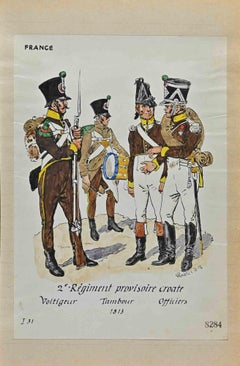
Le Croates en Allemagne (French Army)-Original Drawing By Herbert Knotel - 1940s

Le Croates en Allemagne (French Army)-Original Drawing By Herbert Knotel - 1940s

Located in Roma, IT

Le Croates en Allemagne is an original drawing in ink and watercolor realized by Herbert Knotel in 1930/40s. Good condition except for being aged. The artwork is depicted through strong lines in well-balanced conditions. Herbert Knotel was a german artist, son and pupil of the famous uniformologist and military historian Richard Knotel. He served as officer under Marshal Hindenburg in the Prussian Army...

Category

Modern 1940s Art

Materials

Ink, Watercolor

Pou Pou
Pou Pou

Pou Pou

Located in Milford, NH

A wonderful cement sculpture cast of the artist’s Persian cat Pou Pou by American artist Harriet Whitney Frishmuth (1880-1970). Harriet was born in Philadelphia, PA, and, as a teenager , she studied sculpture in Paris classes (with critiques by Auguste Rodin) and later enrolled at the Academie Colarossi there. On her return to the United States she studied with Gutzon Borglum at the Art Students League, served an apprenticeship with Karl Bitter...

Category

1940s Art

Materials

Cast Stone

Agony, Motif - Drawing by Arshile Gorky - 1946

Agony, Motif - Drawing by Arshile Gorky - 1946

By Arshile Gorky

Located in Roma, IT

Agony, Motif is a contemporary artwork realized by Arshile Gorky in 1946. Ink, pen and wax crayon on paper. Incudes frame: 41.5 x 38.5 Good conditions (little tears and shading of...

Category

Modern 1940s Art

Materials

Wax Crayon, Ink, Pen

A Stylish Vintage 1940s Fashion Study, Design for Women's Hats, Lily Daché

A Stylish Vintage 1940s Fashion Study, Design for Women's Hats, Lily Daché

Located in Chicago, IL

A stylish, vintage, 1940s fashion study featuring a colorful design for a women's hat by Lilly Daché. Artwork size: 11 x 8 1/4 inches. Archivally matted to 16 x 12 inches. Water...

Category

American Modern 1940s Art

Materials

Paper, Watercolor, Pencil

original etching

original etching

By André Lhote

Located in Henderson, NV

Medium: original etching. Printed in 1946 at the atelier Quesneville on BFK Rives paper and published in a limited edition of 300 for the "Alternance" portfolio (a collective art and...

Category

1940s Art

Materials

Etching

Weegee "Distortion: Stripes"

Weegee "Distortion: Stripes"

By Weegee

Located in Toronto, Ontario

Innovative, provocative, inimitable - these are just a few of the words to describe America's boldest photographer. Arthur Fellig, better known as Weegee (1899-1968) was a ground-breaking, successful (and notorious) photojournalist. His images shot on the streets of New York City are iconic and influential. In the 1930s he became the first New York City press photographer to obtain permission to install a police radio in his car. This allowed him to follow the city's first responders and to document their duties; responding to fire, crime, debauchery and of course, murder. By the early 1940s Weegee was experiencing fatigue with crime reportage. Ironically, this was also the point when he finally began experiencing professional validation and acclaim, to the point of being a minor celebrity. Notably in 1941 he was included in The MoMA's seminal "50 Photographs by 50 Photographers" (curated by Edward Steichen). The museum would also acquire five Weegee photographs...

Category

American Modern 1940s Art

Materials

Silver Gelatin

Original Vintage French Provence Travel Poster by Jal 1945 SNCF

Original Vintage French Provence Travel Poster by Jal 1945 SNCF

By JAL

Located in Boca Raton, FL

Just at the conclusion of the Second World War, there was a push to stimulate visitors to France and in this image we are focused on the Provence region in the south of France. The i...

Category

1940s Art

Materials

Lithograph

Antique Dappled Sunlit Barn New England Impressionist Landscape Oil Painting

Antique Dappled Sunlit Barn New England Impressionist Landscape Oil Painting

Located in Buffalo, NY

Antique American impressionist landscape oil painting. Oil on canvas. Framed. Measuring: 20 by 23 inches overall, and 18 by 20 painting alone. Unsigned. Nicely framed. Excellent ...

Category

Impressionist 1940s Art
Materials

Oil

Antique American Foggy Winter Cityscape Framed Winter Impressionist Oil Painting

Antique American Foggy Winter Cityscape Framed Winter Impressionist Oil Painting

Located in Buffalo, NY

Vintage American impressionist oil painting. Oil on canvas, lain to board. Unsigned. Framed. Provenance from a Sag Harbor, NY collection. Measuring: 13 by 12 inches overall. Handsom...

Category

Modern 1940s Art
Materials

Oil

8:30 EXPRESS

8:30 EXPRESS

By Letterio Calapai

Located in Portland, ME

Calapai, Letterio (American, 1902-1993). 8:30 EXPRESS. Wood-engraving, 1943. Edition of 27, numbered "1/27" and titled and signed in pencil. 5 5/8 x 8 3/8 inches (image), 9 1/8 x 12 ...

Category

1940s Art
Materials

Woodcut

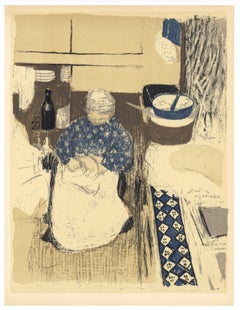
"A travers champs" lithograph

"A travers champs" lithograph

Located in Henderson, NV

Medium: lithograph (after the original Edouard Vuillard lithograph). Printed on Renage wove paper in 1948 by the atelier Mourlot and published in an edition of 2500. Size: 9 1/2 x 12...

Category

1940s Art
Materials

Lithograph