Maurice Randall

to
1
1
1
1
1
1
1
1
1
1
1
1
1
1
12,337
3,859
2,500
2,227
Creator: Maurice Randall
Painting of St Ives Cornwall Water Colour Pictures
By Maurice Randall
Located in Staffordshire, GB
St Ives Water Colour Painting Cornwall 19th Century England by Maurice Randall (1865-1950) Fisherman gathered around the notice board on Smeatons Pier, Saint Ives, Cornwall showing b...
Category

19th Century English Victorian Antique Maurice Randall

Materials

Canvas

Related Items
Pair of 18 Century Paintings of St Francis Xavier and St Carlo Borromeo
Located in Vancouver, British Columbia
A beautifully executed and rare complementary pair of oil on canvas paintings depicting two of the moist famous and important counter reformation catholic saints St Francis Xavier and St Carlo Borromeo shown in scenes of what the respective saints are mostly famous for. St Francis Xavier for the conversion to Christianity of many S. E Asian countries notably India and St Carlo Borromeo shown asking the Virgin Mary to intercede for the cessation of the terrible plague of 1576. The paintings are presented in refreshed gilded carved wooden frames and are unsigned. St. Francis Xavier was born in Spanish Navarre in 1506 and in 1528, he met St. Ignatius of Loyola. He became one of the seven in 1534 who founded the Society of Jesus (Jesuit Order). In 1536, he left the University of Paris and joined St. Ignatius in Venice. He was ordained in 1537, and in 1540 after the Society was recognized by the Pope, he journeyed to the Far East. Francis Xavier first evangelized the Portuguese colony of Goa in India, then Travancore, Ceylon, Malacca, and the surrounding islands. From there he journeyed to Japan, where he gave Christianity such deep roots that it survived centuries of violent persecution. He died on Sancian Island in 1552, while he was seeking to penetrate into the great forbidden land of China. Despite language problems, lack of funds, resistance from the Europeans as well as the natives, he persevered. St. Francis converted more people in his life than anyone since the Apostle St. Paul. He baptized over 3 million people, converted the entire town of Goa in India, and he labored in India, Pakistan, Bangladesh, Sri Lanka, Malaysia, Indonesia, Singapore, and Japan. He was truly a missionary par excellence. St Carlo Borromeo (1538-1584), was a Cardinal of the Holy Roman Catholic Church and Archbishop of Milan from 1565 to 1583. He was described in the decree for his canonization, as “a man, even while the world smiles on him with the utmost flattery, he lives crucified to the world, spiritually, trampling earthly things, seeking continuously the things of heaven, emulating the life of the Angels on earth, in his thoughts and actions. The plague began in the month of August that year. Milan was celebrating joyfully the arrival of Don John of Austria, on his way to Flanders, where he had been appointed governor. The city authorities were abuzz with excitement in their desire to bestow the highest honours on the Spanish prince, but Charles, who had been Archbishop of the diocese for six years, was following with concern the news coming from Trento, Verona and Mantua, where the plague had begun claiming victims. The first cases exploded in Milan on August 11th, right at the moment when Don John of Austria arrived. The victor of Lepanto, followed by the governor, Antonio de Guzmán y Zuñiga, departed the city, while Carlo Borromeo, who was in Lodi for the Bishop’s funeral, returned in haste. Confusion and fear reigned in Milan and the Archbishop dedicated himself completely to assisting the sick and ordering public and private prayers. Dom Prosper Guéranger sums up his infinite charity in this way: “In the absence of local authorities, he organized the health service, founded or renewed hospitals, sought money and provisions, decreed preventive measures. Most importantly though, he took steps to ensure spiritual help, assistance to the sick and the burial of the dead. Unafraid of being infected, he paid in person, by visiting hospitals, leading penitential processions, being everything to everyone, like a father and true shepherd” St. Carlo was convinced that the epidemic was “a scourge sent by Heaven” as chastisement for the sins of the people and that recourse to spiritual measures was necessary to fight against it: prayer and penitence. He rebuked the civil authorities for having placed their trust in human measures rather than divine ones. “Hadn’t they prohibited all the pious gatherings and processions during the time of the Jubilee? For him, and he was convinced of it, these were the causes of the chastisement. The magistrates who governed the city continued to oppose public ceremonies, out of fear that the large gathering of people would spread contagion, but Charles “who was guided by the Divine Spirit” – recounts another biographer – convinced them by citing various examples, among which was the one regarding St. Gregory the Great who had halted the plague devastating Rome in 590. While the pestilence spread, the Archbishop then ordered three general processions to take place in Milan on the 3rd, 5th and 6th of October, “to placate the wrath of God”. On the first day, the Saint, despite it not being the Lenten season, placed ashes on the heads of the thousands gathered, exhorting them to penitence. Once the ceremony was over, the procession went to the Basilica of St. Ambrose. Charles put himself at the head of the people, dressed in a hooded purple robe, barefoot, penitential cord at his neck and large cross in his hand. The second procession led by the Cardinal headed towards the Basilica of San Lorenzo. The third day the procession from the Duomo headed for the Basilica of Santa Maria at San Celso. St. Carlo carried in his hands a relique of Our Lord’s Holy Nail, which had been given by the Emperor Theodosius to St. Ambrose in the 5th century. The plague didn’t show any signs of waning and Milan appeared depopulated, as a third of its citizens had lost their lives and the others were in quarantine or didn’t dare leave their homes. The Archbishop ordered about twenty stone columns with a cross at the top to be erected in the main squares and city crossroads, allowing the inhabitants from every quarter to take part in the Masses and public prayers - from the windows of their homes. One of Milan’s protectors was St. Sebastian, the martyr the Romans had recourse to during the plague in 672. St. Charles suggested that the magistrates of Milan reconstruct the sanctuary dedicated to him, which was falling into ruins, and to celebrate a solemn feast in his honour for ten years. Finally in July 1577, the plague ceased and in September the founding stone was laid in the civic temple of St. Sebastian, where on January 20th every year, even today a Mass is offered to recall the end of the scourge. St.Carlo Borromeo died on November 3rd 1584 and was buried in the Duomo of Milan. His heart was solemnly translated to Rome, in the Basilica of Saints Ambrose...
Category

Late 18th Century French Baroque Antique Maurice Randall

Materials

Canvas

Antique Water Colour Attlio Simonetti 'The Music Recital' 19th Century
Located in London, GB
This is a beautiful antique watercolour entitled "The Music Recital" by Attillio Simonetti (Italian 1843 - 1925)  signed Attillio Simonetti, Roma, bottom right and Circa 1890 in date...
Category

19th Century Italian Antique Maurice Randall

Materials

Canvas

TWO Framed Silhouette Pictures of Military Gentlemen, 20thC
Located in Lincoln, Lincolnshire
These are TWO silhouette coloured portrait pictures of Military Gentlemen, in wood frames, dating to the 20th Century . Each picture is set within an oval mount within wood frames, ...
Category

20th Century English Georgian Maurice Randall

Materials

Glass, Paper, Softwood

Decorating with Pictures by Stephanie Hoppen
Located in valatie, NY
Decorating With Pictures by Stephanie Hoppen. Published by Clarkson Potter, 1991. Stated 1st Ed hardcover with dust jacket. This book inspires the rea...
Category

1990s Maurice Randall

Materials

Paper

Decorating with Pictures by Stephanie Hoppen
$85
H 10.25 in W 10 in D 0.75 in
Pair of 19th Century Chinese Reverse-Painted Mirror Pictures
Located in Rome, IT
A pair of Chinese reverse glass painting representing women and a child in a garden pavillion. Original "Chinese Chippendale" framing. China for expo...
Category

19th Century Chinese Chinese Export Antique Maurice Randall

Materials

Art Glass

Pair of 19th Century Chinese Reverse-Painted Mirror Pictures
$8,630 Sale Price / set
20% Off
H 21.66 in W 27.56 in D 3.15 in
Pair of Rustic Adirondack Hunt Scene Pictures
Located in Queens, NY
PAIR of Rustic Adirondack style (1940s) mezzotint hunt scene pictures framed in carved bark (PRICED AS PAIR) (Similar pair: 056178)
Category

20th Century American Rustic Maurice Randall

Materials

Wood

Large decorative painting of birds in water, France 1960s
Located in Meulebeke, BE
France / 1960 / Painting / wood, canvas / Mid-century / Vintage French painting from the 1960s featuring two graceful birds standing in low water. This decorative painting has a bea...
Category

1960s French Mid-Century Modern Vintage Maurice Randall

Materials

Canvas, Wood

Cornwall Iron Banks Original Oil Painting
Located in Annville, PA
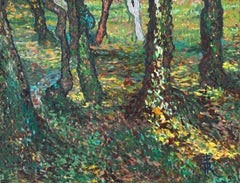
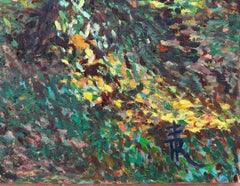
A very interesting and unusual Cornwall Iron Banks Original Oil Painting by artist J. Earle Pfoutz. The painting is produced on canvas and comes complete with what appears to be an original artist decorated/painted frame with later touch ups. The Cornwall Iron Banks Original Oil Painting is signed on the front by the artist and appears to be dated 1948 on the rear. Known for his unusual subjects Pfoutz outdid himself with this effort, capturing the workings of one of the largest iron ore mines in the eastern United States, located in Cornwall PA. This mine and others in the area that came before it, played a crucial role in the development of the United States of America from the Revolutionary War, through the industrial revolution up until the 1970’s when the mine was flooded during Hurricane Agnes and closed operations. Overall frame Size approximately 26″ wide x 2″ deep x 30″ high J. Earle Pfoutz had a long and distinguished career as a self trained artist. More can be learned about him from reading this article produced by Gary Hawbaker at askART Earle Pfoutz Born: 1891 – Lancaster, Pennsylvania Died: 1957 Known for: Landscape, figure, still life painting An image of J Earle Pfoutz Biography from the Archives of askART J. Earle Pfoutz (John Earle Pfoutz) – (Oct 23, 1891-Nov 9, 1957) “A seventh generation descendant of a Swiss family which arrived in America early in the 17th Century, J. Earle Pfoutz was born in Lancaster, PA, son of John Bachman and Susan Allison Pfoutz. He painted houses for a living and pictures for a life. A self-taught artist, described as a primitive, he was distinctive for his vivid imagination and bold color application. He painted hundreds of Lancaster County scenes. Pfoutz traveled through the hills near his home and along the Susquehanna River in search of scenes. He began painting with a brush when he was fourteen, but added a palette knife after suffering an eye injury. He completed eighth grade in the Lancaster Public Schools and there his formal education ended. However, the Department of Public Instruction of the State of Pennsylvania thought so highly of his work as an artist that officials certified him as an art instructor and he taught for a year in the York (PA) public schools. He also was an art instructor under the program for disabled veterans, sponsored by the Veterans Administration, when he gave private instruction to veterans in their homes. In 1947, J. Earle Pfoutz finally earned national recognition as an artist. His painting, Opalescent October, was chosen by the Museum of Art of Dayton Ohio, to travel all over the country for a year with its Group Exhibition. Described as a “very colorful, calm scene, iridescent in color, sweeping in design,” the painting started on its journey around the country early in 1948. In an interview with the Sunday News (Lancaster, PA – Nov 2, 1947), Pfoutz stated that he didn’t know whether he was a “primitive” or an “impressionist.” No master taught him, no school channeled his style. “Sometimes I didn’t eat, but I always managed to paint,” he recalled. Many of his hundreds of canvases -most of them not sold, but given away to friends – found their way to other parts of the country. “I never remember the day when I did not love color,” Pfoutz said. “I was about 12 years old when I saw my first palette – a string of different colored paint paddles that graced the stores of that day. As a boy I had two great desires. One was to be able to eat all the strawberry jam I could, and the other to possess a string of those beautiful paint paddles. Well, I’ve got my fill of jelly, but I’ve never yet got my fill of beautiful colors.” In 1950, Pfoutz’s one man show of paintings made front page headlines in the Lancaster Intelligencer Journal: “Most of the twenty oil paintings on exhibition are landscapes, although there are several interesting figure studies. Colors again, as in all Pfoutziana are rich and full-bodied, but for the most part not as startlingly as in some of the earlier work. Most of the paintings were done during the past year, and also reveal the painter’s characteristic heavy impasto technique, in which the rich swirls of paint carry their own message. Among the figures, The Banjo Picker, and The Magician, are the most provocative. Both are character studies; the first being of a tramp musician whose drab clothing is set-off by a luminous aqua blue background. Modern in feeling and treatment is The Magician, a clown-faced wizard whose spinning ball in the air suggests the fourth dimension – space. The use of the primary colors in this picture serves to emphasize the theme effectively. A large colorful landscape, Opalescent October, depicting rolling hills against a late afternoon sky is new to Lancastrians, as it has just returned from Dayton, Ohio, where it hung in the Dayton Art Institute. Another landscape with soft dreamy colors is Fantasie D’Autumne, and one of the loveliest pictures in the show. Pennsylvania Dutch Country is another with eye appeal, and was one of the works which was hung in the Old Customs House in Philadelphia during Pennsylvania Week, and before that in a collection of Pfoutz work in the same place. In deep contrast to the sunny skies and brilliant foliage of many of the pictures, is the somewhat morbid Worry, in which the center of interest is a tremendous rat. This, the painter explains, was symbolic of 1948 in China, which was ‘The Year of The Rat’ in the Chinese calendar. Background material for the picture was furnished to Pfoutz by author Pearl Buck. Other pictures include Autumn Prelude, Miners Village, painted at Cornwall, PA; Humid Day, Saint Peters Kierch, at Middletown, PA; Lady Pfoutz, inspired by the painter’s wife; Sun Flowers, Sentimental Journey, Gyne, Luzon Woman, Old Bridge, The Cow Path. Lemures, based on Roman mythology, and Ethiopian, painted from an ebony wood carving...
Category

Early 20th Century North American Maurice Randall

Materials

Canvas, Paint

Cornwall Iron Banks Original Oil Painting
$3,245
H 30 in W 26 in D 2 in
A Gorgeous Quality Water Colour Painting by Irish Artist A. D. McCormick
Located in Dublin, IE
A gorgeous quality water colour painting by Irish artist A.D. McCormick R.I. (1860-1943). "Embarrassing Congratulations" signed 'A.D. McCormick' (lower right). Exhibited Royal Inst...
Category

Early 20th Century Irish Maurice Randall

Materials

Canvas, Giltwood, Paint

Water Colour Coastal Landscape, 19th Century, English
Located in BUNGAY, SUFFOLK
19th Century coastal landscape water colour, monogram lower right. Delightful picture capturing the softness light and colours of the English coast on an overcast day Wide compo...
Category

1850s English Romantic Antique Maurice Randall

Materials

Paper

Water Colour Coastal Landscape, 19th Century, English
$4,090
H 11.03 in W 16.15 in D 1.19 in
Chinese Water Color Painting of Riverside Village
Located in Greenwich, CT
Framed Chinese water color of riverside village with one artist seal. Overall size: 19.5 width 26" high image size 14 1/4" width 20" high. I am pl...
Category

1980s Chinese Modern Vintage Maurice Randall

Materials

Paper

Chinese Water Color Painting of Riverside Village
$550 Sale Price
26% Off
H 26 in W 19.5 in D 1 in
19th c. English School Oil Painting on Canvas, of Saint Ives
Located in Lambertville, NJ
19th c. English School oil on canvas, untitled, depicts a street scene with mother and child standing in front of what appears to be Butcher Shop, with the ocean in the background, ...
Category

19th Century English Antique Maurice Randall

Materials

Canvas, Giltwood

Previously Available Items
Original Vintage Union Castle Line Poster South & East Africa Royal Mail Service
By Maurice Randall
Located in London, GB
Original vintage Union-Castle Line cruise travel poster advertising their Royal Mail service weekly sailings to South & East Africa - head office 3 Fenchurch Street, London, EC3. Gre...
Category

1920s British Vintage Maurice Randall

Materials

Paper

Original 1920s Blue Funnel Line Travel Poster: South Africa, Australia, Far East
By Maurice Randall
Located in London, GB
Original vintage travel advertising poster for “the Blue Funnel Line, Alfred Holt & Co Liverpool, South Africa / Australia / and to The Far East / appl...
Category

1920s British Vintage Maurice Randall

Materials

Paper

Maurice Randall furniture for sale on 1stDibs.

Maurice Randall furniture are available for sale on 1stDibs.

Still Thinking About These?

All Recently Viewed