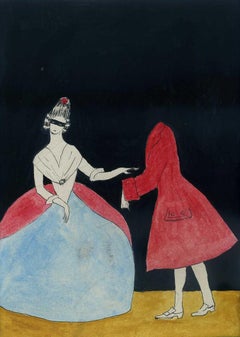
Early 1900s Art

to
311
925
464
296
190
162
Overall Width
to
Overall Height
to
7,570
21,488
164,297
234,717
2,298
4,968
6,480
5,738
15,228
20,895
26,030
18,806
14,127
5,379
327
242
112
99
10
10
7
5
4
4
1
1,035
830
49
1,142
650
402
356
331
187
110
104
98
97
85
84
77
77
77
76
76
76
69
62
935
661
483
375
369
58
45
27
24
17
874
229
1,079
941
Period: Early 1900s
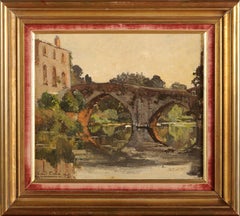
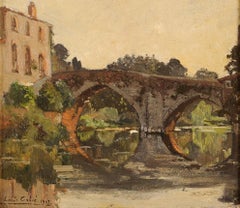
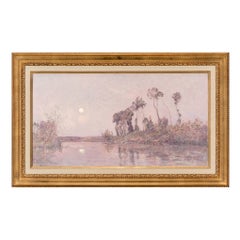
Pont du Chemin de Fer à Moret by Georges Manzana Pissarro - River scene

Pont du Chemin de Fer à Moret by Georges Manzana Pissarro - River scene

By Georges Henri Manzana Pissarro

Located in London, GB

Pont du Chemin de Fer à Moret by Georges Manzana Pissarro (1871-1961) Oil on canvas 54.5 x 65.2 cm (21 ¹/₂ x 25 ⁵/₈ inches) Signed lower right, manzana. Titled and date on the stret...

Category

Post-Impressionist Early 1900s Art

Materials

Canvas, Oil

“Orientalist Tropical Sunset”

“Orientalist Tropical Sunset”

By Paul Pascal

Located in Southampton, NY

Original watercolor and gouache of a colorful tropical sunset by the well known French artist, Paul Pascal. Pascal is known for his watercolor/gouache orientalist paintings. Signe...

Category

Academic Early 1900s Art

Materials

Watercolor, Gouache, Archival Paper

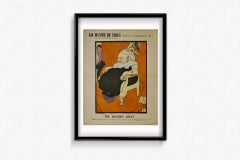
original etching

original etching

Located in Henderson, NV

Medium: original etching. Printed in 1900 and published in Leipzig, Germany for Zeitschrift für Bildende Kunst. This impression is printed on cream wove paper, and the plate size is ...

Category

Realist Early 1900s Art

Materials

Etching

Father Rushing Home with an Armload of Gifts, Saturday Evening Post Cover

Father Rushing Home with an Armload of Gifts, Saturday Evening Post Cover

By Joseph Christian Leyendecker

Located in Fort Washington, PA

Father Rushing Home with an Armload of Gifts, The Saturday Evening Post Cover, December 4, 1909. A charming original cover for The Saturday Evening Post, published December 4, 1909,...

Category

Early 1900s Art

Materials

Canvas, Oil, Masonite

"Lady of Summer"
"Lady of Summer"

"Lady of Summer"

By Martha Walter

Located in Lambertville, NJ

Jim’s of Lambertville is proud to offer this artwork by: Martha Walter (1875-1976) Born in Philadelphia in 1875, Martha Walter attended Girls’ High School followed by the Pennsylva...

Category

American Impressionist Early 1900s Art

Materials

Oil, Board

'The Bath' — Meji Era Cross-Cultural Woman Artist

'The Bath' — Meji Era Cross-Cultural Woman Artist

By Helen Hyde

Located in Myrtle Beach, SC

Helen Hyde, 'The Bath', color woodblock print, edition not stated, 1905, Mason & Mason 59. Signed in pencil in the image, lower right. Numbered '96' in pencil in the image, lower left. The artist's monogram in the block, lower left, and 'Copyright, 1905, by Helen Hyde.' upper right. A superb impression with fresh colors on tissue-thin cream Japanese paper; the full sheet with margins (7/16 to 1 5/8 inches), in excellent condition. Matted to museum standards, unframed. Image size 16 1⁄4 x 10 1⁄8 in. (413 x 260 mm); sheet size: 19 1⁄4 x 11 1⁄8 in. (489 x 283 mm). Literature and Exhibition: Back cover illustration of the catalog of the artist’s prints, 'Helen Hyde', Smithsonian Institution Press, 1990; 'The International Block Print Renaissance, Then And Now, Block Prints In Wichita, Kansas, A Centennial Celebration — 1922-2022', Barbara J. Thompson, Wichita Art Museum, 2022 (back cover). Impressions of this work are held in the following collections: Achenbach Foundation for Graphic Arts, Art Institute of Chicago, Fine Arts Museums of San Francisco (De Young), Harvard Art Museums, Library of Congress, Metropolitan Museum of Art, New York Public Library, Smithsonian American Art Museum, Terra Foundation for American Art, University of Oregon Museum of Art. ABOUT THE ARTIST Helen Hyde (1868-1919) was a pioneer American artist best known for advancing Japanese woodblock printmaking in the United States and for bridging Western and Japanese artistic traditions. Hyde was born in Lima, New York, but after her father died in 1872, her family relocated to Oakland, California, where she spent much of her youth. Hyde pursued formal art education in the United States and Europe. She enrolled in the San Francisco School of Design, where she took classes from the Impressionist painter Emil Carlsen; two years later, she transferred to the Art Students League in New York, studying there with Kenyon Cox. Eager to expand her artistic repertoire, Hyde traveled to Europe, studying under Franz Skarbina in Berlin and Raphael Collin in Paris. While in Paris, she first encountered Japanese ukiyo-e prints, sparking a lifelong fascination with Japanese aesthetics. After ten years of study, Hyde returned to San Francisco, where she continued to paint and began to exhibit her work. Hyde learned to etch from her friend Josephine Hyde in about 1885. Her first plates, which she etched herself but had professionally printed, represented children. On sketching expeditions, she sought out quaint subjects for her etchings and watercolors. In 1897, Hyde made her first color etchings—inked á la poupée (applying different ink colors to a single printing plate)—which became the basis for her early reputation. She also enjoyed success as a book illustrator, and her images sometimes depicted the children of Chinatown. After her mother died in 1899, Hyde sailed to Japan, accompanied by her friend Josephine, where she would reside, with only brief interruptions, until 1914. For over three years, she studied classical Japanese ink painting with the ninth and last master of the great Kano school of painters, Kano Tomonobu. She also studied with Emil Orlik, an Austrian artist working in Tokyo. Orlik sought to renew the old ukiyo-e tradition in what became the shin hanga “new woodcut prints” art movement. She immersed herself in the study of traditional Japanese printmaking techniques, apprenticing with master printer Kanō Tomonobu. Hyde adopted Japanese tools, materials, and techniques, choosing to employ the traditional Japanese system of using craftsmen to cut the multiple blocks and execute the exacting color printing of the images she created. Her lyrical works often depicted scenes of family domesticity, particularly focusing on women and children, rendered in delicate lines and muted colors. Through her distinctive fusion of East and West, Hyde’s contributions to Western printmaking were groundbreaking. At a time when few Western women ventured to Japan, she mastered its artistic traditions and emerged as a significant figure in the international art scene. Suffering from poor health, she returned to the United States in 1914, moving to Chicago. Having found restored health and new inspiration during an extended trip to Mexico in 1911, Hyde continued to seek out warmer climates and new subject matter. During the winter of 1916, Hyde was a houseguest at Chicora Wood, the Georgetown, South Carolina, plantation illustrated by Alice Ravenel Huger Smith in Elizabeth Allston Pringle’s 1914 book A Woman Rice Planter. The Lowcountry was a revelation for Hyde. She temporarily put aside her woodcuts and began creating sketches and intaglio etchings of Southern genre scenes and African Americans at work. During her stay, Hyde encouraged Smith’s burgeoning interest in Japanese printmaking and later helped facilitate an exhibition of Smith’s prints at the Art Institute of Chicago. During World War I, Hyde designed posters for the Red Cross and produced color prints extolling the virtues of home-front diligence. In ill health, Hyde traveled to be near her sister in Pasadena a few weeks before her death on May 13, 1919. She was buried in the family plot near Oakland, California. Throughout her career, Hyde enjoyed substantial support from galleries and collectors in the States and in London. She exhibited works at the St. Louis Exposition in 1897, the Pan-American Exhibition in Buffalo in 1901, the Tokyo Exhibition for Native Art (where she won first prize for an ink drawing) in 1901, the Alaska-Yukon-Pacific Exhibition in Seattle in 1909 (received a gold medal for a print), the Newark Museum in 1913, a solo show at the Chicago Art Institute in 1916, and a memorial exhibition in 1920, Detroit Institute of Arts, Color Woodcut Exhibition in 1919, New York Public Library, American Woodblock Prints...

Category

Showa Early 1900s Art

Materials

Woodcut

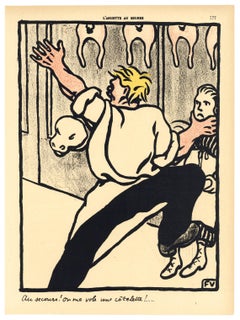
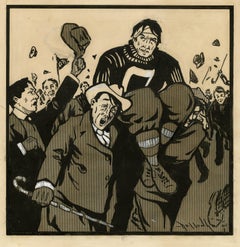
original lithograph

original lithograph

By Félix Vallotton

Located in Henderson, NV

Medium: original lithograph. Printed in Paris in 1902 for the special Felix Vallotton issue of L'Assiette au Beurre on the theme of Crimes et Chatiments (Crime and Punnishment). Size...

Category

Early 1900s Art

Materials

Lithograph

Alfred De Breanski Jr. “Invergary Castle Loch Oich” Oil Painting

Alfred De Breanski Jr. “Invergary Castle Loch Oich” Oil Painting

By Alfred de Breanski Jnr.

Located in Dallas, TX

Alfred de Breanski Jr, oil on canvas, "Invergary Castle, Loch Oich", Grazing sheep in the foreground and cattle in the background. A beautiful lake and mountain landscape with meadows, trees and snow capped peaks. The colors are vibrant. Signed: A De Breanski B/L. Titled and signed verso. Painting size: 18 inches x 24 inches Framed size: 24.25 inches x 30.75 inches Condition: Very Good with brilliant colors and no damage or restoration. Original frame with restorations. AVANTIQUES is dedicated to providing an exclusive curated collection of Fine Arts, Paintings, Bronzes, Asian treasures, Art Glass and Antiques. Our inventory represents time-tested investment quality items with everlasting decorative beauty. We look forward to your business and appreciate any reasonable offers. All of our curated items are vetted and guaranteed authentic and as described. Avantiques only deals in original antiques and never reproductions. We stand behind our treasures with a full money back return if the items are not as described.  Alfred Fontville De Breanski Jr...

Category

Barbizon School Early 1900s Art

Materials

Paint

Wooded Landscape - Large Antique British Impressionist Oil on Canvas Painting

Wooded Landscape - Large Antique British Impressionist Oil on Canvas Painting

By Theodore Casimir Roussel

Located in Sevenoaks, GB

A beautiful large late 19th or early 20th century impressionist oil on canvas depicting a wooded landscape with pond and outbuilding, by Theodore Casimir Roussel. Roussel was one of...

Category

Impressionist Early 1900s Art

Materials

Canvas, Oil

'Hyde Park, England, 1904' — British Impressionism

'Hyde Park, England, 1904' — British Impressionism

By Hayley Lever

Located in Myrtle Beach, SC

Hailey Lever 'Hyde Park, London, England, 1904', watercolor, 1904. Signed 'HL' in pencil, lower right. Titled and dated in pencil, on the original mat backing. A fine spontaneous wor...

Category

Impressionist Early 1900s Art

Materials

Watercolor

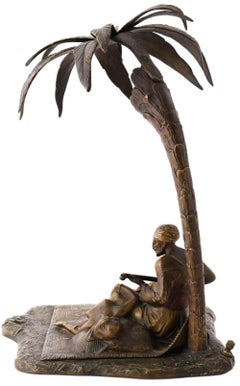
Musician and Muse
Musician and Muse

Musician and Muse

By Franz Bergmann

Located in New York, NY

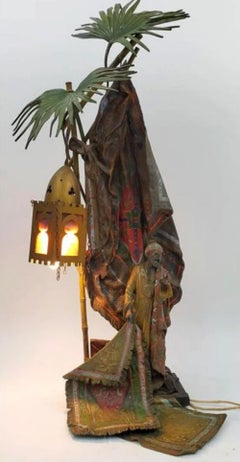
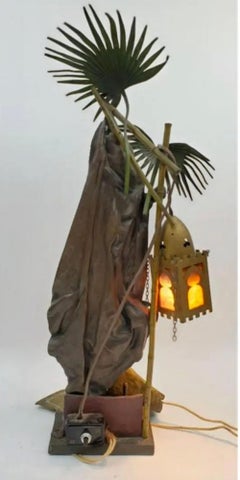
A Fine Cold-Painted Bronze Sculpture of a Musician and Muse A cold-painted cast bronze table lamp . The lamp represents a musician and a nude woman under a palm tree. This item is an...

Category

Naturalistic Early 1900s Art

Materials

Bronze

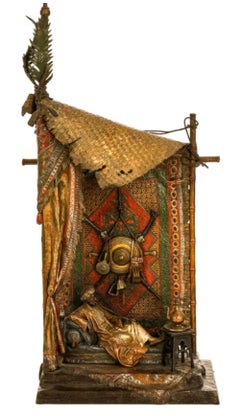
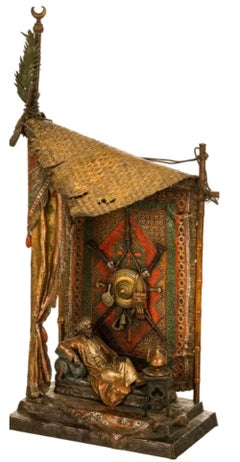
A Sultan reclining
A Sultan reclining

A Sultan reclining

By Franz Bergmann

Located in New York, NY

A Sultan reclining on a chaise within an open Bedouin tent made of draped rugs and a bamboo frame. A shield, swords and ornate bags, hang from the intricately woven rug above him. He...

Category

Naturalistic Early 1900s Art

Materials

Bronze

Sundown at the Village

Sundown at the Village

By James Whitelaw Hamilton

Located in Mc Lean, VA

Exhibited: Venice, Esposizione Internazionale d’Arte della Citta di Venezia, 1905, (no. 40, Tramonto sul villaggio)

Category

Impressionist Early 1900s Art

Materials

Canvas, Oil

Roman Bronze Statue of Youth

Roman Bronze Statue of Youth

Located in Los Angeles, CA

A cast, Roman, Grand Tour bronze figure of a youth. Wonderful patina. Measures : Statue is 23"H. Base is 8.75"W x 7.5"D.

Category

Early 1900s Art

Materials

Bronze

Oil Painting by Gordon A Meadows "Barnes on Thames"

Oil Painting by Gordon A Meadows "Barnes on Thames"

Located in Mere, GB

Oil Painting by Gordon A Meadows "Barnes on Thames" Gordon A Meadows 1868 - 1935 was the son of Arthur Joseph Meadows. Oil on canvas. Signed and dated 1905. Oil on canvas. Dimensio...

Category

Early 1900s Art

Materials

Oil

New Growth (Vertical Wooden Curvy Multicolored Standing Tower Sculpture)

New Growth (Vertical Wooden Curvy Multicolored Standing Tower Sculpture)

By Peter Hoffman

Located in Hudson, NY

"New Growth" by Hudson Valley artist, Peter Hoffman, made in 2020 74 x 9 x 9 inches A Vertical Wooden sculpture created with multiple sections of painted wood segments, cut at angl...

Category

Contemporary Early 1900s Art

Materials

Wood, Acrylic

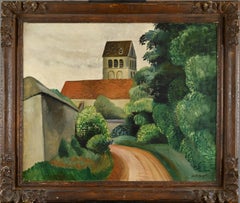
La rue du village
La rue du village

La rue du village

By Léopold Survage

Located in LE HAVRE, FR

Léopold SURVAGE (1879-1968) La rue du village Oil on canvas Size: 50 x 61 cm Signed lower right Provenance: Private collection in Normandy. Oil on canvas in good condition. Small...

Category

Impressionist Early 1900s Art

Materials

Canvas, Oil

“Orientalist Arab on Camel Landscape”

“Orientalist Arab on Camel Landscape”

By Paul Pascal

Located in Southampton, NY

Original watercolor and gouache by the well known French painter, Paul Pascal. Orientalist landscape with nomads with camels. Signed lower left by the artist and dated 1903. Condit...

Category

Academic Early 1900s Art

Materials

Watercolor, Gouache, Archival Paper

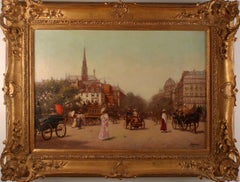
"Place Clichy" 20th Century Impressionist Oil on Canvas by  Eduardo León Garrido

"Place Clichy" 20th Century Impressionist Oil on Canvas by Eduardo León Garrido

By Eduardo Leon Garrido

Located in Madrid, ES

EDUARDO LEÓN GARRIDO Spanish, 1856- 1949 PLACE CLICHY signed "E. L Garrido" (lower right) oil on canvas 24-1/8 x 19-3/4 inches (61 x 50 cm.) framed: 33-1/4 x 28-7/8 inches (84 x 73 cm.) PROVENANCE Private Spanish Collector Fresh and bright view of Clichy Square, Paris, where Leon Garrido offers us his most impressionistic and innovative technique. The work has a pyramidal composition, from where monument to "Mariscal Moncey" on an 8 meter high pedestal and decorated with bas-reliefs that dominates the entire square. The florist occupies a central place, from which distinguished figures appear around her. Its delicate and smooth chromaticism in gray and pearly dark almost black and a touch of red. Eduardo León Garrido (Madrid, 1856 - Caen, 1949) was a Spanish painter. He began his training at the Higher School of Painting in Madrid and as a disciple in Vicente Palmaroli...

Category

Post-Impressionist Early 1900s Art

Materials

Canvas, Oil

Illustration of Ballet Slippers

Illustration of Ballet Slippers

By Thomas Watson Greig

Located in London, London

Chromolithographed illustration of a pair of Ballet Slippers, printed with gold and silver inks. [Published by David Douglas, Edinburgh, 1900]. Plate...

Category

Naturalistic Early 1900s Art

Materials

Lithograph

Oil Painting by Stephen Samuel Lewin "The Armada in Sight"

Oil Painting by Stephen Samuel Lewin "The Armada in Sight"

Located in Mere, GB

Oil Painting by Stephen Samuel Lewin "The Armada in Sight" 1848 - 1909 London painter of historical and domestic genre scenes. He exhibited at the Royal Academy and Royal society of British Artists. Oil on canvas. Signed and dated 1904 Dimensions unframed 24 x 32 inches Dimensions framed 32...

Category

Early 1900s Art

Materials

Oil

"La charrue" original etching

"La charrue" original etching

By Pieter Dupont

Located in Henderson, NV

Medium: original etching. This impression on japon paper was printed in 1902 and published in Paris by the by Gazette des Beaux Arts. Image size: 5 x 8 1/2 inches (127 x 213 mm). Not...

Category

Realist Early 1900s Art

Materials

Etching

A. Maurer "Ready for the rendezvous" Large Oil painting Oil on canvas circa 1907

A. Maurer "Ready for the rendezvous" Large Oil painting Oil on canvas circa 1907

Located in Berlin, DE

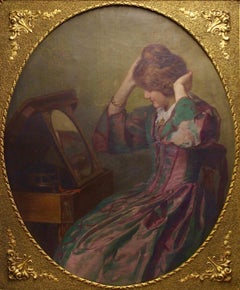
Large imposing and very decorative painting. Oil on canvas. Signed A. Maurer (under the dressing table). Around 1907. Motif of an elegant lady dressing up. Beautiful painting in im...

Category

Impressionist Early 1900s Art

Materials

Canvas, Oil

A Summer Afternoon Rest

A Summer Afternoon Rest

Located in Mc Lean, VA

19th Century Swedish, Oil on canvas

Category

Early 1900s Art

Materials

Canvas, Oil

The Sunbonnet Babies - Modernist Female Artist

The Sunbonnet Babies - Modernist Female Artist

Located in Miami, FL

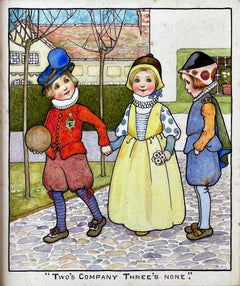
Bertha Corbett Melcher's The Sunbonnet Babies, with their flat, minimalist, semi-abstract, and symbolic style, are an early example of American Modernism/Surrealism by a lesser-known female artist/illustrator. The present work demonstrates a delicate balance between abstraction and representation and between the commonplace and the mysterious. Her signature use of a hat or sunbonnet to hide the identity of her subjects is a big conceptual and visual idea that has been overlooked in the fine art canon. The exact meaning of this is unknown, but 120 years after they were done, it resonates as somewhat surrealistic. Her work is a contradiction. She shows innocent children engaging in everyday activity but are depicted in vail of mystery. Why does she not show the faces of her subjects? Watercolor on paper (each) Six drawings in all on one board. 6-1/8 x 5 inches (15.6 x 12.7 cm) (each) One signed; two initialed; three not signed. Six drawing in all on one board. 6-1/8 x 5 inches (15.6 x 12.7 cm) (each) One signed; two initialed; three not signed The Sunbonnet Babies characters were created by illustration Bertha L. Corbett when she was challenged to create a faceless character who nonetheless was engaging and appealing. The characters were a wild hit and appeared in books, comics, and popular collectibles. They also became a popular motif in quilting. Few of Corbett's original drawings for the babies are known to survive, making this a rare offering. From: Wikipedia Sunbonnet Babies are characters created by commercial artist Bertha Corbett Melcher (1872–1950). Sunbonnet Babies featured two girls in pastel colored dresses with their faces covered by sunbonnets. Sunbonnet Babies appeared in books, illustrations and advertisements between the years of 1900 and 1930. Sunbonnet Babies were later used as a popular quilting pattern also known as Sunbonnet Sue.[1] Melcher created a male version of the Sunbonnet Babies, named the 'Overall Boys' in 1905.[2][3] History Bertha L. Corbett Melcher Sunbonnet Babies were created by Bertha Corbett Melcher (1872–1950).[4] Melcher was born in Denver and moved with her family to Minneapolis in the 1880s. Melcher attended art school in Minneapolis with plans to become a commercial artist.[5] She may have also studied with Howard Pyle.[6] By the 1920s, Melcher had moved to Topanga, California.[7][4] Melcher started drawing the Sunbonnet Babies in 1897. The origin of the signature style of the faces being covered by sunbonnets is contested by different members of Melcher's family and by Melcher herself. In an interview, Melcher's brother said their mother suggested Bertha avoid the difficulty of drawing faces by covering them with sunbonnets.[4] Melcher herself said that covering faces allowed her to communicate with body position.[4] Melcher has also said that the design came about in "answer to a friend’s challenge to convey emotion without a face."[2] Melcher published her first book, The Sun-Bonnet Babies in 1900.[3] Later, she shopped her illustrations to publisher Rand McNally of Chicago, and nine subsequent books were written by Eulalie Osgood Grover and illustrated by Bertha Corbett. In 1905, Melcher wrote The Overall Boys.[3] Many of these books were used as primers and used widely in primary schools in the midwest. Melcher used the sunbonnet babies in advertising and later established the Sunbonnet Babies Company. She started a studio to illustrate and create merchandise of the Sunbonnet Babies.[2] The characters also appeared in a comic strip.[2] Quilting Melcher herself did not originate the use of the sunbonnet babies as quilting pattern. The Sunbonnet Babies quilting pattern appeared in textile art 1910's in the Ladies Home Journal 1911–1912 in a quilt stitched by Marie Webster. The pattern was popular during the Great Depression. In the American South, it was often known as "Dutch Doll" until the 1970s.[3] There was also a quilt pattern based on the "Overall Boys," known by the various names including “Overall Bill, “Overall Andy,” “Sunbonnet Sam,” “Suspender Sam,” “Fisherman Jim."[3] Many patterns for quilts and sewing were designed by Ruby Short McKim and published in nationally syndicated newspapers.[8] Sunbonnet Sue became symbolic of 'female innocence and docility'.[9] Linda Pershing collected accounts from women quilters who depicted 'Sues' doing activities such as smoking, wearing more revealing clothing, and subverting feminine stereotypes.[10] In 1979, the “Seamsters Union Local #500," a group of quilters from Lawrence, Kansas, created “The Sun Sets on Sunbonnet Sue," a quilt depicting the character murdered in a variety of ways.[3] Collectibles Sunbonnet Babies merchandise includes school books, valentines cards, postcards, china, and quilts.[2][5][11] Sunbonnet Babies were adapted into three dimensional porcelain collectibles and pottery made by Royal Bayreuth Company in the early 1900s. The Royal Bayreuth China...

Category

American Modern Early 1900s Art

Materials

Paper, Watercolor

original lithograph

original lithograph

By Félix Vallotton

Located in Henderson, NV

Medium: original lithograph. Printed in Paris in 1902 for the special Felix Vallotton issue of L'Assiette au Beurre on the theme of Crimes et Chatiments (Crime and Punnishment). Size...

Category

Early 1900s Art

Materials

Lithograph

original lithograph

original lithograph

By Félix Vallotton

Located in Henderson, NV

Medium: original lithograph. Printed in Paris in 1902 for the special Felix Vallotton issue of L'Assiette au Beurre on the theme of Crimes et Chatiments (Crime and Punnishment). Size...

Category

Early 1900s Art

Materials

Lithograph

La Lecture de la lettre sur la terrasse

La Lecture de la lettre sur la terrasse

Located in Mc Lean, VA

Genre painting with Elegant Figures on a terrace and extended countryside landscape reading a letter Oil on canvas - signed lower right Provenance: Mercier Paris 2007 Guarisco Ga...

Category

Early 1900s Art

Materials

Oil

"Bellosguardo (Florence, Italy)"

"Bellosguardo (Florence, Italy)"

By Daniel Garber

Located in Lambertville, NJ

Jim’s of Lambertville Fine Art Gallery is proud to present this piece by Daniel Garber (1880 - 1958). One of the two most important and, so far, the most valuable of the New Hope Sc...

Category

American Impressionist Early 1900s Art

Materials

Oil, Board

"Self Portrait" lithograph

"Self Portrait" lithograph

By After Paul Cezanne

Located in Henderson, NV

Medium: lithograph (in smaller size after the original lithograph). This edition was published in Germany by Cassirer ca. 1903, and is now rare. Printed on smooth cream wove paper. I...

Category

Early 1900s Art

Materials

Lithograph

L'Aieule (The Grandmother)

L'Aieule (The Grandmother)

By Louis Legrand

Located in Fairlawn, OH

L'Aieule (The Grandmother) Etching and aquatint printed in colors, 1904 Signed with the red stamp of the publisher, Gustave Pellet, Lugt 1193 and numbered (see photo) Edition: 100 (81/100) Reference: Arwas 202 iv/IV IFF 98 Condition: Excellent, the sheet aged as usual Image size: 14 1/4 x 18 5/8" Sheet size: 16 15/16 x 24 1/4" Louis Auguste Mathieu Legrand (29 September 1863 – 1951) was a French artist, known especially for his aquatint engravings, which were sometimes erotic. He was awarded the Légion d'honneur for his work in 1906. Life Legrand was born in the city of Dijon in the east of France. He worked as a bank clerk before deciding to study art part-time at Dijon's Ecole des Beaux-Arts. He won the Devosge prize at the school in 1883.[2] In 1884 Legrand studied engraving under the Belgian printmaker Félicien Rops. Legrand's artworks include etchings, graphic art and paintings. His paintings featured Parisian social life. Many were of prostitutes, dancers and bar scenes, which featured a sense of eroticism. According to the Hope Gallery, "Louis Legrand is simply one of France's finest early twentieth century masters of etching." His black and white etchings especially provide a sense of decadence; they have been compared to those of Henri de Toulouse-Lautrec, though his drawings of the Moulin Rouge, the can-can dance and the young women of Montmartre preceded Toulouse-Lautrec's paintings of similar scenes. He made over three hundred prints of the night life of Paris. They demonstrate "his remarkable powers of observation and are executed with great skill, delicacy, and an ironic sense of humor that pervades them all." Two of his satirical artworks caused him to be tried for obscenity. The first, "Prostitution" was a symbolic drawing which depicted a naked girl being grasped by a dark monster which had the face of an old woman and claws on its hands; the second, "Naturalism", showed the French novelist Émile Zola minutely studying the thighs of a woman with a magnifying glass. Defended by his friend the lawyer Eugène Rodrigues-Henriques (1853–1928), he was found not guilty in the lower court, but was convicted in the appeal court and then given a short prison sentence for refusing to pay his fine. Legrand was made famous by his colour illustrations for Gil Blas magazine's coverage of the can-can, with text by Rodrigues (who wrote under the pseudonym Erastene Ramiro). It was a tremendous success, with the exceptional quantity of 60,000 copies of the magazine being printed and instantly sold out in 1891. In 1892, at the instigation of the publishing house Dentu, Legrand made a set of etchings of his Gil Blas illustrations. The etchings were published in a book, Le Cours de Danse Fin de Siecle (The End of the Century Dance Classes). Legrand took a holiday in Brittany, which inspired him to engrave a set of fourteen lithographs of simple country life called Au Cap de la Chevre (On Goat Promontory). It was published by Gustave Pellet who became a close friend of Legrand's. Pellet eventually published a total of 300 etchings by Legrand, who was his first artist; he also published Toulouse-Lautrec and Félicien Rops among others. He did not only work in graphics; he exhibited paintings at the Paris salon of the Société Nationale des Beaux-Arts starting in 1902. In 1906 he was made a chevalier of the Légion d'honneur. Legrand died in obscurity in 1951. A retrospective exhibition was held at the Félicien Rops museum in Namur, Belgium in 2006 to celebrate his graphic art. The art collector Victor Arwas published a catalogue raisonné for the occasion. Books illustrated de Maupassant, Guy: Cinq Contes Parisiens, 1905. Poe, Edgar Alan: Quinze Histoires d'Edgar Poe...

Category

Art Nouveau Early 1900s Art
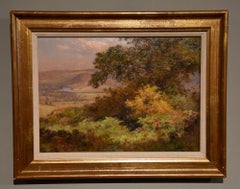
Materials

Aquatint

H.O. Miethke Das Werk folio "Fruit Trees" collotype print

H.O. Miethke Das Werk folio "Fruit Trees" collotype print

DAS WERK GUSTAV KLIMTS, a portfolio of 50 prints, ten of which are multicolor collotypes on chine colle paper laid down on hand-made heavy cream wove paper with deckled edges; under ...

Category

Vienna Secession Early 1900s Art

Materials

Paper

Ancient granite capital, Corinthian style, Andalusia, Spain

Ancient granite capital, Corinthian style, Andalusia, Spain

Located in Valladolid, ES

An exceptional Corinthian capital with smooth leaves in granite, foregoing the intricate carving of the classical acanthus in favor of a much more geometric, clean, and stylized fini...

Category

Italian School Early 1900s Art

Materials

Granite

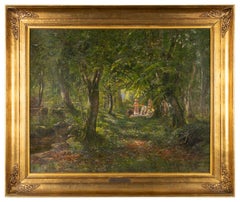
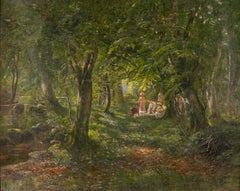
Figures in the Forest

Figures in the Forest

Located in Sheffield, MA

Carl Carlsen Danish, 1855-1917 Figures in the Forest Oil on canvas Signed and dated ‘Carl Carlsen 1900’ lower right 24 ½ by 30 ½ in. w/frame 31 by 36 i...

Category

Impressionist Early 1900s Art

Materials

Oil

Art Nouveau "Pimpernel" original floral watercolor by Charles Rennie Mackintosh

Art Nouveau "Pimpernel" original floral watercolor by Charles Rennie Mackintosh

By Charles Rennie Mackintosh 1

Located in Palm Beach, FL

Note: We do not ship packages without insurance. We strongly suggest you use 1stDibs for its cost effectiveness, full insurance coverage, and reliable handling. While standard parcel...

Category

Art Nouveau Early 1900s Art
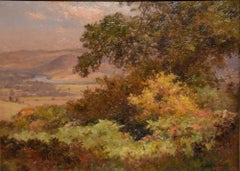
Materials

Watercolor, Pencil

"Le buisson" etching

"Le buisson" etching

By Jacques Beurdeley

Located in Henderson, NV

Medium: etching. Etched by Jacques Beurdeley after Jacob van Ruisdael. Catalogue reference: Sanchez & Seydoux 1906-2. Printed in Paris and published in 1906 by Gazette des Beaux ...

Category

Realist Early 1900s Art
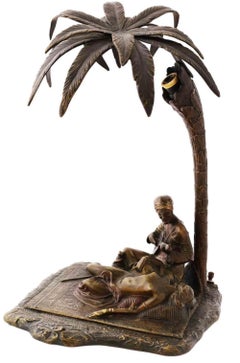
Materials

Etching

"Au cap d'Antibes" original etching

"Au cap d'Antibes" original etching

Located in Henderson, NV

Medium: original etching. Printed in 1902 and published in Paris by Gazette des Beaux Arts. Image size: 5 3/4 x 8 1/4 inches (145 x 210 mm). Signed in the plate, not hand-signed.

Category

Realist Early 1900s Art
Materials

Etching