
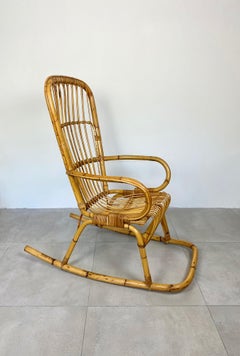
Bamboo Wicker Rocking Chair, Italy, 1960s
Located in Rome, IT
Elegant and robust Italian Mid-Century Modern bamboo rocking chair.
Category
Vintage 1960s Italian Mid-Century Modern Rocking Chairs
Materials
Bamboo, Wicker, Cane, Rattan
Bamboo Wicker Rocking Chair, Italy, 1960s
Located in Rome, IT
Elegant and robust Italian Mid-Century Modern bamboo rocking chair.
Bamboo, Wicker, Cane, Rattan
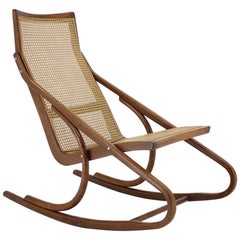
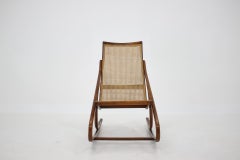
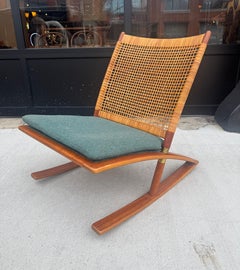
1960s Antonin Suman Bentwood Rocking Chair, Czechoslovakia
By Antonín Šuman
Located in Praha, CZ
- Bentwood and caned seat in good condition - The wooden parts have been repolished.
Cane, Bentwood
$4,860
H 30.5 in W 24 in D 30.5 in
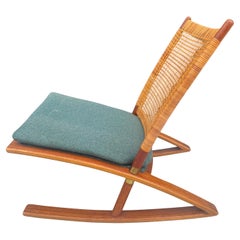
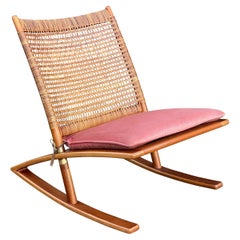
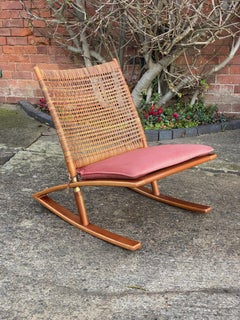
Rare Fredrik Kayser Model 599 Teak Rocking Chair, Rocker Norway, circa 1960s
By Fredrik A. Kayser
Located in Buffalo, NY
twentieth century Fredrik A. Kayser for Vatne Mobler, Model 599 Teak & Cane rocking chair, Norway 1960, the
Brass
Unavailable
H 30.5 in W 23.5 in D 30.5 in
Fredrik Kayser Model 599 Teak Rocking Chair, Rocker Norway, circa 1960s
By Fredrik A. Kayser
Located in Longdon, Tewkesbury
twentieth century Fredrik A. Kayser for Vatne Mobler, Model 599 Teak & Cane rocking chair, Norway 1960, the
Cane, Teak
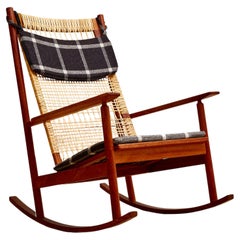
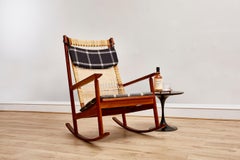
Teak and Cane Rocking Chair by Hans Olsen for JK Denmark, 1960s
By Hans Olsen
Located in London, GB
teak wood and intricate cane detailing, this rocking chair is a true collector's gem. Dimensions
Cane, Teak

Sold
H 42.92 in W 25.79 in D 35.04 in
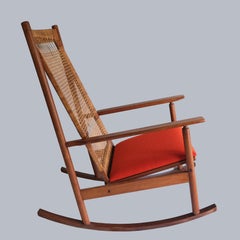
Hans Olsen, a Teak and Cane Rocking Chair, Juul Kristensen, 1960s
By Hans Olsen, Juul Kristensen
Located in Paris, FR
The frame made of teak, the back woven in cane, the seat upholstered with an orange fabric
Teak
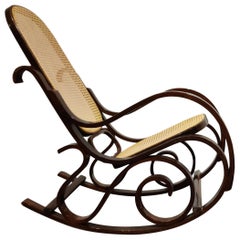
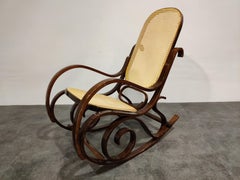
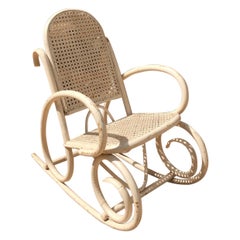
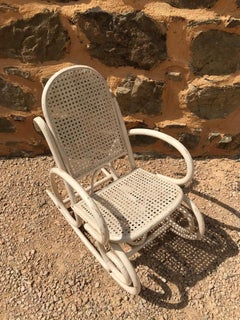
Vintage Thonet Style Rocking Chair, 1960s
Located in Leuven, Vlaams Gewest
Midcentury dark brown wooden and cane webbing rocking chair. These Thonet style rocking chair
Cane, Bentwood
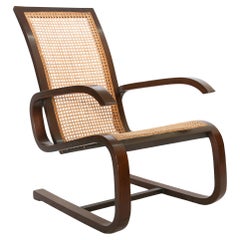
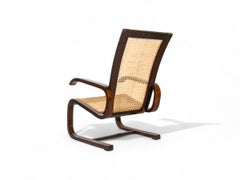
20th Century French Thonet Style Child Rocking Chair, 1960s
By Thonet
Located in LEGNY, FR
Very nice 20th century French Thonet style child rocking chair from the 1960s. It is made with
Cane, Wood
Sold
H 35.4 in W 23.2 in D 32.4 in
Brazilian Mid-Century Rocking Chair in Hardwood and Caning, Unknown, c. 1960’s
Located in New York, NY
Rocking Chair in Hardwood and Caning, Unknown, c. 1960’s, is nothing less than gorgeous! Crafted from
Cane, Hardwood
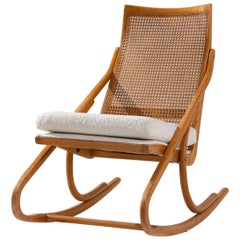
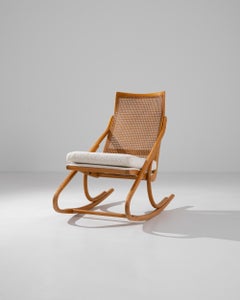
1960s Czech Rocking Chair by Antonin Suman
By TON a.s., Antonín Šuman
Located in High Point, NC
This vintage wooden chair was produced in Czechia, circa 1960. A rocking armchair sculpted with
Bouclé, Upholstery, Cane, Bentwood
$5,600
H 38 in W 22 in D 39 in
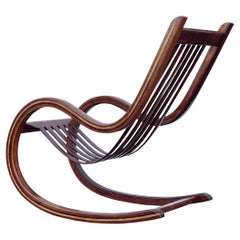
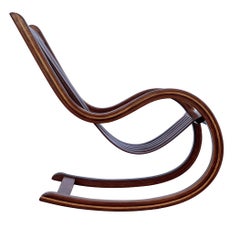
Mid-Century Modern Sculptural Studio Made Lounge Rocking Chair in Exotic Wood
Located in Philadelphia, PA
This studio made rocking chair is a stunning work of art. It features laminated exotic hardwood construction in a breathtaking sculptural form. In well cared for condition.
Wood
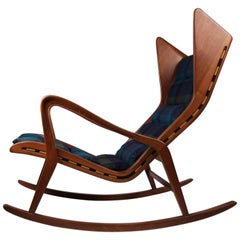
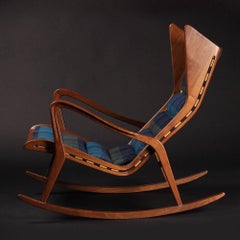
Italian Rocking Chair Model 572 By Cassina
By Cassina
Located in London, GB
An incredible and very rare rocking chair (has been attributed to Gio Ponti in the past and shows a strong and striking resemblance to his designs) in walnut, rubber and fabric for C...
Steel
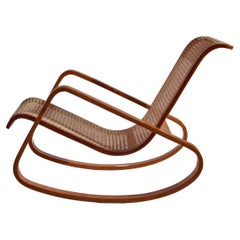
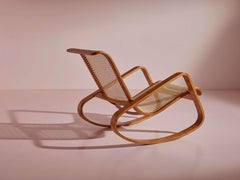
Caned Rocking Chair Made by Porino, Italy, 1930s
By Luigi Crassevig
Located in Chiavari, Liguria
An extraordinary and very rare rocking chair originating from the 1930s, meticulously crafted and designed by Ditta Porino of Torino, Italy. The design of this piece evokes awe thro...
Cane, Beech
$20,000 / item
H 37 in W 25.25 in D 39.5 in
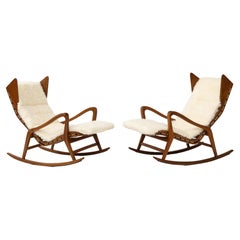
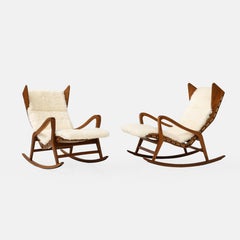
Cassina Walnut Rocking Lounge Chairs Model 572 in Ivory Kalgan Lambskin, 1950s
By Cassina, Studio Tecnico
Located in New York, NY
Cassina, sculptural walnut rocking lounge chairs model 572 with ivory Kalgan lambskin channeled cushions on Pirelli webbing, Italy, 1955. These exquisite modernist rocking chairs ha...
Lambskin, Rubber, Walnut
Organically shaped, clean-lined and elegantly simple are three terms that well describe vintage mid-century modern furniture. The style, which emerged primarily in the years following World War II, is characterized by pieces that were conceived and made in an energetic, optimistic spirit by creators who believed that good design was an essential part of good living.
ORIGINS OF MID-CENTURY MODERN FURNITURE DESIGN
CHARACTERISTICS OF MID-CENTURY MODERN FURNITURE DESIGN
MID-CENTURY MODERN FURNITURE DESIGNERS TO KNOW
ICONIC MID-CENTURY MODERN FURNITURE DESIGNS
VINTAGE MID-CENTURY MODERN FURNITURE ON 1STDIBS
The mid-century modern era saw leagues of postwar American architects and designers animated by new ideas and new technology. The lean, functionalist International-style architecture of Le Corbusier and Bauhaus eminences Ludwig Mies van der Rohe and Walter Gropius had been promoted in the United States during the 1930s by Philip Johnson and others. New building techniques, such as “post-and-beam” construction, allowed the International-style schemes to be realized on a small scale in open-plan houses with long walls of glass.
Materials developed for wartime use became available for domestic goods and were incorporated into mid-century modern furniture designs. Charles and Ray Eames and Eero Saarinen, who had experimented extensively with molded plywood, eagerly embraced fiberglass for pieces such as the La Chaise and the Womb chair, respectively.
Architect, writer and designer George Nelson created with his team shades for the Bubble lamp using a new translucent polymer skin and, as design director at Herman Miller, recruited the Eameses, Alexander Girard and others for projects at the legendary Michigan furniture manufacturer.
Harry Bertoia and Isamu Noguchi devised chairs and tables built of wire mesh and wire struts. Materials were repurposed too: The Danish-born designer Jens Risom created a line of chairs using surplus parachute straps for webbed seats and backrests.
The Risom lounge chair was among the first pieces of furniture commissioned and produced by celebrated manufacturer Knoll, a chief influencer in the rise of modern design in the United States, thanks to the work of Florence Knoll, the pioneering architect and designer who made the firm a leader in its field. The seating that Knoll created for office spaces — as well as pieces designed by Florence initially for commercial clients — soon became desirable for the home.
As the demand for casual, uncluttered furnishings grew, more mid-century furniture designers caught the spirit.
Classically oriented creators such as Edward Wormley, house designer for Dunbar Inc., offered such pieces as the sinuous Listen to Me chaise; the British expatriate T.H. Robsjohn-Gibbings switched gears, creating items such as the tiered, biomorphic Mesa table. There were Young Turks such as Paul McCobb, who designed holistic groups of sleek, blond wood furniture, and Milo Baughman, who espoused a West Coast aesthetic in minimalist teak dining tables and lushly upholstered chairs and sofas with angular steel frames.
Generations turn over, and mid-century modern remains arguably the most popular style going. As the collection of vintage mid-century modern chairs, dressers, coffee tables and other furniture for the living room, dining room, bedroom and elsewhere on 1stDibs demonstrates, this period saw one of the most delightful and dramatic flowerings of creativity in design history.
If the interiors people have been saving on Instagram lately are any indication, we’ll be seeing a lot more antique, new and vintage cane furniture in the years ahead.
Cane — the material of the moment that is inspiring a new generation of designers — has been cropping up everywhere, from sleek armchairs to lounge chairs, side tables and desks.
In case you’re wondering, cane refers to the peeled-off bark of rattan, an Old World species of climbing palm, while wicker may be used to describe natural or synthetic materials that were woven into a pattern. Raffia, another term thrown around when discussing woven furniture, refers to a palm tree native to tropical regions in Africa.
Of course, designers’ obsession with traditional artisanal techniques is nothing new. Marcel Breuer’s tubular Cesca chair, a design originally conceived in the 1920s, has drawn renewed attention in the past few years. And the popularity of materials like raffia and wicker reflects our desire for all things handmade.
Find a wide range of antique, new and vintage cane furniture on 1stDibs.
The phrase “rocking chair” didn’t find its way into the dictionary until the mid-18th century. While most of the sitting furniture that we use in our homes originated in either England or France, the iconic rocking chair is a quintessentially American piece of furniture.
A Philadelphia cabinetmaker’s bill for a proto-rocking chair issued in 1742, which identified the seat as a “Nurse Chair with rockers,” is the earliest surviving evidence of this design’s humble beginnings. The nurse chair was a low side chair intended for nursing women, so giving it a soothing rocking motion made sense. Rocking chairs, which saw a curved slat affixed to the chairs’ feet so that they could be literally rocked, quickly gained popularity across the United States, garnering a reputation as a seat that everyone could love. They offered casual comfort without the expensive fabrics and upholstery that put armchairs out of many families’ budgets.
Rocking chairs are unique in that they don’t just offer a place to rest — they offer an opportunity to reminisce. The presence of one of these classic pieces stirs up our penchant for nostalgia and has the power to transform a space. They easily introduce a simple country feel to the city or bring the peaceful rhythm of a porch swing into a sheltered sunroom. Although craftsmen took to painting and stenciling varieties of the chairs that emerged in New England during the 19th century, the most traditional rocking chairs are generally unadorned seats constructed with time-tested materials like wood and metal. As such, a minimalist vintage rocking chair can be ushered into any corner of your home without significantly disrupting your existing decor scheme or the room’s color palette.
In the decades since the first rocker, top designers have made the piece their own. Viennese chair maker Michael Thonet produced a series of rockers in the middle of the 19th century in which the different curved steam-bent wood parts were integrated into fluid, sinuous wholes. Mid-century modernists Charles and Ray Eames added wooden rockers to their famous plastic shell armchair, while Danish designer Frank Reenskaug opted for teak and polished beech, introducing pops of color with small cushions (a precursor to the bold works that would follow in the 1970s and 1980s).
No matter your personal style, let 1stDibs pair you with your perfect seat. Deck out your porch, patio or parlor — browse the vintage, new and antique rocking chairs in our vast collection today.
Modern icons are showing up in gracefully layered dining nooks, living rooms and lounges — proof that great design only gets better with context.
You know the designs, now get the stories about how they came to be.
The enduring appeal of the Barcelona chair is in the details.
The brand that turned Charles and Ray Eames, Isamu Noguchi and George Nelson into mid-century household names is just as relevant today as it was six decades ago.
Our feed is filled with the world's most beautiful spaces. See the rooms our followers have deemed the best of the best this month.
Our feed is filled with the world's most beautiful spaces. See the 10 our followers have deemed the best of the best this month.
There are many lessons to be learned from the lofts, apartments and townhouses of architects and decorators in Manhattan and beyond.
Having created extravagant homes for reality TV’s biggest stars, the designer is stepping into the spotlight with his first book.