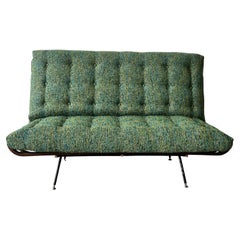
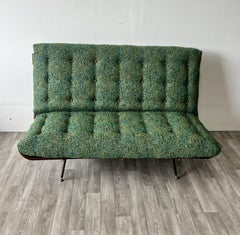
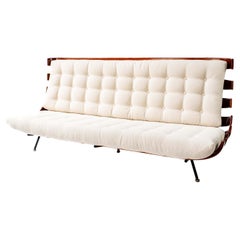
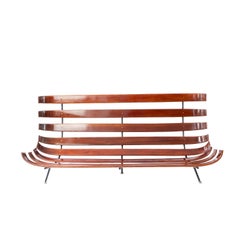
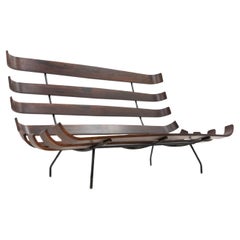
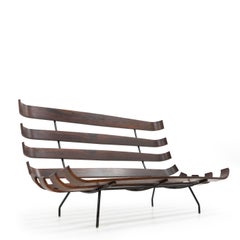
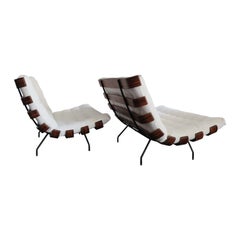
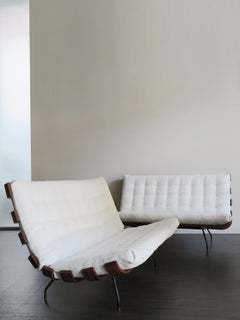
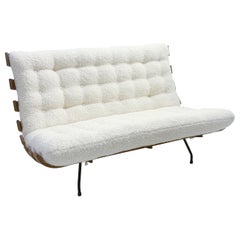
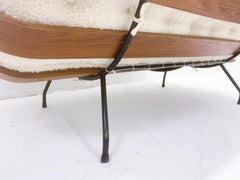
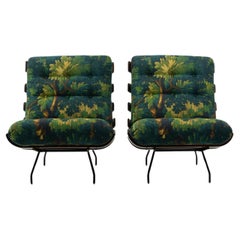
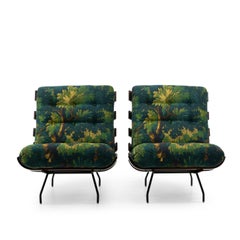
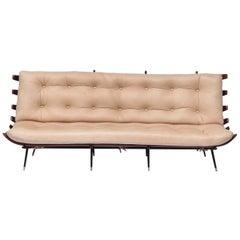
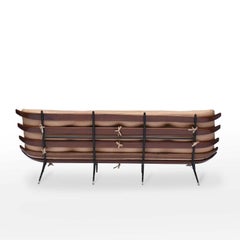
Forma began in São Paulo, under the leadership of Italian designer Carlo Hauner and Austrian architect and interior designer Martin Eisler. Hauner studied drawing and technical drawing at the Brera Academy in Milan. After participating in the Venice Biennale, he emigrated to São Paulo, where he established the furniture manufacturer Móveis Artesanal, for which Carlo and Martin — as well as Carlo’s brother Ernesto Hauner — would create a range of pieces for the home.
In 1936, Eisler earned a degree in architecture from the Academy of Fine Arts in Vienna, where he studied under Oskar Strnad and Clemens Holzmeister. With World War II looming, he left Austria immediately after graduating. He first went to Czechoslovakia, to which some of his family had already fled. In 1938, he moved to Buenos Aires, Argentina, and opened his interior design firm Interieur Forma.
Eisler relocated to Brazil in the early 1950s, where he met Hauner. At the time, Eisler had been looking for help producing furniture for his brother-in-law, Ernesto Wolf, and contacted Hauner. The two found that they had a shared vision, and with financial help from Wolf, they opened Galeria Artesanal as a storefront for Móveis Artesanal.
Looking to expand into international sales, the duo rebranded the company Forma. Sérgio Rodrigues, who helped launch a branch of Artesanal in Curitiba, was put in charge of interiors at Forma. That company soon became one of the biggest names in Brazilian furniture — it sold its own sculptural rattan lounge chairs, bookcases and other case pieces crafted with rosewood or jacaranda, and Forma was eventually distributing furniture licensed from iconic American manufacturer Knoll, thereby bringing works by noted designers such as Ludwig Mies van der Rohe, Charles Eames and Harry Bertoia to the Brazilian market.
Forma stands at the forefront of a revival of Brazilian modern furniture. Fashioned from high-grade regionally sourced hardwoods, leather and iron, even Forma's earliest creations have stood the test of time. The company’s alluring mid-century modern works appealed to homeowners at its peak, from the 1950s through the ’70s, and given the broadening interest in Brazilian furniture and the likes of designers such as Rodrigues, vintage Forma is making a major comeback today.
The Forma furniture company continued producing masterfully crafted furniture into the 1970s, until Eisler's death in 1977. Forma folded soon after, but Eisler's company in Argentina, Interieur Forma, is still in business today.
On 1stDibs, find vintage Carlo Hauner and Martin Eisler furniture for sale.
Organically shaped, clean-lined and elegantly simple are three terms that well describe vintage mid-century modern furniture. The style, which emerged primarily in the years following World War II, is characterized by pieces that were conceived and made in an energetic, optimistic spirit by creators who believed that good design was an essential part of good living.
ORIGINS OF MID-CENTURY MODERN FURNITURE DESIGN
CHARACTERISTICS OF MID-CENTURY MODERN FURNITURE DESIGN
MID-CENTURY MODERN FURNITURE DESIGNERS TO KNOW
ICONIC MID-CENTURY MODERN FURNITURE DESIGNS
VINTAGE MID-CENTURY MODERN FURNITURE ON 1STDIBS
The mid-century modern era saw leagues of postwar American architects and designers animated by new ideas and new technology. The lean, functionalist International-style architecture of Le Corbusier and Bauhaus eminences Ludwig Mies van der Rohe and Walter Gropius had been promoted in the United States during the 1930s by Philip Johnson and others. New building techniques, such as “post-and-beam” construction, allowed the International-style schemes to be realized on a small scale in open-plan houses with long walls of glass.
Materials developed for wartime use became available for domestic goods and were incorporated into mid-century modern furniture designs. Charles and Ray Eames and Eero Saarinen, who had experimented extensively with molded plywood, eagerly embraced fiberglass for pieces such as the La Chaise and the Womb chair, respectively.
Architect, writer and designer George Nelson created with his team shades for the Bubble lamp using a new translucent polymer skin and, as design director at Herman Miller, recruited the Eameses, Alexander Girard and others for projects at the legendary Michigan furniture manufacturer.
Harry Bertoia and Isamu Noguchi devised chairs and tables built of wire mesh and wire struts. Materials were repurposed too: The Danish-born designer Jens Risom created a line of chairs using surplus parachute straps for webbed seats and backrests.
The Risom lounge chair was among the first pieces of furniture commissioned and produced by celebrated manufacturer Knoll, a chief influencer in the rise of modern design in the United States, thanks to the work of Florence Knoll, the pioneering architect and designer who made the firm a leader in its field. The seating that Knoll created for office spaces — as well as pieces designed by Florence initially for commercial clients — soon became desirable for the home.
As the demand for casual, uncluttered furnishings grew, more mid-century furniture designers caught the spirit.
Classically oriented creators such as Edward Wormley, house designer for Dunbar Inc., offered such pieces as the sinuous Listen to Me chaise; the British expatriate T.H. Robsjohn-Gibbings switched gears, creating items such as the tiered, biomorphic Mesa table. There were Young Turks such as Paul McCobb, who designed holistic groups of sleek, blond wood furniture, and Milo Baughman, who espoused a West Coast aesthetic in minimalist teak dining tables and lushly upholstered chairs and sofas with angular steel frames.
Generations turn over, and mid-century modern remains arguably the most popular style going. As the collection of vintage mid-century modern chairs, dressers, coffee tables and other furniture for the living room, dining room, bedroom and elsewhere on 1stDibs demonstrates, this period saw one of the most delightful and dramatic flowerings of creativity in design history.
Vintage couches and antique sofas have anchored living rooms for generations. The pieces most sought after today carry the deep-buttoned tufting of a Chesterfield or the low, sculptural ease of mid-century modern and Hollywood Regency design.
Styles to Know
Rolled arms and tufted backs point to Mid-Century Modern or Hollywood Regency pieces, while tight backs and turned legs skew more traditional. Velvet is enjoying a renewed moment across most of these silhouettes; see our velvet chesterfield sofa trend report for examples. A mid-century modern coffee table within reach and a vintage mirror nearby round out the seating area.
How to Choose the Right Vintage Sofa
A sofa's frame and upholstery history can be difficult to judge from photographs alone. Ask a seller for more information when a listing doesn't show the fabric or joinery clearly, and confirm whether the upholstery is original or has been redone. Each piece comes from a vetted 1stDibs seller, with era, designer and condition detailed, and the 1stDibs Promise stands behind every purchase.