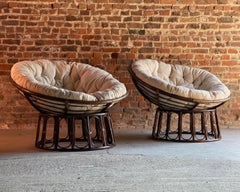
At 1stDibs, there are many versions of the ideal papasan used for your home. Each papasan used for sale was constructed with extraordinary care, often using
bamboo,
fabric and
natural fiber. There are many kinds of the papasan used you’re looking for, from those produced as long ago as the 20th Century to those made as recently as the 20th Century. Each papasan used bearing
mid-century modern hallmarks is very popular. You’ll likely find more than one papasan used that is appealing in its simplicity, but
Ficks Reed produced versions that are worth a look.
The International Style, a modernist movement within architecture and furniture design that was given its name by American architect Philip Johnson and historian Henry-Russell Hitchcock, was born during the 1920s and ’30s. It gained steam initially in Europe and then in the United States as a response to the first World War. Building projects associated with the movement, as well as vintage International Style chairs, tables and other furnishings, are minimal and pared back.
Pioneers of the International Style — architect Walter Gropius and his Bauhaus colleagues Ludwig Mies van der Rohe and Marcel Breuer, De Stijl advocate and Dutch architect J.J.P. Oud and visionary designer Le Corbusier — stripped away decorative elements and placed considerable value on functionality and clean lines, integrating the use of industrial materials like steel, concrete and large sheets of glass in their work. Quite aptly, this mode of design and architectural style coincided with an era now known as the Machine Age and became a global symbol of modernism. The primary motive of its practitioners was to address the changing needs of a rapidly industrializing society, especially the demand for office complexes and apartments in large cities, through economical, technologically advanced, yet aesthetically pleasing designs for furniture and buildings.
“Space and light and order. Those are the things that men need just as much as they need bread or a place to sleep,” said Le Corbusier of the philosophy behind his practical modernist architecture.
The International Style’s designers and architects were inspired by the advantages afforded them by the era’s new technology and industrial machinery as well as state-of-the-art materials. Le Corbusier was fond of framing his buildings in steel but reinforced concrete made far more economic sense. He is probably most admired for the iconic private homes and commercial buildings that he designed or codesigned with his cousin Pierre Jeanneret, which are spread across the world, from New York City to Paris to Chandigarh, India. Today, Breuer’s Wassily Lounge chair; the elegant LC series created by Le Corbusier, Jeanneret and Charlotte Perriand; and Mies van der Rohe’s Barcelona chair, crafted with his romantic partner, designer Lilly Reich, are emblems of progressive modernist design and all make prominent use of tubular steel. Vintage originals are the prized cornerstone of collections.
“The International Style is probably the first fundamentally original and widely distributed style since the Gothic,” posited Johnson in the book that accompanied “Modern Architecture: International Exhibition,” an architectural show he cocurated with Hitchcock that featured the work of Frank Lloyd Wright, Le Corbusier, Richard Neutra and others. While the term “International Style” had previously been circulating in Europe, when the show opened at the Museum of Modern Art in 1932, it yielded a much broader application of this important style of design.
Find International Style furniture on 1stDibs.
Chairs are an indispensable component of your home and office. Can you imagine your life without the vintage, new or antique chairs you love?
With the exception of rocking chairs, the majority of the seating in our homes today — Windsor chairs, chaise longues, wingback chairs — originated in either England or France. Art Nouveau chairs, the style of which also originated in those regions, embraced the inherent magnificence of the natural world with decorative flourishes and refined designs that blended both curved and geometric contour lines. While craftsmanship and styles have evolved in the past century, chairs have had a singular significance in our lives, no matter what your favorite chair looks like.
“The chair is the piece of furniture that is closest to human beings,” said Hans Wegner. The revered Danish cabinetmaker and furniture designer was prolific, having designed nearly 500 chairs over the course of his lifetime. His beloved designs include the Wishbone chair, the wingback Papa Bear chair and many more.
Other designers of Scandinavian modernist chairs introduced new dynamics to this staple with sculptural flowing lines, curvaceous shapes and efficient functionality. The Paimio armchair, Swan chair and Panton chair are vintage works of Finnish and Danish seating that left an indelible mark on the history of good furniture design.
“What works good is better than what looks good, because what works good lasts,” said Ray Eames.
Visionary polymaths Ray and Charles Eames experimented with bent plywood and fiberglass with the goal of producing affordable furniture for a mass market. Like other celebrated mid-century modern furniture designers of elegant low-profile furnishings — among them Ludwig Mies van der Rohe and Finn Juhl — the Eameses considered ergonomic support, durability and cost, all of which should be top of mind when shopping for the perfect chair. The mid-century years yielded many popular chairs.
The Eameses introduced numerous icons for manufacturer Herman Miller, such as the Eames lounge chair and ottoman, molded plywood dining chairs the DCM and DCW (which can be artfully mismatched around your dining table) and a wealth of other treasured pieces for the home and office.
A good chair anchors us to a place and can become an object of timeless appeal. Take a seat and browse the rich variety of vintage, new and antique chairs on 1stDibs today.