Late 18th Century Prints and Multiples

to
575
1,589
393
68
11
16
Overall Width
to
Overall Height
to
1,048
593
3
1
1
94
69
51
50
37
4,816
10,504
57,249
25,067
716
1,028
2,263
2,344
2,437
4,902
7,663
13,483
7,914
4,152
3,980
1,115
645
316
1,014
485
393
364
332
263
227
217
171
150
147
113
68
67
66
65
65
64
51
48
1,776
304
95
46
40
91
1,600
1,075
255
Period: Late 18th Century
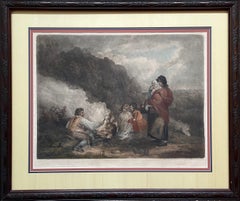
Fishermen resting by a riverbank
Located in Middletown, NY
Copperplate stipple engraving with hand coloring in watercolor, 17 1/2 x 10 1/4 inches (445 x 260 mm), the full sheet, full margins. In very good condition with some minor, light sta...
Category

Old Masters Late 18th Century Prints and Multiples

Materials

Watercolor, Handmade Paper, Engraving
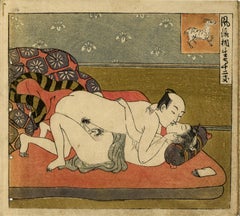
Shunga: Twelve Signs of the Zodiac - Goat
Located in Fairlawn, OH
Shunga: Twelve Signs of the Zodiac - Goat Color woodcut with gauffrage (embossing) Unsigned (as usual) Format: Shikishiban Publisher: Privately produced Unusually well preserved with the fugitive blue still intact Image size: 5-1/8 x 5-3/4" Sheet size: 5 3/8 x 6 1/4" From Wikipedia, the free encyclopedia In this Japanese name, the surname is Isoda. Isoda Koryūsai (礒田 湖龍斎, 1735–1790) was a Japanese ukiyo-e print designer and painter active from 1769 to 1790. Life and career Koryūsai was born in 1735 and worked as a samurai in the service of the Tsuchiya clan. He became a masterless rōnin after the death of the head of the clan and moved to Edo (modern Tokyo) where he settled near Ryōgoku Bridge in the Yagenbori area. He became a print designer there under the art name Haruhiro in 1769, at first making samurai-themed designs. The ukiyo-e print master Harunobu died in 1770, and about that time Koryūsai began making prints in a similar style of life in the pleasure districts. Koryūsai was a prolific designer of individual prints and print series,[1] most of which appeared between 1769 and 1881. In 1782, Koryūsai applied for and received the Buddhist honour hokkyō ("Bridge of the Law") from the imperial court and thereafter used the title as part of his signature. His output slowed from this time, though he continued to design prints until his death in 1790. Works Koryūsai created a total of 2,500 known designs, or an average of four a week. According to art historian Allen Hockley, "Koryūsai may ... have been the most productive artist of the eighteenth century". The series Models for Fashion: New Designs as Fresh Young Leaves (Hinagata wakana no hatsumoyō, 1776–1781) ran for 140 prints, the longest known ukiyo-e print series of beauties. He designed at least 350 hashira-e pillar prints, numerous kachō-e bird-and-flower prints, a great number of shunga erotic prints, and others. Ninety of his nikuhitsu-ga paintings are known, making him one of the most productive painters of the period. Legacy Despite Koryūsai's productivity and popularity—both in his time and amongst later collectors—his work has attracted little scholarship. The first ukiyo-e histories written in the West in the 19th century elevated certain artists as exemplars; Koryūsai's work came to be seen as too indebted to Harunobu, who died in 1770, and inferior to that of Kiyonaga, whose peak period came in the 1880s. An example is Woldemar von Seidlitz's Geschichte des japanischen Farbenholzschnittes ("History of Japanese colour prints", 1897), the most popular of the early ukiyo-e histories, which paints Koryūsai as a successor to Harunobu and a rival of Kiyonaga in the 1770s who slipped into mediocrity and imitation of his rival by the end of the decade.[5] Interest lay mainly in the details of Koryūsai's life—a samurai who received court honours was unusual in the proletarian world of ukiyo-e. In 2021, contemporary woodblock printmaker David Bull...
Category

Other Art Style Late 18th Century Prints and Multiples

Materials

Woodcut

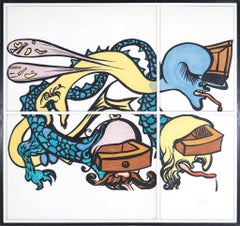
Vitraux in Four Sheets Puzzle of Life by Salvador Dali
Located in New York, NY
Vitraux in Four Sheets, Puzzle of Life, 1974, by Salvador Dali (1904-1989) Lithograph on paper 52 ¼ x 55 ½ inches unframed (132.715 x 140.97 cm) 53 ½ x ...
Category

Surrealist Late 18th Century Prints and Multiples

Materials

Lithograph

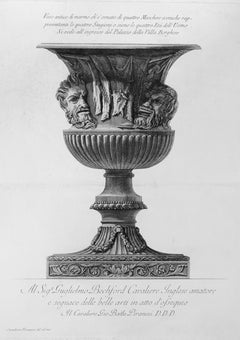
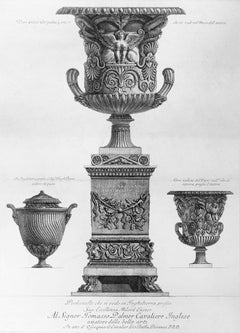
Vaso antico di marmo che è ornato di quattro Maschere - Etching 1778
Located in Roma, IT
Antique marble vase decorated with four masks Artist proof, printed on contemporary laid paper, wide margins, representing an “antique marble vase ...
Category

Late 18th Century Prints and Multiples

Materials

Etching

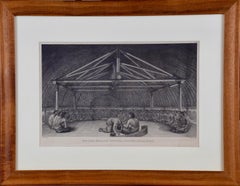
"Inside of a House in Nootka Sound" (Canada) from Captain Cook's 3rd Voyage
Located in Alamo, CA
"The Inside of a House in Nootka Sound" is an engraving created by William Sharp (1749-1824), from a drawing by John Webber (1752-1793), who was the artist on Captain James Cook's 3rd and final voyage of discovery. It is Plate 65 in "A Voyage to the Pacific Ocean Undertaken by the Command of His Majesty, for Making Discoveries in the Northern Hemisphere", the official British Admirality sanctioned journal published upon completion of the voyage in London in 1784 by Strahan & Cadell. This engraving is presented in a Koa wood frame and a white mat. There are occasional tiny faint spots, but the print is otherwise in very good condition. Koa wood is legendary in Hawaii. Not only is this amazing wood native to Hawaii, but it is known for the deep rich colors and varied grain pattern. Koa has an honored heritage in Hawaii and is highly revered and sacred. The word “koa” means “warrior” in Hawaiian. The warriors of King Kamehameha the Great, created canoes and weapons from a wood plentiful on the Big Island of Hawaii. This wood became synonymous with the warriors themselves, and it became known as koa. There are three other engravings listed form the official journal of Captain Cook's 3rd voyage available that are presented in identical Koa wood frames and mats. They would make a wonderful grouping for a display of 2, 3 or 4 prints. Please see listings: LU117324682432, LU117324684022, LU117324684062. A discount is available for a grouping depending on the number of items included. Nootka Sound is on the west coast of Vancouver Island, British Columbia, Canada. It was explored by Captain Cook in 1778 after he discovered Hawaii during his 3rd voyage. He originally named it King George's Sound, but did record Nootka Sound, which he thought was its native name. Hawaii was originally called The Sandwich Islands in honor of The Earl of...
Category

Realist Late 18th Century Prints and Multiples

Materials

Engraving

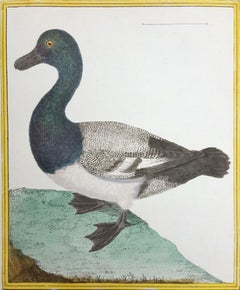
Le Millouinan /// Ornithology Martinet Bird Animal Art Duck Natural History
Located in Saint Augustine, FL
Artist: François-Nicolas Martinet (French, 1731-1800) Title: "Le Millouinan" (Plate 1002) Portfolio: Histoire Naturelle Des Oiseaux *Signed by Martinet in the plate (printed signatur...
Category

Old Masters Late 18th Century Prints and Multiples

Materials

Watercolor, Laid Paper, Engraving, Intaglio
Letter T - Etching by Luigi Vanvitelli - 1780
Located in Roma, IT
Letter T is an Etching hand watercolored realized by Luigi Vanvitelli in 18th century. The etching belongs to the print suite “Antiquities of Herculaneum Exposed” (original title: “...
Category

Old Masters Late 18th Century Prints and Multiples

Materials

Etching

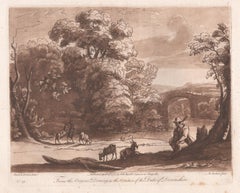
Italianate Landscape, mezzotint by Richard Earlom after Claude le Lorrain
Located in Melbourne, Victoria
Sepia mezzotint by Richard Earlom (1743-1822) After Claude Gellee ('Claude Lorrain') (1600-82). From 'Liber Veritatis; or A Collection of Prints after ...
Category

Italian School Late 18th Century Prints and Multiples

Materials

Engraving, Mezzotint, Etching

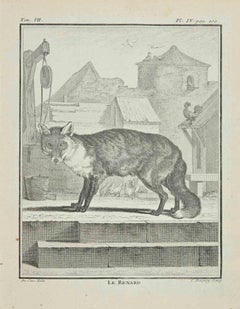
Le Renard - Etching by Jean C. Baquoy - 1771
Located in Roma, IT
Etching realized by Jean Charles Baquoy in 1771. It belongs to the first edition of the suite "Histoire Naturelle de Buffon". Good conditions with slight foxing.
Category

Modern Late 18th Century Prints and Multiples

Materials

Etching

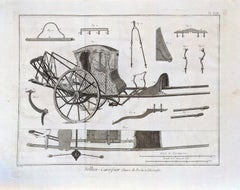
Carriage engraving from the Encyclopedie ( Sellier Carossier )
By Denis Diderot
Located in New York, NY
Carriage engraving from the Encyclopedie ou Dictionnaire raisonne des sciences, des arts et des metiers, par une societe de gens de lettres. edited by Denis Diderot and Jean le Rond ...
Category

French School Late 18th Century Prints and Multiples

Materials

Engraving, Etching, Intaglio

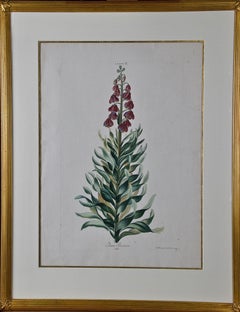
"Lilium Persicum" Ehret 18th Century Hand Colored Botanical Engraving
By Georg Dionysius Ehret
Located in Alamo, CA
A beautiful and important 18th century hand colored copperplate engraving of lillies which was most likely designed by Georg Dionysius Ehret (1708-1770) and engraved by Johann Michae...
Category

Naturalistic Late 18th Century Prints and Multiples

Materials

Engraving

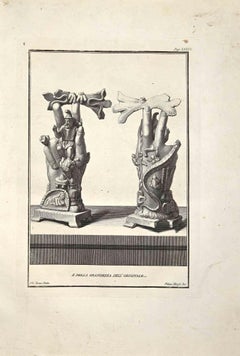
Ancient Roman Sculptures - Original Etching by Filippo Morghen - 18th Century
Located in Roma, IT
Ancient Roman Sculptures, from the series "Antiquities of Herculaneum", is an original etching on paper realized by Filippo Morghen. Signed on ...
Category

Modern Late 18th Century Prints and Multiples

Materials

Etching

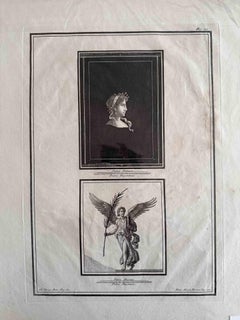
Decorative Wall Fresco - Etching by Filippo Morghen - 1780s
Located in Roma, IT
Decorative Wall Fresco from "Antiquities of Herculaneum" is an etching on paper realized by Filippo Morghen in the 1780s. Signed on the plate. Good conditions with slight folding o...
Category

Modern Late 18th Century Prints and Multiples

Materials

Etching

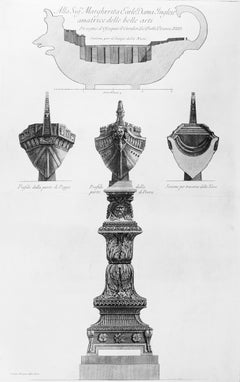
Sezione per il Luogo della Nave - Etching by G.B. Piranesi - 1778
Located in Roma, IT
Section for the place of the boat. Wonderful proof, printed on contemporary laid paper, wide margins, representing a “section for the place of the boat”. Etching with good contrasts ...
Category

Late 18th Century Prints and Multiples

Materials

Etching

Horn - Etching by Jean C. Baquoy - 1771
Located in Roma, IT
Etching realized by Jean Charles Baquoy in 1771. It belongs to the first edition of the suite "Histoire Naturelle de Buffon". Good conditions with slight foxing.
Category

Modern Late 18th Century Prints and Multiples

Materials

Etching

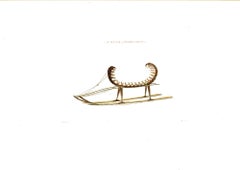
A Sledge of Kamtschatka – An image of a relic from Captain Cook's third voyage
Located in Middletown, NY
London: Scatcherd & Whitaker, 1784. Etching with hand coloring in watercolor on cream wove paper, 7 1/2 x 10 (190 x 255); sheet 16 1/4 x 22 (414 x 560 mm), full margins. In good cond...
Category

English School Late 18th Century Prints and Multiples

Materials

Watercolor, Handmade Paper, Etching

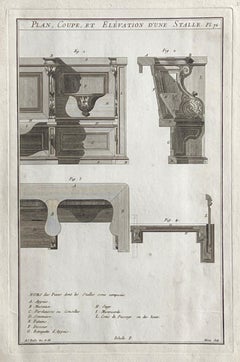
Plan, Coupe, et Elevation d'une Stalle, Roubo French cabinetmaking engraving
Located in Melbourne, Victoria
'Plan, Coupe, et Elevation d'une Stalle' French copper-line engraving by Milson after Andre Jacob Roubo (1739–1791). 18th century laid watermarked paper. From Roubo's 'L'Art du Men...
Category

French School Late 18th Century Prints and Multiples

Materials

Engraving

Girls and Pigs - Etching by William Ward After George Morland - 1797
Located in Roma, IT
Image dimensions: 38.2 x 45.7 cm. Girl and Pigs is an original etching, hand-colored, d'après George Morland. Interesting artist's proof by William Ward ...
Category

Late 18th Century Prints and Multiples

Materials

Etching

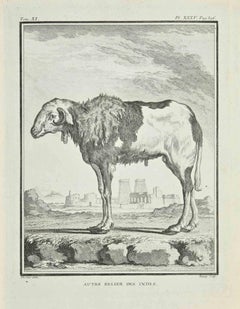
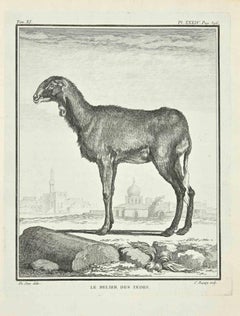
Le Brebis des Indes - Etching by Jean C. Baquoy - 1771
Located in Roma, IT
Etching realized by Jean Charles Baquoy in 1771. It belongs to the first edition of the suite "Histoire Naturelle de Buffon". Good conditions with slight foxing.
Category

Modern Late 18th Century Prints and Multiples

Materials

Etching

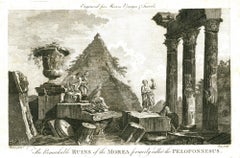
Remarkable Ruins of Morea, formerly called the Peloponnesus
Located in Middletown, NY
Engraved by Pierre François TARDIEU, after Giovanni Paolo PANNINI London: Alexander Hogg, c1778. Etching with engraving on light weight wove paper, 7 1/2 x 11 1/4 inches( 190 x 285...
Category

Late 18th Century Prints and Multiples

Materials

Ink, Handmade Paper

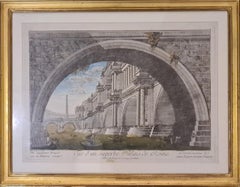
Piranesi, Hand Coloured Period Engraving, Vue d'un Superb Palais de Rome
Located in Cotignac, FR
A fine hand coloured 18th Century engraving after the original by Piranesi (Rome 1743), published by Danisy, Paris. Presented in period gold leaf frame, under glass. Piranesi was born in Venice, in the parish of S. Moisè where he was baptised. His father was a stonemason. His brother Andrea introduced him to Latin literature and ancient Greco-Roman civilization, and later he was apprenticed under his uncle, Matteo Lucchesi, who was a leading architect in Magistrato delle Acque, the state organization responsible for engineering and restoring historical buildings. From 1740, he had an opportunity to work in Rome as a draughtsman for Marco Foscarini, the Venetian ambassador of the new Pope Benedict XIV. He resided in the Palazzo Venezia and studied under Giuseppe Vasi, who introduced him to the art of etching and engraving of the city and its monuments. Giuseppe Vasi found Piranesi's talent was much greater than that of a mere engraver. According to Legrand, Vasi told Piranesi that "you are too much of a painter, my friend, to be an engraver." After his studies with Vasi, he collaborated with pupils of the French Academy in Rome to produce a series of vedute (views) of the city; his first work was Prima parte di Architettura e Prospettive (1743), followed in 1745 by Varie Vedute di Roma Antica e Moderna. From 1743 to 1747, he was mainly in Venice where, according to some sources, he often visited Giovanni Battista Tiepolo, a leading artist in Venice. It was Tiepolo who expanded the restrictive conventions of reproductive, topographical and antiquarian engravings. He then returned to Rome, where he opened a workshop in Via del Corso. In 1748–1774, he created an important series of vedute of the city which established his fame. In the meantime Piranesi devoted himself to the measurement of many of the ancient buildings: this led to the publication of Le Antichità Romane de' tempo della prima Repubblica e dei primi imperatori ("Roman Antiquities of the Time of the First Republic...
Category

Baroque Late 18th Century Prints and Multiples

Materials

Paper, Ink, Watercolor

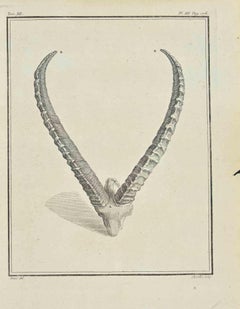
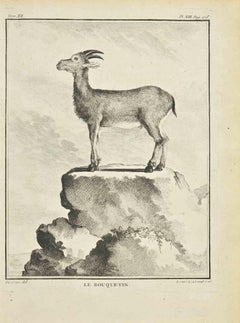
Le Bouquetin - Etching by Jean C. Baquoy - 1771
Located in Roma, IT
Etching realized by Jean Charles Baquoy in 1771. It belongs to the first edition of the suite "Histoire Naturelle de Buffon". Good conditions with slight foxing.
Category

Modern Late 18th Century Prints and Multiples

Materials

Etching

Le Brebis des Indes - Etching by Jean C. Baquoy - 1771
Located in Roma, IT
Etching realized by Jean Charles Baquoy in 1771. It belongs to the first edition of the suite "Histoire Naturelle de Buffon". Good conditions with slight foxing.
Category

Modern Late 18th Century Prints and Multiples

Materials

Etching

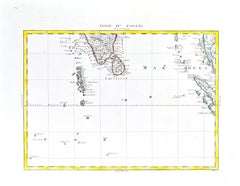
Indie - II Sheet
Located in Roma, IT
Etching hand colored realized by Antonio Zatta in 1785, and published by G. Pitteri. It depicts the Eastern Indian Ocean & its islands. Southern India, Sri Lanka, the Maldives, The ...
Category

Modern Late 18th Century Prints and Multiples

Materials

Etching

Vasi Antichi - Etching by G.B. Piranesi - 1778
Located in Roma, IT
Antique Vases Artist proof, printed on contemporary laid paper, wide margins, representing two antique vases, whom details are in the captures. Etching with good contrasts and sharp ...
Category

Late 18th Century Prints and Multiples

Materials

Etching

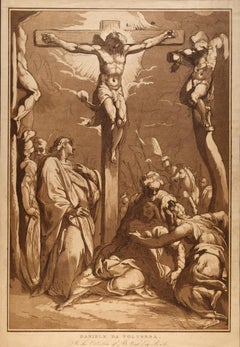
Crucifixion: 18th Century Etching by Conrad Metz after Daniele da Volterra
Located in Alamo, CA
"Crucifixion" is an etching and aquatint, printed in brown ink by Conrad M. Metz after a painting by Daniele da Volterra. It was published in London in 1789 in 'Imitations Of Ancient...
Category

Old Masters Late 18th Century Prints and Multiples

Materials

Etching, Aquatint

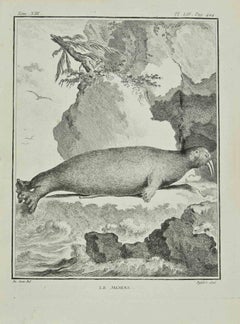
Le Morse - Etching by Antoine Defehrt - 1771
Located in Roma, IT
Etching realized in 1771. It belongs to the first edition of the suite "Histoire Naturelle de Buffon". Good conditions with slight foxing.
Category

Modern Late 18th Century Prints and Multiples

Materials

Etching

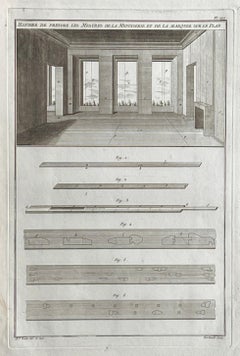
Maniere de Prendre Les Mesures, Roubo French cabinetmaking design engraving
Located in Melbourne, Victoria
'Maniere de Prendre Les Mesures de la Menuiserie et de la Marquer sur le Plan' French copper-line engraving by Berthault after Andre Jacob Roubo (1739–1791). 18th century laid water...
Category

French School Late 18th Century Prints and Multiples

Materials

Engraving

French Neoclassical Design Engraving for Braziers
Located in Melbourne, Victoria
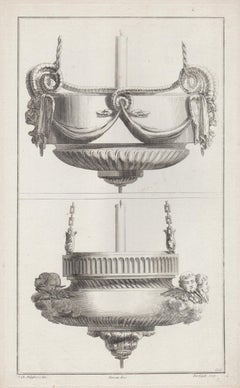
Copper-line engraving. C1768. Delafosse was a French decorative designer, engraver and architect. Apprenticed for a time to a sculptor, by 1767 he styled himself an 'architect and professor of design'. He published the first volume of his most important work, 'Nouvelle Iconologie Historique' in 1768, containing 110 plates of his designs for furniture, decorative arts and architectural...
Category

French School Late 18th Century Prints and Multiples

Materials

Engraving

Le Porc - Etching by Jacques Baron - 1771
Located in Roma, IT
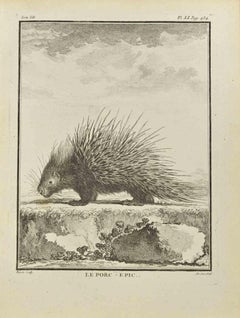
Le Porc is an etching realized by Jacques Baron in 1771. It belongs to the suite "Histoire Naturelle de Buffon". The Artist's signature is engraved lower right. Good conditions wi...
Category

Modern Late 18th Century Prints and Multiples

Materials

Etching

William Woollett, engraver, late 18th century artist portrait engraving print
Located in Melbourne, Victoria
William Woollett, Engraver Proof before letters. Etching by Francesco Bartolozzi after Thomas Hearne, 1795. Wove paper. William Woollett (1735-85) was an important English 18th cen...
Category

Naturalistic Late 18th Century Prints and Multiples

Materials

Engraving, Etching

Remains of Henry II's Palace, late 18th century English sepia aquatint, 1799
Located in Melbourne, Victoria
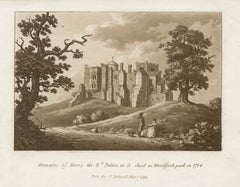
'Remains of Henry II's Palace, as it stood in Woodstock Park in 1714' Aquatint published by Samuel Ireland. From his 'Picturesque Views on the River Thames'. Ireland was an author a...
Category

Naturalistic Late 18th Century Prints and Multiples

Materials

Engraving, Etching, Aquatint

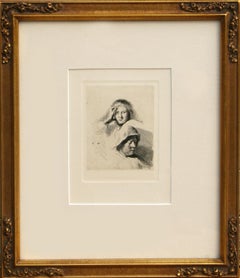
Three Heads of Women, Old Masters Etching by Rembrandt van Rijn
Located in Long Island City, NY
Rembrandt van Rijn, After by Amand Durand, Dutch (1606 - 1669) - Three Heads of Women, Year: of original: 1637, Medium: Etching, Size: 12 in. x 10 in. (30.48 cm x 25.4 cm), Printer: ...
Category

Late 18th Century Prints and Multiples

Materials

Etching

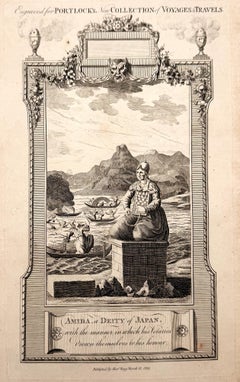
Amida, a Deity of Japan – English School, 18th century
Located in Middletown, NY
Amida, a Deity of Japan; One plate from A new and complete collection of voyages and travels containing all that have been remarkable from the earliest period to the present time Vol...
Category

English School Late 18th Century Prints and Multiples

Materials

Watercolor, Handmade Paper, Engraving
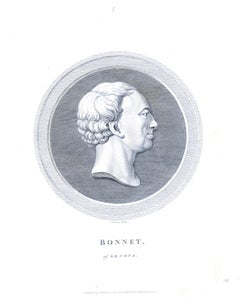
A portrait of Charles Etienne Bonnet
Located in Middletown, NY
London: Thomas Holloway, 1794. Engraving on cream laid paper, 9 3/4 x 8 inches (246 x 201 mm), full margins. In good condition with some light discoloration throughout the sheet. As...
Category

English School Late 18th Century Prints and Multiples

Materials

Handmade Paper, Etching, Laid Paper

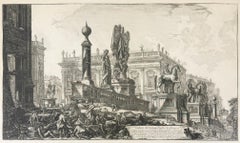
Veduta del Campidoglio di fianco
Located in New York, NY
Etching. Signed in the plate lower right. From the fourth state, of six, a late 18th / early 19th century impression; first Paris edition. From the Vedute di Rome series. Overall...
Category

Old Masters Late 18th Century Prints and Multiples

Materials

Etching

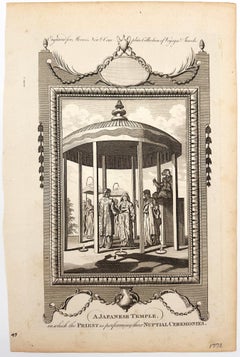
A Japanese Temple – English School, 18th century
Located in Middletown, NY
18th century image of a priest presiding over a traditional Japanese nuptual ceremony. One plate from A new and complete collection of voyages and travels containing all that have b...
Category

English School Late 18th Century Prints and Multiples

Materials

Watercolor, Handmade Paper, Engraving
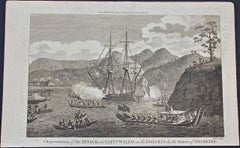
Attack on Captain Wallis When He Discovered Tahiti: Original 18th C. Engraving
Located in Alamo, CA
"A Representation of the Attack on Captain Wallis in the Dolphin by the Natives of Otaheite (Tahiti)" is an engraving created by the artist Sparrow based on an engraving in John Hawk...
Category

Late 18th Century Prints and Multiples

Materials

Engraving

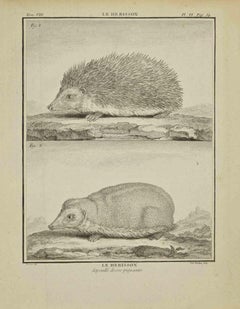
Le Herisson - Etching by Pierre Francois Tardieu - 1771
Located in Roma, IT
Le Herisson is an etching realized by P.F. Tardieu in 1771. It belongs to the suite "Histoire naturelle, générale et particulière avec la description du Cabinet du Roi". Artist's s...
Category

Modern Late 18th Century Prints and Multiples

Materials

Etching

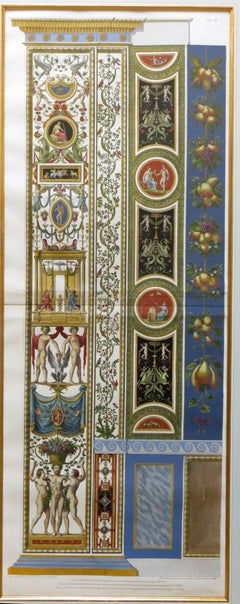
Logge di Rafaele nel Vaticano (Raphael's Loggia in the Vatican) Plate X Pilaster
By Gaetano Savorelli
Located in San Francisco, CA
Artists: Raffaello Sanzio d’Urbino.(1483 – 1520) Gateano Savorelli, artist. (unk.- 1791) Ludovico Teseo, draughtsman. (1731-1782) Pietro Camporesi, architect (1726 - 1781) Giovanni Ottoviani (1735-1808) & Giovanni Volpato (1735 – 1803), engravers Title: Delle Logge di Rafaele nel Vaticano, Plate X (10) Year: 1772-1777 Medium: Hand-colored copperplate engraving Sight size: 42 x 16 inches. Framed size: 55.5 x 28.5 inches Condition: Very good Frame: Frame in very good condition A tall and incredibly detailed printed panel, “Delle Logge di Rafaele nel Vaticano” (“Raphael Loggia...
Category

Renaissance Late 18th Century Prints and Multiples

Materials

Engraving, Watercolor

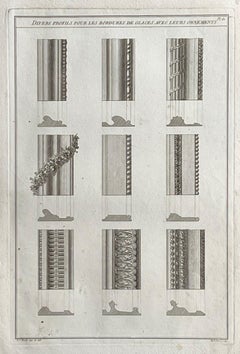
Different Profils Pour Les Bordures, Roubo French cabinetmaking design engraving
Located in Melbourne, Victoria
'Different Profils Pour Les Bordures de Glaces avec leurs Ornements' French copper-line engraving by Michelinot after Andre Jacob Roubo (1739–1791). 18th century laid watermarked pa...
Category

French School Late 18th Century Prints and Multiples

Materials

Engraving

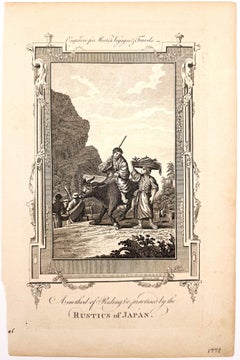
Rustics of Japan – English School, 18th century
Located in Middletown, NY
A Method of Riding as Practised by the Rustics of Japan. One plate from A new and complete collection of voyages and travels containing all that have been remarkable from the earlies...
Category

English School Late 18th Century Prints and Multiples

Materials

Watercolor, Handmade Paper, Engraving
"The Fern Gatherers" 18th Century Antique Mezzotint Engraving by John R. Smith
Located in Carmel, CA
"The Fern Gatherers" After a painting by George Morland. 1763-1804. - Mezzotint engraving by John Raphael Smith. 1752-1812. Print: 20.75" x 26" - With Frame: 28" x 33.5" Published:...
Category

Realist Late 18th Century Prints and Multiples

Materials

Engraving, Mezzotint

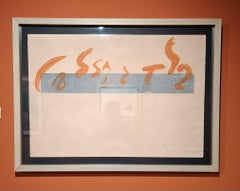
Sígnic
Located in BARCELONA, ES
Antoni Tàpies, 1981 “Signic” Engraving with carborundum and resins. Signed and numbered by hand Bona tiré copy 50 copies Edited by galerie Lelong (Paris) Printed by Joan Barberà (...
Category

Abstract Late 18th Century Prints and Multiples

Materials

Resin, Engraving

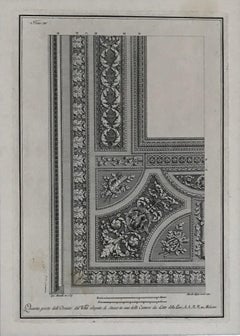
Ceiling designs. A set of three architectural engravings.
Located in Paris, FR
Ceiling designs. A set of three architectural engravings. These engravings are framed in white gold covered french frames. From the publication publishe...
Category

Late 18th Century Prints and Multiples

Materials

Engraving

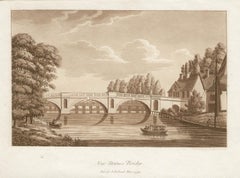
New Staines Bridge, late 18th century English sepia aquatint, 1799
Located in Melbourne, Victoria
'New Staines Bridge' Aquatint published by Samuel Ireland. From his 'Picturesque Views on the River Thames'. Ireland was an author and engraver who published several series of aquat...
Category

Naturalistic Late 18th Century Prints and Multiples

Materials

Engraving, Etching, Aquatint

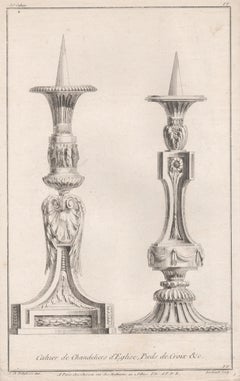
French Neoclassical Design for Candlesticks, engraving after Delafosse
Located in Melbourne, Victoria
Copper-line engraving. C1768. Delafosse was a French decorative designer, engraver and architect. Apprenticed for a time to a sculptor, by 1767 he styled himself an 'architect and professor of design'. He published the first volume of his most important work, 'Nouvelle Iconologie Historique' in 1768, containing 110 plates of his designs for furniture, decorative arts and architectural...
Category

French School Late 18th Century Prints and Multiples

Materials

Engraving

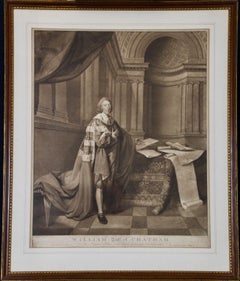
Portrait of William Pitt, Earl of Chatham: Rare Framed Mezzotint after Brompton
By Edward Fisher
Located in Alamo, CA
This is a large framed very rare hand-colored copperplate mezzotint engraved portrait of William Pitt, the Elder, 1st Earl of Chatham by Edward Fisher, published in London in 1779 after a painting by Richard Brompton. Pitt is depicted attired in a flowing regal appearing cape, standing in an ornate room with his left hand outstretched over a serious of manuscripts and scrolls that are laying on a table or desk to his left. The table is covered by a beautiful oriental carpet. The manuscripts include the Magna Carta, a map of the colonies, including Long Island and Staten Island, and papers entitled "A Plan for the Reconciliation between Great Britain and the Colonies", "A Motion Made in 1775 for the Recall of Troops from Boston", "A Provisional Act for Settling the Troubles in America Offered to the House of Lords in 1775", and "It is doing Nothing to repeal a few Scraps of Paper or Pieces of Parchment called Acts of Parliament. But our Business is to repeal the Ill-Will and the Animosity unfortunately now subsisting between Great Britain and North America". This engraving is held by the British Museum and the British Royal Collection Trust. This large framed mezzotint engraving is presented in a brown wood frame with gold-colored beaded inner and outer trim, and a cream-colored French mat. The frame measures 31.63" high by 26.63" wide by 0.75" deep. There are three short tears along the right edge and mild creasing in the left upper, left lower and right lower corners. It is otherwise in very good condition. William Pitt (1708-1778) was a member of the British parliament from 1735 to 1761 and prime minister from 1766 to 1768. Pitt was an advocate for the American colonies leading up to the War of Independence. He called for an amiable relationship between Great Britain and the colonies and opposed the Stamp Act and military action in America. He advocated for a withdrawal of English troops from Boston in 1775 and the settling of troubles in America, as two of his manuscripts on the table outline. Pitt's colleague, Lord Shelburne (later the Marquess of Lansdowne) shared his sympathies and after Pitt's death, signed a peace treaty with the United States in 1782. The American city of Pittsburgh, Pennsylvania is named for William Pitt, the Elder. The name originated when the conflict between the British and French over territorial claims in the Northeast were settled in 1758. General John Forbes and his British army, supported by the American colonial troops, expelled the French from Fort Duquesne (which had been constructed by the French in 1754). Forbes re-named the site for William Pitt the Elder, who at the time was a British statesman. The earliest known reference to the new name, Pittsburgh, is in a letter sent from General John Forbes to Pitt, dated November 27, 1758. Pitt's son, William Pitt, the Younger, like his father, also served as British Prime Minister. Edward Fisher (1730-1785) was born in Ireland in 1730. He was originally a hatter, but learned engraving in London. He became a member of the Incorporated Society of Artists in 1766, and exhibited there fourteen times between 1761 and 1776. He engraved more than sixty portraits. In addition to this portrait of William Pitt, Earl of Chatham, after Richard Brompton he engraved several portraits after Brompton, including George, Earl of Albemarle, as well as engraved portraits after paintings by Joshua Reynolds, including the Shakespearean actor David Garrick, Hugh, Earl of Northumberland, and Elizabeth, Countess of Northumberland and Laurence Sterne, and Hope Nursing Love, as well as Robert Brown, after Mason Chamberlin, Colley Cibber, after Jean-Baptiste van Loo, Christian VII of Denmark, after Nathaniel Dance, Simon, Earl Harcourt, after Hunter, Roger Long, after Benjamin Wilson...
Category

Old Masters Late 18th Century Prints and Multiples

Materials

Mezzotint

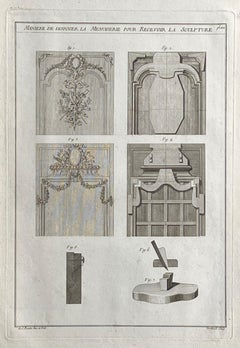
Maniere de Disposer La Menuiserie, Roubo French cabinetmaking design engraving
Located in Melbourne, Victoria
'Maniere de Disposer La Menuiserie pour Recevoir La Sculpture' French copper-line engraving by Berthault after Andre Jacob Roubo (1739–1791). 18th century laid watermarked paper. F...
Category

French School Late 18th Century Prints and Multiples

Materials

Engraving

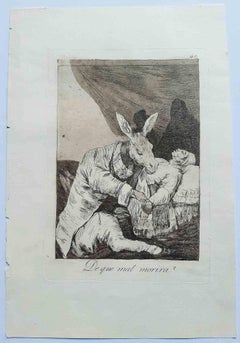
¿De qué mal morirá? - Etching by Francisco Goya - 1799
Located in Roma, IT
¿De qué mal morirá? from the first edition of Los Caprichos is an original artwork realized by the artist Francisco Goya and published in 1799. Etching and aquatint on paper. The etching is part of the First Edition of "Los Caprichos" published by the Calcografia Nacional for the Real Academia of Madrid. Plate N. 40. Numbered on the upper right corner, with very fresh inking and sheet in good condition. Titled on the lower central margin " ¿De qué mal morirá? " (What's going to happen?). Good conditions. Dimensions of plate: 2 x 3.4 cm. Assez bonnes marges. A scene that makes us reflect upon the condition of poor people during the Spanish court...
Category

Modern Late 18th Century Prints and Multiples

Materials

Etching, Aquatint

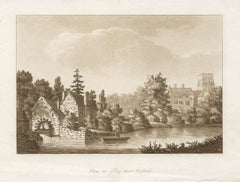
View at Ifley, near Oxford, late 18th century English sepia aquatint, 1799
Located in Melbourne, Victoria
'View at Ifley, near Oxford' Aquatint published by Samuel Ireland. From his 'Picturesque Views on the River Thames'. Ireland was an author and engraver who published several series ...
Category

Naturalistic Late 18th Century Prints and Multiples

Materials

Engraving, Etching, Aquatint

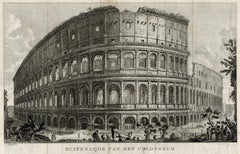
Buitenzijde Van Het Colosseum (Exterior of the Colosseum)
Located in Middletown, NY
The Hague: circa 1799. Engraving with burin on cream laid paper, 7 7/8 x 13 inches (198 x 330 mm) full margins. Octavo fold with additional hard creases with an associated loss in t...
Category

Dutch School Late 18th Century Prints and Multiples

Materials

Laid Paper, Engraving

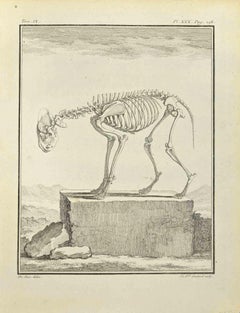
The Skeleton - Etching by Françoise Guelard - 1771
Located in Roma, IT
The Skeleton is an etching realized in 1771 by F. Guelard. Titled and Signed on the plate. The artwork Belongs to the suite "Histoire naturelle, générale et particulière avec la de...
Category

Modern Late 18th Century Prints and Multiples

Materials

Etching

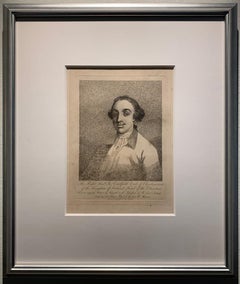
'Portrait of James Caulfield' by William Hogarth, Etching
Located in Oklahoma City, OK
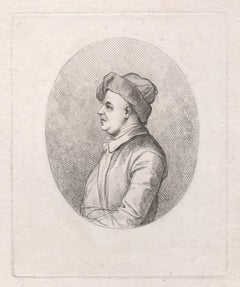
This 21" x 18" etching was produced by William Hogarth in the mid-18th century. The work has been newly matted and framed with archival materials. The subject, identified as James Caulfield, 4th Viscount, 1st Earl of Charlemont (1728-1799), became commander in chief of the Irish Volunteers...
Category

Realist Late 18th Century Prints and Multiples

Materials

Etching

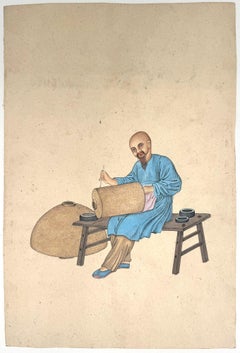
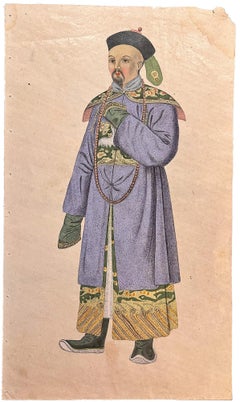
A Chinese Nobleman, from The Costume of China, by G.H. Mason, engr. John Dadley
Located in Middletown, NY
London: 1799. Copperplate stipple engraving with hand coloring in watercolor, 17 1/2 x 10 1/4 inches (445 x 260 mm) (sheet), full margins. In very good condition with some minor, lig...
Category

Old Masters Late 18th Century Prints and Multiples

Materials

Watercolor, Handmade Paper, Engraving
"King of the Friendly Islands" (Tonga); Engraving from Captain Cook's 3rd Voyage
Located in Alamo, CA
"Poulaho, King of the Friendly Islands, Drinking Kava" is an engraving created by William Sharp (1749-1824), from a drawing by John Webber (1752-1793), who was the artist on Captain James Cook's 3rd and final voyage of discovery. It was published in the atlas of "A Voyage to the Pacific Ocean Undertaken by the Command of His Majesty, for Making Discoveries in the Northern Hemisphere", the official British Admirality sanctioned journal published upon completion of the voyage in London in 1784 by Strahan & Cadell. Captain Cook visited Tonga on his 3rd voyage, which he named The Friendly Islands because of the warm welcome he and his crew received, unlike some of the other more hostile Pacific islands. The engraving depicts Cook and his men observed a kava ceremony at the village of Mu’a on Tongatapu. King Paulaho sits in the centre foreground, his back to the spectator with a man kneeling before him. The ceremonial mat depicted behind Paulaho indicates that nobody was allowed to sit behind him. The figure in the centre holds a single cup, referring to the Tongan custom of offering the cup to the king first. Kava is native to the islands of the South Pacific and was first described for English readers in 1768 by Captain James Cook. The kava root has been used for centuries as a central feature of ceremonies and celebrations because it was able to bring about a calming and pleasant social atmosphere. The root was crushed and processed into coconut milk to become the focal ceremonial beverage, simply referred to as kava. This engraving is presented in a Koa wood frame and a white mat. Koa wood is legendary in Hawaii. There are occasional faint spots, but the print is otherwise in very good condition. This amazing Koa wood is native to Hawaii and it is known for the deep rich colors and varied grain pattern. Koa has an honored heritage in Hawaii and is highly revered and sacred. The word “koa” means “warrior” in Hawaiian. The warriors of King Kamehameha the Great, created canoes and weapons from a wood plentiful on the Big Island of Hawaii. This wood became synonymous with the warriors themselves, and it became known as koa. There are three other engravings listed from the official journal of Captain Cook's 3rd voyage available that are presented in identical Koa wood frames and mats (LU117324682422, LU117324684052, LU117324684032). They would make a wonderful grouping for a display of 2, 3 or 4 prints. A discount is available for a grouping depending on the number of items included. Captain Cook is remembered as one of the greatest explorers and navigators in history. His explorations included Australia, New Zealand and islands of the South Pacific and the northwest coast of North America. Hawaii was discovered by Captain Cook during this voyage. Hawaii was originally called The Sandwich Islands in honor of The Earl of Sandwich...
Category

Realist Late 18th Century Prints and Multiples

Materials

Engraving

Family in Dusky Bay, New Zealand: Original 18th C. Engraving from Captain Cook
Located in Alamo, CA
"A Family in Dusk Bay, New Zealand" is an original 18th century engraving from a drawing by William Hodges (1744-1797), who was the artist who accompanies Captain Cook on his second ...
Category

Late 18th Century Prints and Multiples

Materials

Engraving

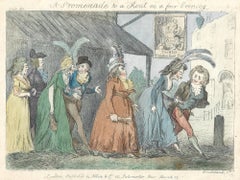
A Promenade to a Rout on a fair Evening
By Isaac Cruikshank
Located in Middletown, NY
London: Allen & West, 1797. Engraving with hand coloring in watercolor on cream wove paper, 8 1/8 x 10 5/8 inches (213 x 270 mm), wide margins. Scattered toning, mat tone, and dog-e...
Category

English School Late 18th Century Prints and Multiples

Materials

Watercolor, Handmade Paper, Engraving
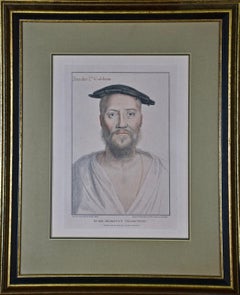
18th C. Bartolozzi Portrait of Brooke Cobham from a 16th Century Holbein Drawing
Located in Alamo, CA
This is an 18th century engraved portrait of Brooke Cobham, a nobleman in King Henry VIII's court, created by Francesco Bartolozzi (1728–1815), after a drawing by Hans Holbein the Younger (1497- 1543) in the 16th century. Holbein was the official artist in the court of King Henry VIII. Bartolozzi used both etching and stipple engraving techniques to create the work which was then was printed in color on pink paper and hand finished with watercolor. It was published by John Chamberlaine in London in 1793 in "The Book of Imitations of Original Drawings by Hans Holbein in the Collection of His Majesty". Sir George Brooke, Baron Cobham (1497-1558) was a prominent member of King Henry VIII's royal court. He became a member of parliament in 1529 and served as a peer in the trial of Queen Anne Boleyn, which resulted in her beheading. He was rewarded for his political and military service to King Henry and Britain with land, castles and former monasteries and was made a Knight of the Garter, a prestigious membership limited to the king and a very limited number of prominent British subjects. As a member of the Privy Council following the death of young King Edward VI (Henry VIII's son), he fell out of favor when he signed a ruling disinheriting both of Henry VIII's daughters, Mary and Elizabeth, in favor of Lady Jane Grey...
Category

Old Masters Late 18th Century Prints and Multiples

Materials

Engraving, Etching

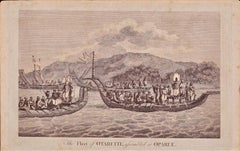
The Fleet of Tahiti displayed for Captain Cook: An Original 18th C. Engraving
Located in Alamo, CA
"The Fleet of Otaheite, Assembled at Oparee" is an original 18th century engraving from a drawing by William Hodges (1744-1797), who was the artist who accompanies Captain Cook on hi...
Category

Late 18th Century Prints and Multiples

Materials

Engraving

Recently Viewed

View All