Stickley Metropolitan
Recent Sales
21st Century and Contemporary American Modern Side Tables
Cherry
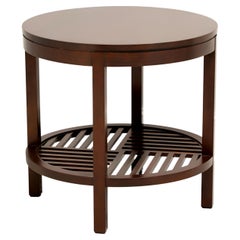

21st Century and Contemporary American Modern Side Tables
Copper
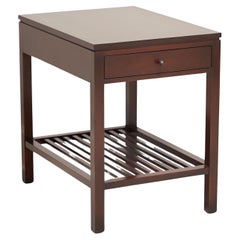
L. & J.G. Stickley Inc. for sale on 1stDibs
Gustav Stickley was one of the principal figures in the American Arts and Crafts movement and the creator of the Craftsman style. In 1883, Stickley established a furniture company called Stickley Brothers with two of his brothers, Albert and Charles. Gustav’s other siblings, Leopold and John George, would later form L & J.G. Stickley Inc. in Fayetteville, New York, in 1905.
As a furniture designer and publisher of the magazine The Craftsman, Gustav adopted many of the ideals of the British design reform movement and popularized both its philosophy and its aesthetics in the United States.
Born in Wisconsin, Stickley moved with his family to Pennsylvania when he was a teenager and began working in his uncle’s chair factory in the town of Brandt. There, he learned the techniques of late-19th-century furniture making at a time when the vogue was for Victorian revival furniture, which was characterized by extensive ornamentation.
When Stickley Brothers foundered, Gustav partnered five years later with salesman Elgin Simonds to form a new firm, Stickley & Simonds, which produced traditional furniture that appealed to the burgeoning American middle class. The success of this venture enabled Stickley to travel to Europe, where he discovered the writings of John Ruskin and William Morris, the two preeminent thinkers of the British Arts and Crafts movement. Stickley also traveled to France, where the Art Nouveau movement impressed him with its imaginative designs and skilled craftsmanship.
Stickley parted ways with Simonds at the turn of the 20th century and decided to focus his creative energies on producing furniture in what became known as the Craftsman style, incorporating some of the elements of the designs and movements he had encountered in Europe.
The pieces Stickley created, which he stamped with the logo of a joiner’s compass, were rectilinear, largely free of ornament, made of oak, and built in such a way that the nature of their construction was plainly visible — all reflections of the tenets of the Arts and Crafts movement. While some people referred to Stickley’s furniture as Mission furniture — a term that references the furnishings of the Spanish missions in California — Gustav commonly called his work “Craftsman” owing to the inspiration he found in the British Arts and Crafts movement.
Stickley benches and rocking chairs were popular, and his leather-upholstered armchairs combine practicality, comfort and an understated silhouette. In 1901, Stickley launched The Craftsman magazine, which contained articles on all manner of domestic topics, from gardening and cooking to art and design, as well as poetry and fiction. In addition to popularizing Stickely’s own designs, the magazine acquainted Americans with the Arts and Crafts style in all its forms through its graphic design and the bungalows, art pottery, and hammered-copper lamps pictured in its pages. When Gustav Stickley died, in 1942, Arts and Crafts had been replaced by modernism as the favored aesthetic.
The work of L & J.G. Stickley flourished even as the Arts and Crafts style fell out of fashion because Leopold and John George adapted to the changing times.
L & J.G. Stickley changed their brand name and maker’s mark to Handcraft in 1906, and rather than continue to produce Arts & Crafts-inspired designs, their bedroom furnishings, dining room chairs and other items of the era reflected the influence of Frank Lloyd Wright and the Prairie School style as well as the work of the Wiener Werkstätte. Later, Leopold’s Cherry Valley collection appealed to enthusiasts of American Colonial furniture.
Find antique L & J.G. Stickley tables, seating, case pieces and more on 1stDibs.
A Close Look at Modern Furniture
The late 19th and early 20th centuries saw sweeping social change and major scientific advances — both of which contributed to a new aesthetic: modernism. Rejecting the rigidity of Victorian artistic conventions, modernists sought a new means of expression. References to the natural world and ornate classical embellishments gave way to the sleek simplicity of the Machine Age. Architect Philip Johnson characterized the hallmarks of modernism as “machine-like simplicity, smoothness or surface [and] avoidance of ornament.”
Early practitioners of modernist design include the De Stijl (“The Style”) group, founded in the Netherlands in 1917, and the Bauhaus School, founded two years later in Germany.
Followers of both groups produced sleek, spare designs — many of which became icons of daily life in the 20th century. The modernists rejected both natural and historical references and relied primarily on industrial materials such as metal, glass, plywood, and, later, plastics. While Bauhaus principals Marcel Breuer and Ludwig Mies van der Rohe created furniture from mass-produced, chrome-plated steel, American visionaries like Charles and Ray Eames worked in materials as novel as molded plywood and fiberglass. Today, Breuer’s Wassily chair, Mies van der Rohe’s Barcelona chair — crafted with his romantic partner, designer Lilly Reich — and the Eames lounge chair are emblems of progressive design and vintage originals are prized cornerstones of collections.
It’s difficult to overstate the influence that modernism continues to wield over designers and architects — and equally difficult to overstate how revolutionary it was when it first appeared a century ago. But because modernist furniture designs are so simple, they can blend in seamlessly with just about any type of décor. Don’t overlook them.
Finding the Right End-tables for You
Beyond just providing additional tabletop space for your living room, an attractive vintage end table can help you organize as well as display books and decorative objects.
The term “end table” is frequently used interchangeably with “coffee table,” and while these two furnishings have much in common, each offers their own distinctive benefits in your space.
Your end table is likely going to stand as tall as the arms of your sofa, and its depth will match the seating. These attributes allow for tucking the table neatly at the end of your sofa in order to provide an elevated surface between your seating and the wall. End tables are accent pieces — they’re a close cousin to side tables, but side tables, not unlike the show-stealing low-profile coffee table, are intended to be positioned prominently and have more to do with the flow and design of a room than an end table, which does a great job but does it out of the way of everything else.
End tables with a drawer or a shelf can easily stow away books or television remotes. Living-room end tables frequently assist with lighting, specifically as they’re often positioned adjacent to a wall. Their height and compact tabletop render them ideal for table lamps and plants, particularly if parked near a window.
And given their practicality, there is no shortage of simple, streamlined end tables from mid-century modern favorites such as Baker Furniture Company, Dunbar and Knoll that will serve your clutter-clearing minimalist efforts or wide-open loft space well. But over the years, furniture designers have taken to venturesome experimentation, crafting tables from fallen trees, introducing organic shapes and playing with sculptural forms, so much so that your understated end table might eventually become the centerpiece of a room, no matter where you choose to place it. One-of-a-kind contemporary designs prove that there are endless options for what an end table can be, while furniture makers working in the Art Deco style have proven that end tables can be stacked, staggered and nested at will, creating all kinds of variations on this popular home accent.
Find an extraordinary variety of antique, new and vintage end tables on 1stDibs today.