The International Style, a modernist movement within architecture and furniture design that was given its name by American architect Philip Johnson and historian Henry-Russell Hitchcock, was born during the 1920s and ’30s. It gained steam initially in Europe and then in the United States as a response to the first World War. Building projects associated with the movement, as well as vintage International Style chairs, tables and other furnishings, are minimal and pared back.
Pioneers of the International Style — architect Walter Gropius and his Bauhaus colleagues Ludwig Mies van der Rohe and Marcel Breuer, De Stijl advocate and Dutch architect J.J.P. Oud and visionary designer Le Corbusier — stripped away decorative elements and placed considerable value on functionality and clean lines, integrating the use of industrial materials like steel, concrete and large sheets of glass in their work. Quite aptly, this mode of design and architectural style coincided with an era now known as the Machine Age and became a global symbol of modernism. The primary motive of its practitioners was to address the changing needs of a rapidly industrializing society, especially the demand for office complexes and apartments in large cities, through economical, technologically advanced, yet aesthetically pleasing designs for furniture and buildings.
“Space and light and order. Those are the things that men need just as much as they need bread or a place to sleep,” said Le Corbusier of the philosophy behind his practical modernist architecture.
The International Style’s designers and architects were inspired by the advantages afforded them by the era’s new technology and industrial machinery as well as state-of-the-art materials. Le Corbusier was fond of framing his buildings in steel but reinforced concrete made far more economic sense. He is probably most admired for the iconic private homes and commercial buildings that he designed or codesigned with his cousin Pierre Jeanneret, which are spread across the world, from New York City to Paris to Chandigarh, India. Today, Breuer’s Wassily Lounge chair; the elegant LC series created by Le Corbusier, Jeanneret and Charlotte Perriand; and Mies van der Rohe’s Barcelona chair, crafted with his romantic partner, designer Lilly Reich, are emblems of progressive modernist design and all make prominent use of tubular steel. Vintage originals are the prized cornerstone of collections.
“The International Style is probably the first fundamentally original and widely distributed style since the Gothic,” posited Johnson in the book that accompanied “Modern Architecture: International Exhibition,” an architectural show he cocurated with Hitchcock that featured the work of Frank Lloyd Wright, Le Corbusier, Richard Neutra and others. While the term “International Style” had previously been circulating in Europe, when the show opened at the Museum of Modern Art in 1932, it yielded a much broader application of this important style of design.
Find International Style furniture on 1stDibs.
Whether burnished or lacquered, antique, new and vintage brass furniture can elevate a room.
From traditional spaces that use brass as an accent — by way of brass dining chairs or brass pendant lights — to contemporary rooms that embrace bold brass decor, there are many ways to incorporate the golden-hued metal.
“I find mixed metals to be a very updated approach, as opposed to the old days, when it was all shiny brass of dulled-out silver tones,” says interior designer Drew McGukin. “I especially love working with brass and blackened steel for added warmth and tonality. To me, aged brass is complementary across many design styles and can trend contemporary or traditional when pushed either way.”
He proves his point in a San Francisco entryway, where a Lindsey Adelman light fixture hangs above a limited-edition table and stools by Kelly Wearstler — also an enthusiast of juxtapositions — all providing bronze accents. The walls were hand-painted by artist Caroline Lizarraga and the ombré stair runner is by DMc.
West Coast designer Catherine Kwong chose a sleek brass and lacquered-parchment credenza by Scala Luxury to fit this San Francisco apartment. “The design of this sideboard is reminiscent of work by French modernist Jean Prouvé. The brass font imbues the space with warmth and the round ‘portholes’ provide an arresting geometric element.”
Find antique, new and vintage brass tables, case pieces and other furnishings now on 1stDibs.
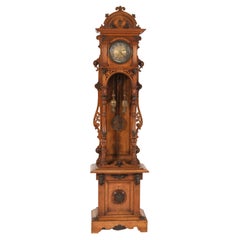
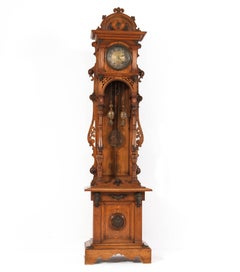
Antique grandfather clocks and longcase clocks are staples of old-world design sensibilities, and, along with their storied history, these statuesque timepieces can bring a feeling of warmth to living rooms, dining rooms and other areas of your home.
Longcase clocks, which originated in England and were manufactured in the United States beginning in the 1700s, refer to tall clocks with a face and clock works positioned high in the housing while a large swinging pendulum movement is tucked inside the case, which is supported by a carved base called a plinth.
While guests making their way through your foyer (another ideal location for such a furnishing) might typically refer to your longcase clock as a “grandfather clock,” there are actually three varieties of these stylish floor clocks, which include granddaughter clocks (the shortest, generally not one solid piece of wood and around three to five feet tall), grandmother clocks (the slimmer middle ground, between five feet and six feet tall) and grandfather clocks, which are typically between six and seven feet tall.
Sculptural and statement-making, antique grandfather clocks created by the likes of the Seth Thomas Clock Company, the Howard Miller Clock Company, Hermle or other clockmakers are an alluring choice in filling up space in a room, while the shorter longcase clocks are just as useful if you need an element that is comparatively muted or you’re working with limited space.
Each generation of artisan clockmakers, working in various furniture styles over time, contributed its own flourishes to the design of longcase clocks. Antique grandfather clocks in the Georgian style share commonalities with neoclassical design. They were often made in dark woods such as mahogany and feature intricate carving. Mahogany is also common for Victorian-era grandfather clocks, although examples of this style can be found in oak and walnut too. Designers of contemporary grandfather clocks are using a range of materials.
It’s easy to get confused when determining the origins or value of an antique grandfather clock or other vintage longcase clock. While an antique appraiser will be able to tell quickly, searching for a manufacturer’s name engraved on the face and dial of the clock may be an easy way to learn about the history of your clock.
Find a distinctive variety of antique grandfather clocks and longcase clocks on 1stDibs, and browse our collection of unusually beautiful clocks, wall clocks, desk clocks and other vintage clocks too.